

If you've ever searched for AI/ML courses, you probably know how quickly the options pile up.
I found that some courses are meant for people who are just curious about AI, while others get into coding and machine learning models pretty early on.
It can be hard to tell where to start, especially when you're not sure how much technical knowledge you need. I think the best way to choose is to look at what each course actually teaches and find one that matches where you are right now.
In this blog, I've shortlisted six AI/ML courses from Coursera, Udacity, Udemy, DataCamp, Educative, and edX.
I've looked at what each course teaches and the kind of learner who might benefit from it.
Here is the list of courses.
List of Best AI/ML Courses
- AI Fundamentals by Udacity
- Understanding Machine Learning by DataCamp
- Supervised Machine Learning: Regression and Classification by Coursera
- The Complete Machine Learning Course with Python by Udemy
- Machine Learning for Beginners by Educative
- Machine Learning with Python: A Practical Introduction by IBM on edX
Now lets get into each course one by one.
1. AI Fundamentals by Udacity
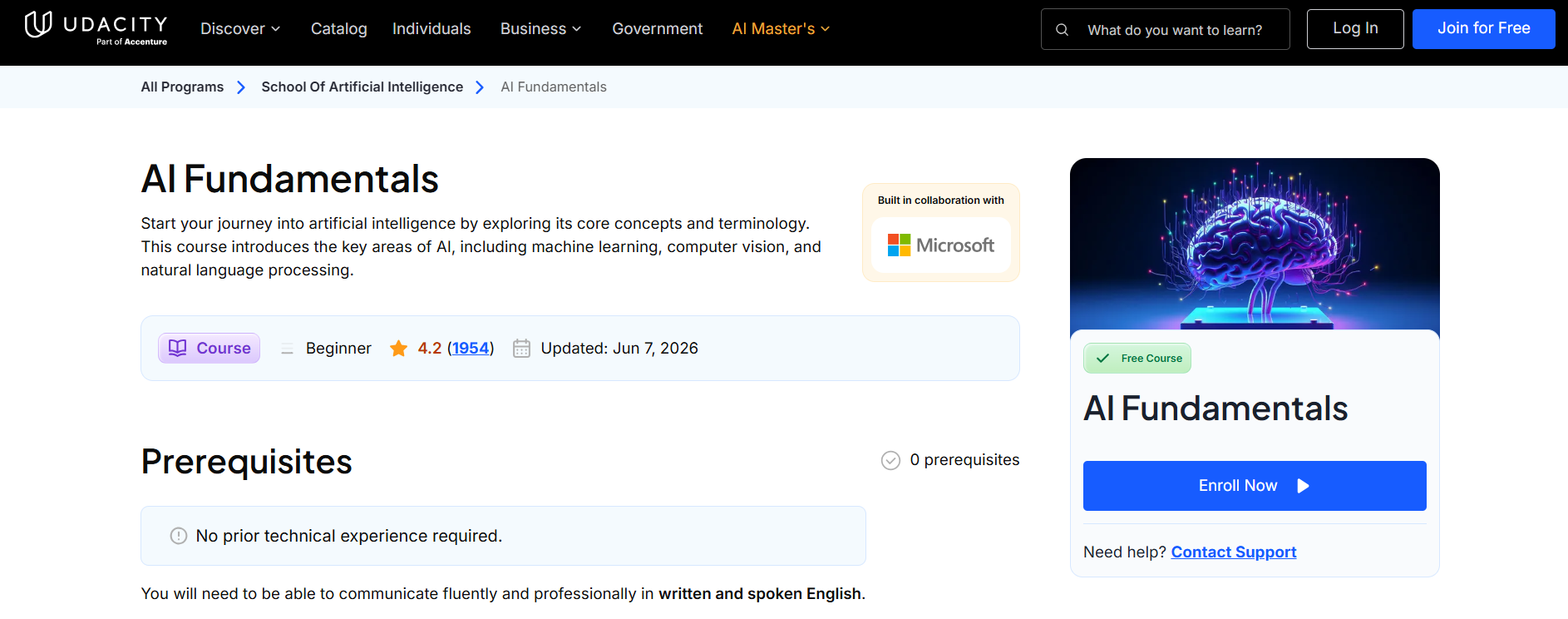
If you're interested in artificial intelligence but aren't sure where to begin, Udacity's AI Fundamentals course is worth considering. One thing I like about this course is that it doesn't get stuck on just one part of AI.
You get to look at different areas, including computer vision and natural language processing, so you can see just how many things fall under the AI umbrella.
I think that's a nice way to start if you're still figuring out which part of AI interests you the most. Computer vision involves working with visual information, such as images.
Natural language processing, often shortened to NLP, focuses on how computers work with human language. The course also introduces responsible AI and machine learning concepts.
This is useful because understanding AI involves more than knowing what the technology can do. It also helps to understand its limitations and the importance of using it responsibly.
Another advantage is that the course is designed for beginners and does not require prior technical experience. If you've been reading about AI but haven't studied it formally, this could be a reasonable place to start.
However, keep in mind that an introductory course is different from technical training in building and deploying machine learning models.
What You'll Learn
- You'll develop an understanding of artificial intelligence and machine learning fundamentals.
- You'll explore computer vision and natural language processing.
- You'll learn about responsible AI and some of the considerations involved in developing and using AI systems.
Course Details
In the table below, I've listed a few details to help you decide whether this course suits your needs.
| Detail | Information |
|---|---|
| Difficulty Level | Beginner |
| Duration | Not Specified |
| Cost | Free |
| Format | Online lessons |
| Certificate | Check the current course page for completion and credential details |
Best suited for: Beginners who want to understand AI concepts before moving into more technical machine learning courses.
2. Understanding Machine Learning by DataCamp
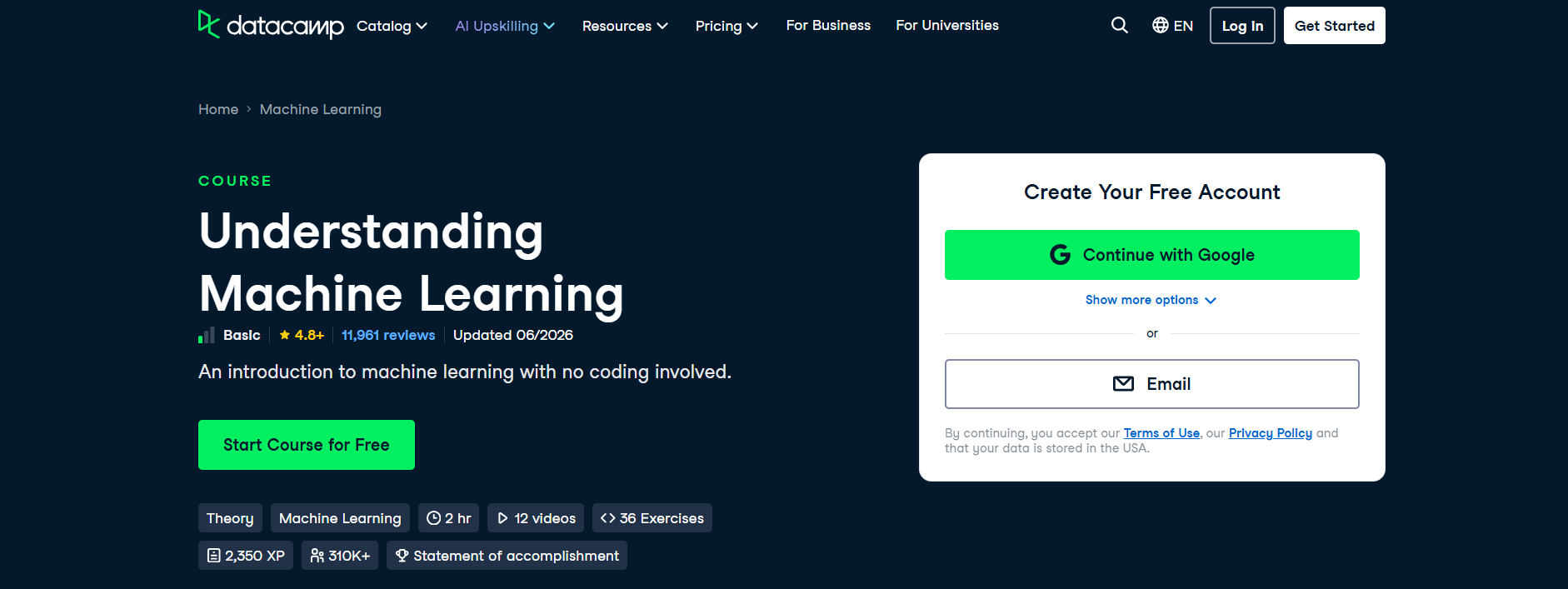
You don't necessarily have to start with coding when learning machine learning. If you want to get a basic idea of how it works first, DataCamp's Understanding Machine Learning course is one option you can look into.
It explains the basic terms you'll come across and walks you through how machine learning works, without getting too technical. The course also touches on model evaluation, which is something you'll come across quite often in machine learning.
It's not just about training a model. You also need to figure out whether it's giving you the right results.
You don't need to master the mathematics behind these measures immediately, but understanding what they tell you is a useful starting point.
The course also introduces supervised and unsupervised learning, explains the basic machine learning workflow, and discusses deep learning applications such as computer vision and NLP.
I think this is a sensible option if you're still deciding whether you want to explore machine learning more deeply.
What You'll Learn
- You'll understand how machine learning relates to artificial intelligence and data science.
- You'll learn the differences between supervised learning, unsupervised learning, and deep learning.
- You'll explore the basic steps involved in preparing data, training models, testing them, and improving their performance.
- You'll learn about model evaluation, including the trade-offs between accuracy, precision, and recall.
- You'll examine some limitations of machine learning.
Course Details
In the table below, I've listed a few important details.
| Detail | Information |
|---|---|
| Difficulty Level | Beginner |
| Duration | Approximately 2 hours |
| Cost | Free |
| Format | Online lessons and interactive exercises |
| Certificate | Statement of accomplishment available |
Best suited for: Learners who want to understand machine learning concepts without committing to a programming-based course straight away.
3. Supervised Machine Learning: Regression and Classification by Coursera
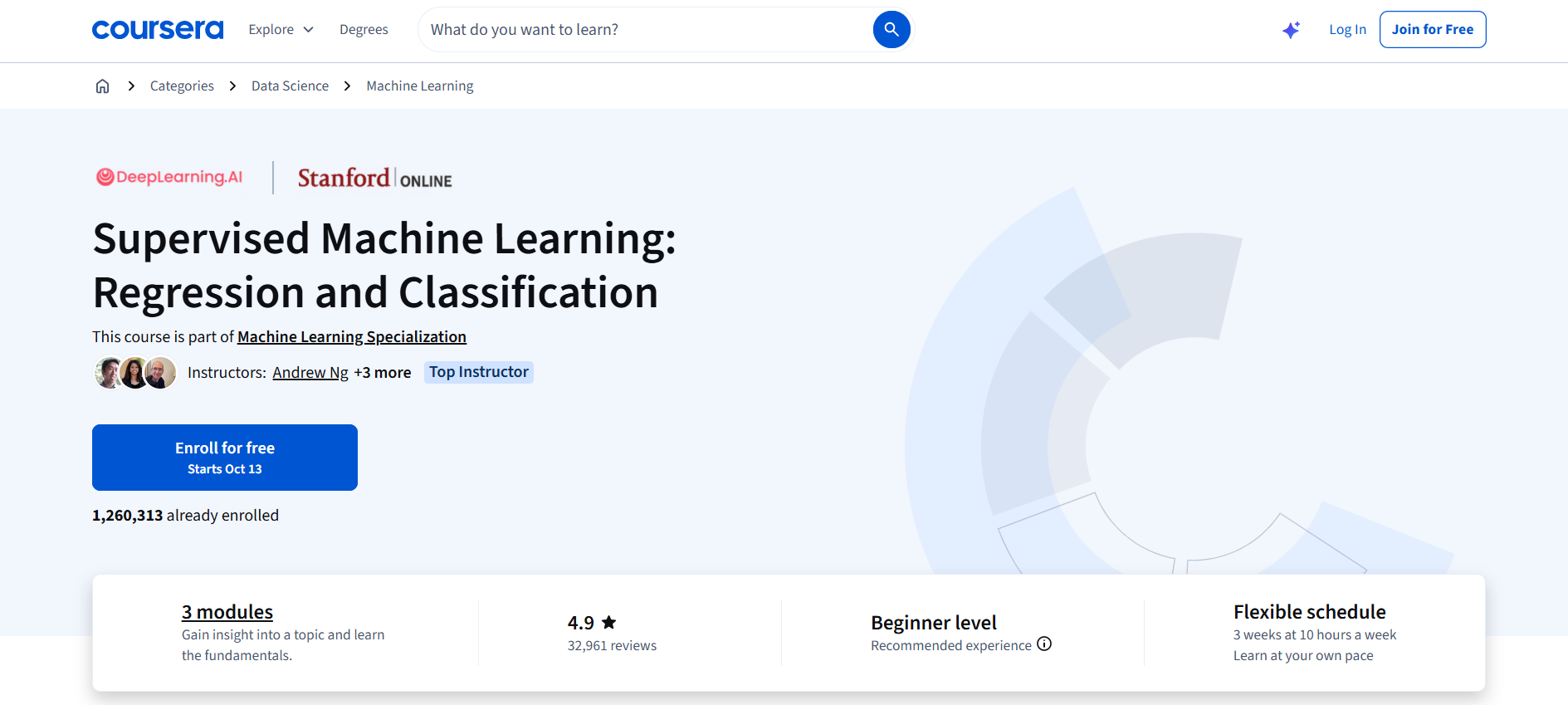
Once you understand the basics of machine learning, you might want to explore how models are actually built.
Coursera's Supervised Machine Learning: Regression and Classification is a good option to consider if you're ready to take that step.
The course focuses on supervised learning. In this approach, a model learns from examples that include the information it needs to make predictions. Two of the main techniques covered are regression and classification.
Regression is used when a model needs to predict a numerical value. For example, a model might estimate a property's price based on information about the property.
Classification, on the other hand, is used when the output belongs to a category. A model might classify an email as spam or not spam.
The course introduces linear regression and logistic regression and teaches learners to build machine learning models using Python, NumPy, and scikit-learn.
You'll also work through practical assignments and labs, giving you an opportunity to apply what you've learned. I like that this course keeps things focused on supervised learning.
There's already a lot to learn when you're starting out with AI, so I feel it's better to get comfortable with a few concepts first instead of trying to learn everything at once.
What You'll Learn
- You'll learn how to build supervised machine learning models using Python, NumPy, and scikit-learn.
- You'll understand how linear regression can be used to predict numerical values.
- You'll explore logistic regression and how it can be used for binary classification.
- You'll practice training models and working through programming assignments and labs.
Course Details
In the table below, I've listed a few noteworthy details.
| Detail | Information |
|---|---|
| Difficulty Level | Beginner |
| Duration | Approximately 3 weeks at 10 hours per week |
| Cost | Free |
| Format | Online lessons, assignments, and practical labs |
| Certificate | Shareable certificate available |
Best suited for: Learners who want a structured introduction to supervised machine learning and are ready to work with Python.
4. The Complete Machine Learning Course with Python by Udemy
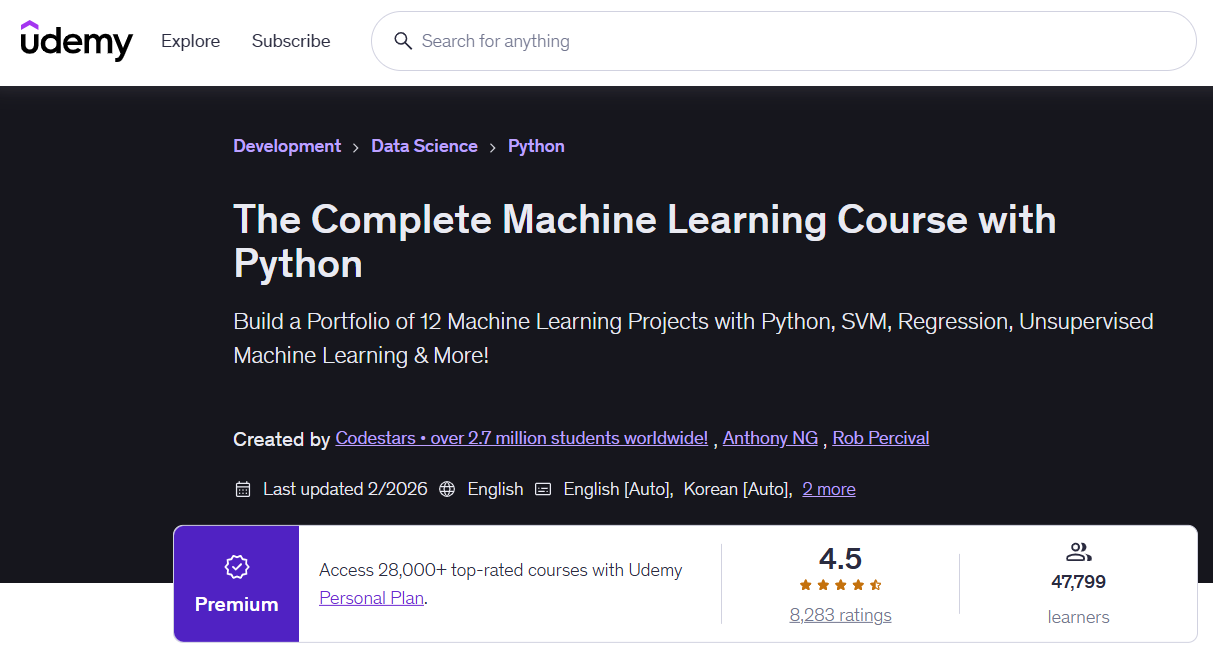
If I were looking for a course where I could actually try things out instead of just learning the theory, I'd probably give Udemy's The Complete Machine Learning Course with Python a look.
The course advertises 12 machine learning projects and covers several techniques, including regression, classification, support vector machines, and unsupervised learning.
Its project-based approach gives learners opportunities to work through different machine learning problems. Examples described on the course page include predicting house prices and recognizing handwritten digits.
These projects help make the subject more concrete. Instead of learning an algorithm only in theory, you can see how it is used as part of a practical exercise.
The course also introduces tools such as NumPy, scikit-learn, Matplotlib, and Seaborn. These are used for working with data, developing models, and visualizing results. There is one thing to keep in mind, though.
The course lists basic Python programming knowledge and a good understanding of linear algebra among its requirements.
So, although the course introduces machine learning concepts, it may not be the most comfortable starting point if you've never programmed before.
What You'll Learn
- You'll learn how to work with Python and machine learning libraries to develop models.
- You'll explore regression, classification, support vector machines, and unsupervised learning techniques.
- You'll practice working through machine learning projects involving tasks such as predicting house prices and recognizing handwritten digits.
- You'll learn about model evaluation, cross-validation, and techniques for improving model performance.
- You'll work with data visualization tools such as Matplotlib and Seaborn.
Course Details
In the table below, I've listed some details that are worth knowing.
| Detail | Information |
|---|---|
| Difficulty Level | Beginner to intermediate |
| Duration | Approximately 17 hours and 21 minutes |
| Cost | Paid course; current price varies by offer |
| Format | Video lessons, coding demonstrations, and projects |
| Certificate | Yes |
Best suited for: Learners who already have some Python knowledge and want to practice implementing machine learning algorithms through projects.
5. Machine Learning for Beginners by Educative
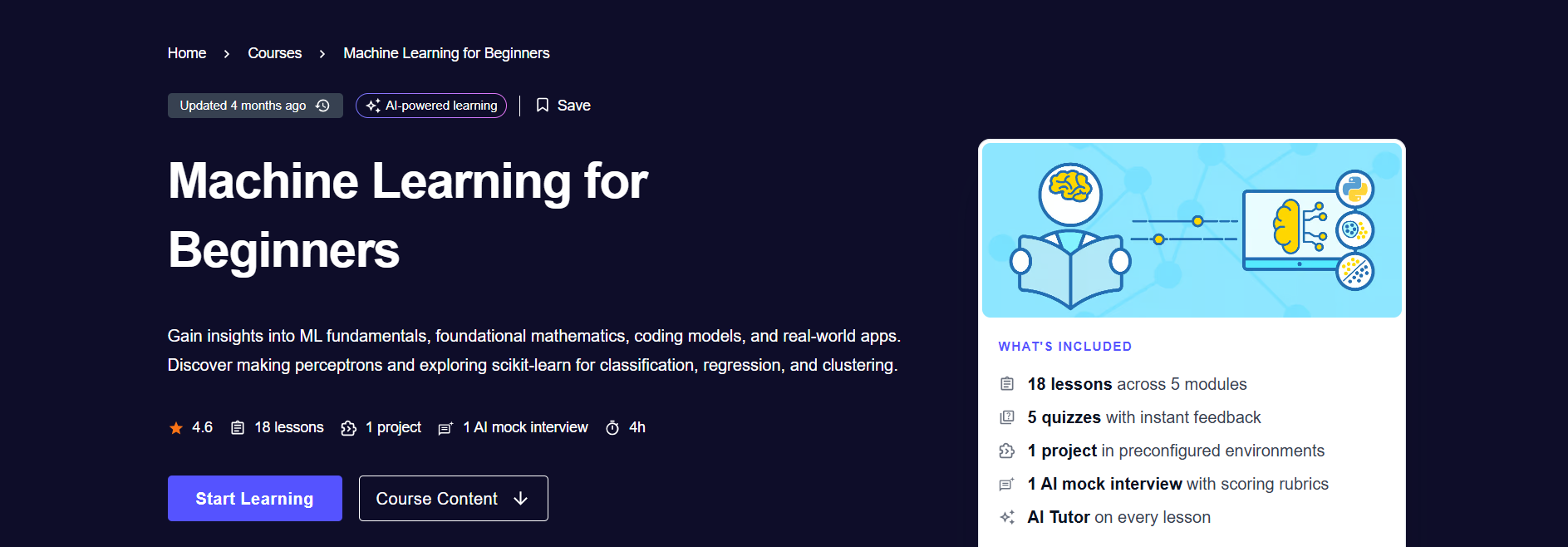
Educative's Machine Learning for Beginners course is another option if you want to move from understanding concepts to trying out basic machine learning models.
You'll start with the basics of machine learning and the math behind it, then get into using Python and scikit-learn to put what you've learned into practice.
The course also touches on neural networks, which are designed to pick up patterns in data. You don't have to understand all the technical details right away.
Getting a basic idea of how they work is enough to help you follow along when you come across them in more advanced courses. The course also covers classification, regression, and clustering.
These techniques serve different purposes, from predicting values to grouping similar data points. With an estimated duration of four hours, this is a relatively short introduction.
I would treat it as a way to get familiar with the foundations rather than as a complete course in deep learning.
What You'll Learn
- You'll develop an understanding of machine learning fundamentals and their applications.
- You'll learn how to implement a basic perceptron model for binary classification using Python.
- You'll explore how data is collected, models are trained, and their performance is evaluated.
- You'll learn about neural network architecture and how neural networks can handle classification problems.
- You'll practice developing and evaluating classification and regression models using scikit-learn.
Course Details
In the table below, I've mentioned a few important details you might want to know.
| Detail | Information |
|---|---|
| Difficulty Level | Beginner |
| Duration | Approximately 4 hours |
| Cost | Free preview available |
| Format | Interactive online lessons |
| Certificate | Yes |
Best suited for: Learners who want a short introduction to machine learning concepts with opportunities to implement basic models.
6. Machine Learning with Python: A Practical Introduction by IBM on edX
If you want to explore several machine learning techniques in one course, IBM's Machine Learning with Python: A Practical Introduction on edX is worth considering.
The course introduces both supervised and unsupervised learning and covers a range of techniques, including regression, classification, clustering, dimensionality reduction, and recommender systems.
That range is useful because machine learning isn't one single method. Different problems call for different approaches, and learning the basics of several techniques can help you understand how they differ.
Regression is about predicting a number, like how much a house might cost. Clustering works a little differently. It looks for things that have something in common and groups them together.
You'll also learn about recommender systems. If you've ever wondered how shopping sites seem to know what you might want to buy next, this is one of the things behind those suggestions.
Python basics are recommended, so it helps to have some familiarity with programming before starting.
What You'll Learn
- You'll understand the differences between supervised and unsupervised machine learning.
- You'll explore regression techniques and methods for evaluating model performance.
- You'll learn about classification algorithms, including decision trees, logistic regression, and support vector machines.
- You'll practice unsupervised learning techniques such as k-means and hierarchical clustering.
- You'll explore how recommender systems use different approaches to suggest relevant items.
Course Details
In the table below, I've listed a few details to help you decide whether this course suits your needs.
| Detail | Information |
|---|---|
| Difficulty Level | Introductory |
| Duration | Approximately 5 weeks at 4 to 6 hours per week |
| Cost | Audit option available; paid certificate option listed at US$99 when researched |
| Format | Self-paced online lessons and practical learning activities |
| Certificate | Available with the paid certificate option |
Best suited for: Learners who want a structured introduction to several machine learning techniques and practical work with Python.
Conclusion
Choosing an AI/ML course becomes easier when you stop looking for one option that is supposed to be the best for everyone.
So, which one should you choose?
If you're new to the subject, Udacity's AI Fundamentals or DataCamp's Understanding Machine Learning course may help you get started.
If you want to work with machine learning models, Coursera, Udemy, Educative, and edX offer different ways to approach the technical side.
Some courses go straight into the technical side, and others spend more time explaining the basics. What you're comfortable with right now and what you want to get out of learning machine learning are the things that actually matter.
Andrew Ng, the computer scientist and Coursera co-founder, has described AI as having the potential to transform industries in much the same way electricity did.
That is a useful reminder of why understanding AI matters, but you don't have to learn everything at once. Start with a course that fits your current level.
Work through the material, practice what you learn, and use that experience to decide what to study next. That's a much more useful approach than choosing a course simply because it has the longest syllabus or the highest rating.