
If you want to learn AI or machine learning right now, finding a course is probably the easiest part
There are hundreds of them.
You can learn machine learning from a university, practice with real datasets, build deep learning models, study large language models, or take a short course on a very specific AI skill.
The difficult part is figuring out where to start and which website actually fits what you want to learn.
That confusion is more common than you might think.
A 2025 edX survey of 1,016 U.S. adults found that 26% of respondents said they did not know where to start learning AI skills. Cost and time were also among the biggest barriers to AI education.
A lot of people are also trying to get into AI right now. The World Economic Forum's Future of Jobs Report 2025 puts AI and big data at the top of its list of fastest-growing skills for 2025 to 2030.
So, where should you actually learn?
I looked at the current learning options across different platforms and found that they are not really trying to do the same thing.
Some are better for structured courses, some for hands-on practice, and others make more sense once you want to specialize in deep learning or LLMs.
Here are the websites worth looking at.
List of best Websites to learn AI/ML
Now let's dive right into the websites.
1. Coursera
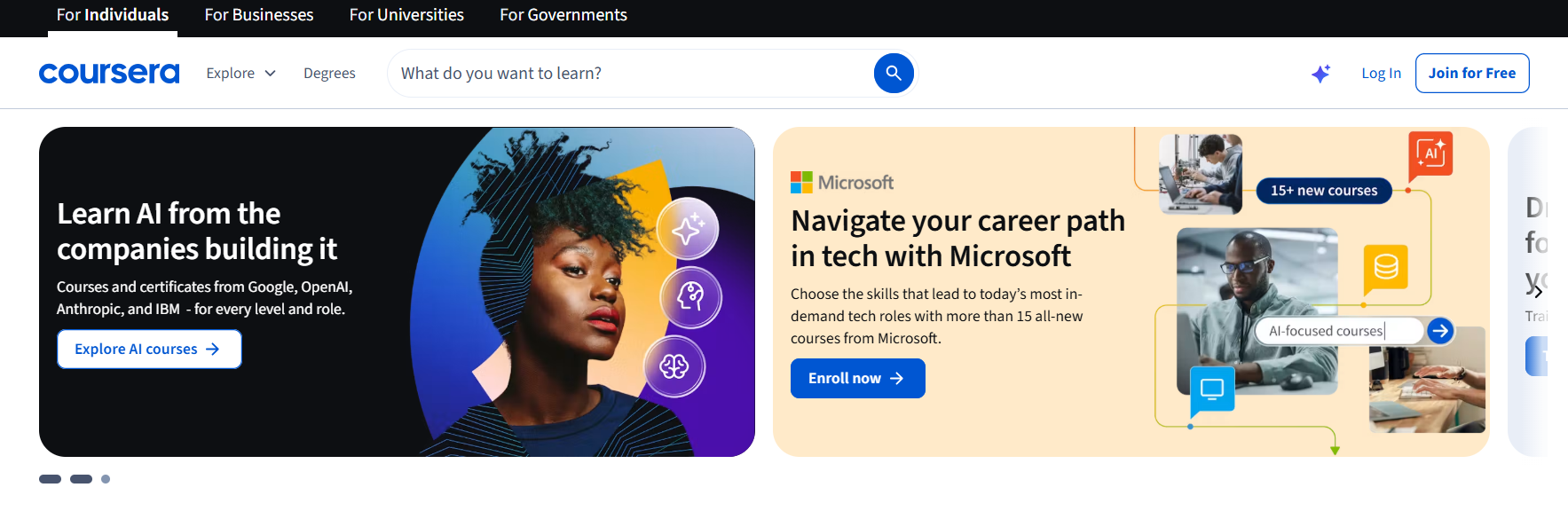
Best for: Structured AI/ML learning.
If you want someone to give you a proper learning path instead of leaving you to figure everything out yourself, Coursera is one of the easiest places to start.
What makes it useful for AI and machine learning is the combination of university courses, professional programs, and industry-created learning.
You can find everything from beginner-level introductions to more specialized machine learning and deep learning programs.
One of the most relevant examples is the Machine Learning Specialization from DeepLearning.AI and Stanford Online.
It covers supervised learning, neural networks, decision trees, unsupervised learning, recommender systems, and reinforcement learning.
The program also includes hands-on work with Python and common machine learning libraries such as NumPy and scikit-learn. There are also more advanced options.
For example, the Deep Learning Specialization covers deep neural networks and their applications and is aimed at learners with some existing background.
What I like about Coursera for this particular use case is the structure.
You can move from one course to the next without constantly asking yourself what you should learn next.
It is particularly useful if your goal is to build a foundation before moving into more specialized areas.
Good choice if: You want a guided learning path and prefer structured courses over piecing together tutorials yourself.
2. DataCamp
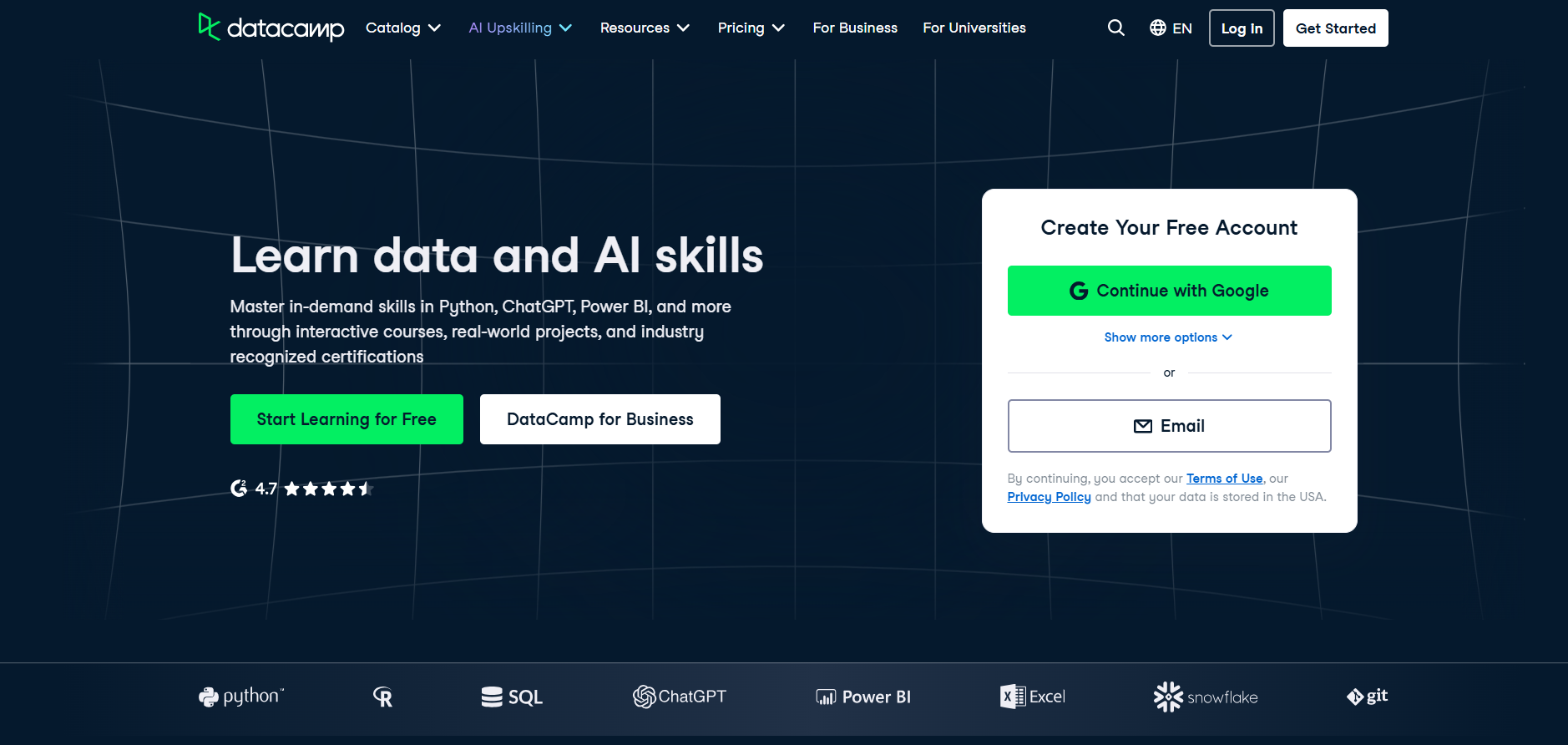
Best for: Interactive, coding-based learning.
DataCamp takes a different approach. Instead of relying mainly on long lectures, much of the learning happens through interactive exercises.
Its machine learning catalog currently covers areas such as Python, machine learning, NLP, deep learning, and MLOps.
It also has beginner-friendly options.
For example, its Understanding Machine Learning course introduces the basic concepts without requiring coding, while its more technical tracks move into Python and actual machine learning models.
This makes DataCamp interesting for people who learn better by doing something every few minutes rather than watching a long explanation and hoping they remember it later.
It also makes the learning experience less intimidating for someone who is still getting comfortable with technical concepts.
One thing to keep in mind is that interactive exercises and structured practice are not a replacement for building larger projects.
If you're learning ML with a career goal in mind, you'll eventually want to move beyond individual exercises and work with your own datasets and projects.
Good choice if: You like learning by doing and would rather write some code than sit through hours of lectures.
3. edX
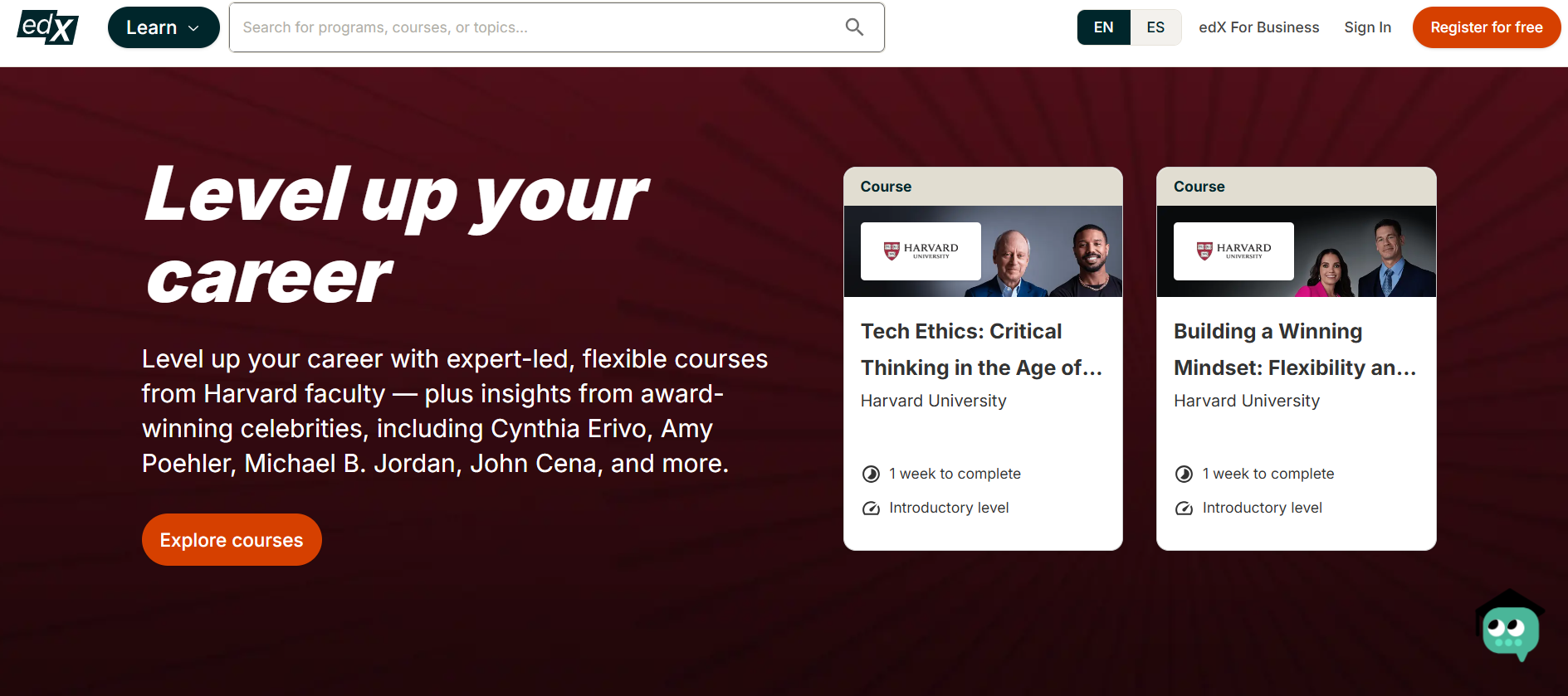
Best for: University-backed AI/ML learning.
If the academic side of AI and machine learning matters to you, edX is worth considering.
The platform works with universities and industry organizations and currently offers AI/ML courses from institutions including Harvard, Georgia Tech, and IBM.
Its machine learning catalog covers areas such as Python, statistics, algorithms, and machine learning fundamentals. The range is quite broad.
You can find introductory courses as well as professional certificate programs and more advanced options.
That makes edX useful for someone who wants a learning experience that feels closer to formal education rather than simply taking a collection of short online courses. It is also worth mentioning the other side of the platform.
The large number of options can make the starting point less obvious.
That ties back to the bigger issue with AI education today: having more choices doesn't necessarily make choosing easier.
Good choice if: You prefer university-style learning or want to explore programs from established academic and industry institutions.
4. DeepLearning.AI
Best for: Focused AI and ML specializations.
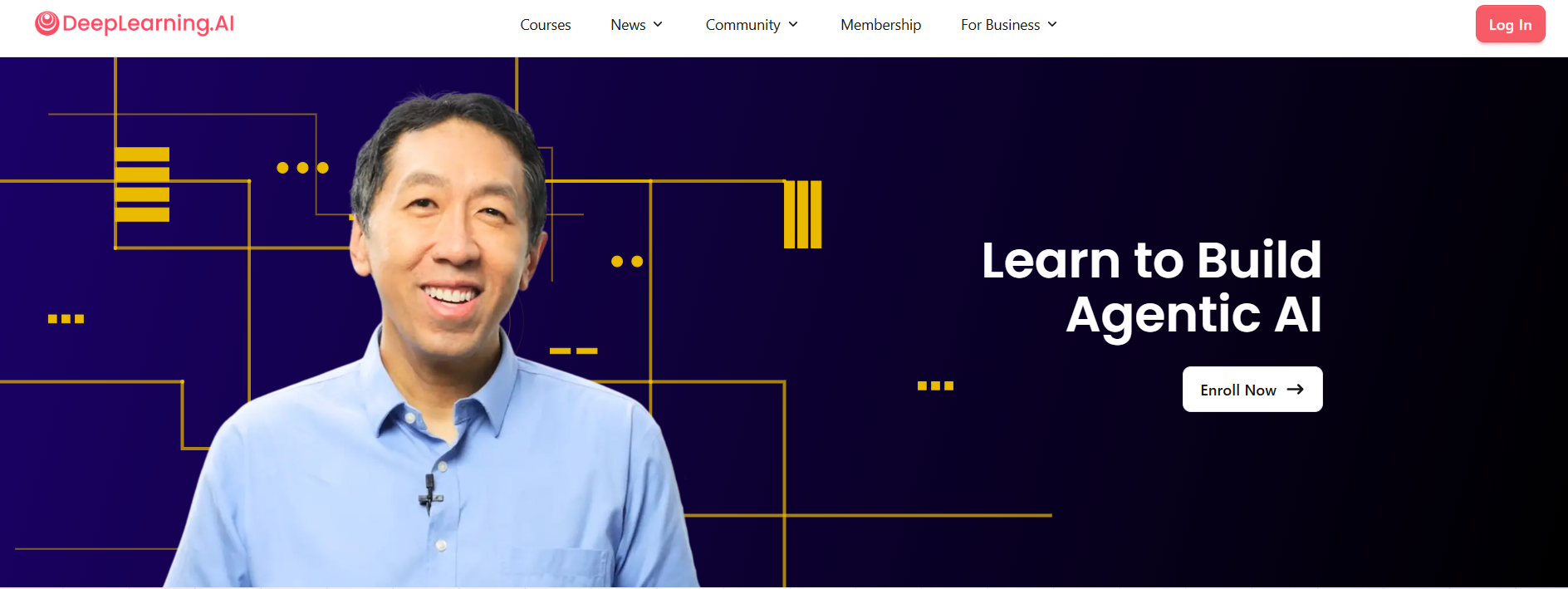
DeepLearning.AI is particularly interesting because it has gone well beyond the traditional machine learning syllabus.
The platform offers foundational programs as well as specialized courses covering areas such as deep learning, generative AI, agents, RAG, transformers, fine-tuning, MLOps, computer vision, and more.
That range makes it useful at different stages of learning.
For example, someone starting out can look at foundational machine learning content, while someone who already understands ML can move into a specific area such as generative AI or LLMs.
Its current catalogue also reflects how much AI education has changed.
There are now courses focused on things such as AI agents, multimodal applications, LLM inference, and other newer areas that would not have been part of a traditional machine learning curriculum.
I think this is one of the more useful platforms if you already have an idea of the area you want to explore. You don't necessarily have to commit to a huge program. You can focus on a particular skill and go deeper.
Good choice if: You want specialized AI learning and are interested in areas beyond basic machine learning.
5. Kaggle
Best for: Hands-on practice with real datasets.
Kaggle is different from most of the websites on this list. You don't go to Kaggle only to watch a course. You go there to work with data.
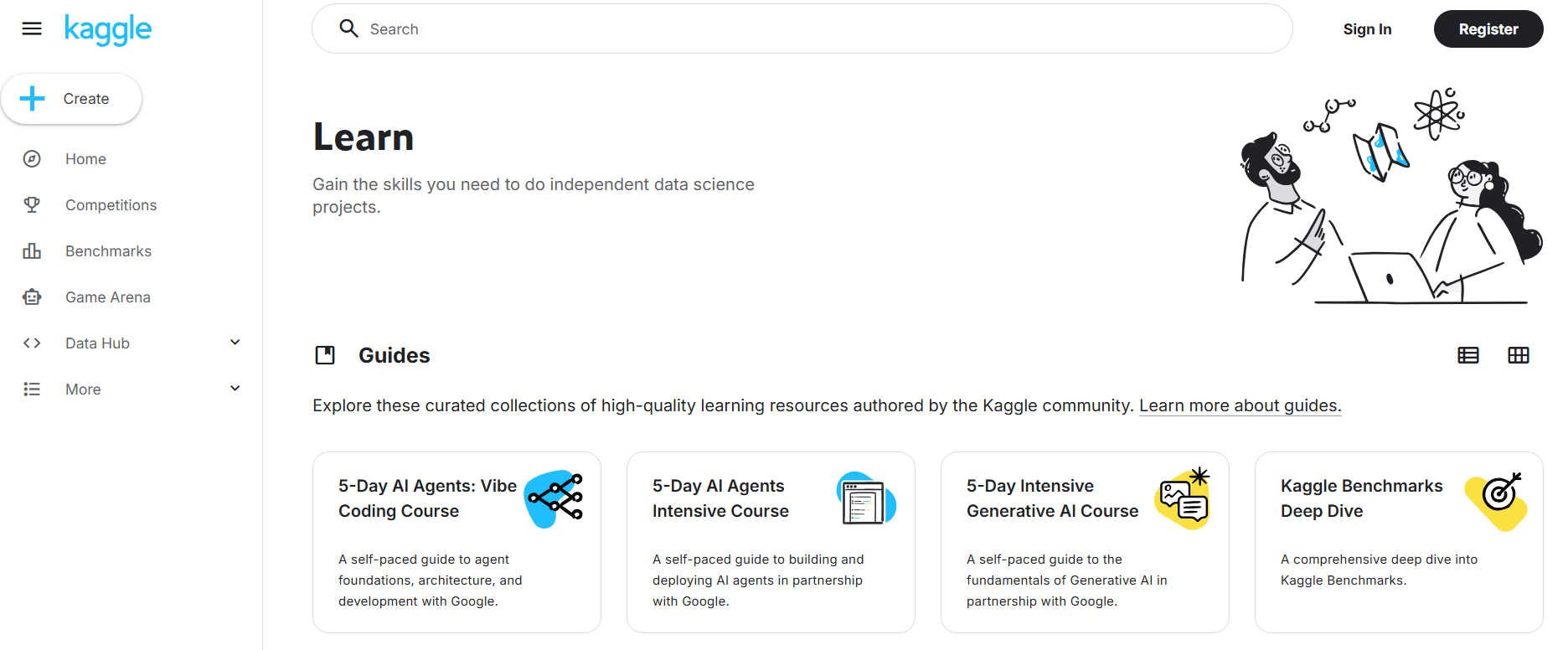
Its Learn section currently includes courses on Python, machine learning, intermediate machine learning, deep learning, computer vision, NLP, data cleaning, feature engineering, and more.
The courses are designed to teach practical skills in relatively short sessions.
For example, Kaggle's Intro to Machine Learning course takes learners through model building, validation, overfitting, random forests, and machine learning competitions. The course itself is listed as free.
Then there are the competitions. Kaggle competitions give learners a chance to work on machine learning problems and compare their approaches with other participants.
The platform currently includes everything from beginner-friendly challenges to research competitions and hackathons.
This is where Kaggle becomes particularly useful for someone who wants to move from learning concepts to actually applying them. You can understand what overfitting means in a course.
Working with a messy dataset and seeing your model perform badly is a different kind of lesson.
Good choice if: You want to practice machine learning with datasets, notebooks, and real challenges.
6. Fast.ai

Best for: Project-first deep learning.
fast.ai has a different teaching philosophy.
Instead of spending a long time learning every theoretical detail before building anything, its courses are designed around getting learners to build useful things and then understanding what is happening underneath.
The fast.ai ecosystem includes a free course and a library for building deep learning applications.
Its documentation shows examples covering image classification, image segmentation, text sentiment, recommendation systems, and tabular models. This approach can be refreshing if you find traditional technical courses too abstract.
It is also relevant if your interest is deep learning rather than introductory AI concepts. You will still need to understand the underlying ideas, but the learning process is closely tied to actually building models.
The practical approach is great, but I wouldn’t jump into it with zero coding experience. Having some programming basics already will make the deeper parts much easier to follow.
Good choice if: You learn best by building things and want to go deeper into practical deep learning.
7. Google Machine Learning
Best for: Learning ML fundamentals.
This course happens to be a focused introduction to machine learning. You can get through the core concepts without signing up for a large course and end up spending weeks figuring out what is what.
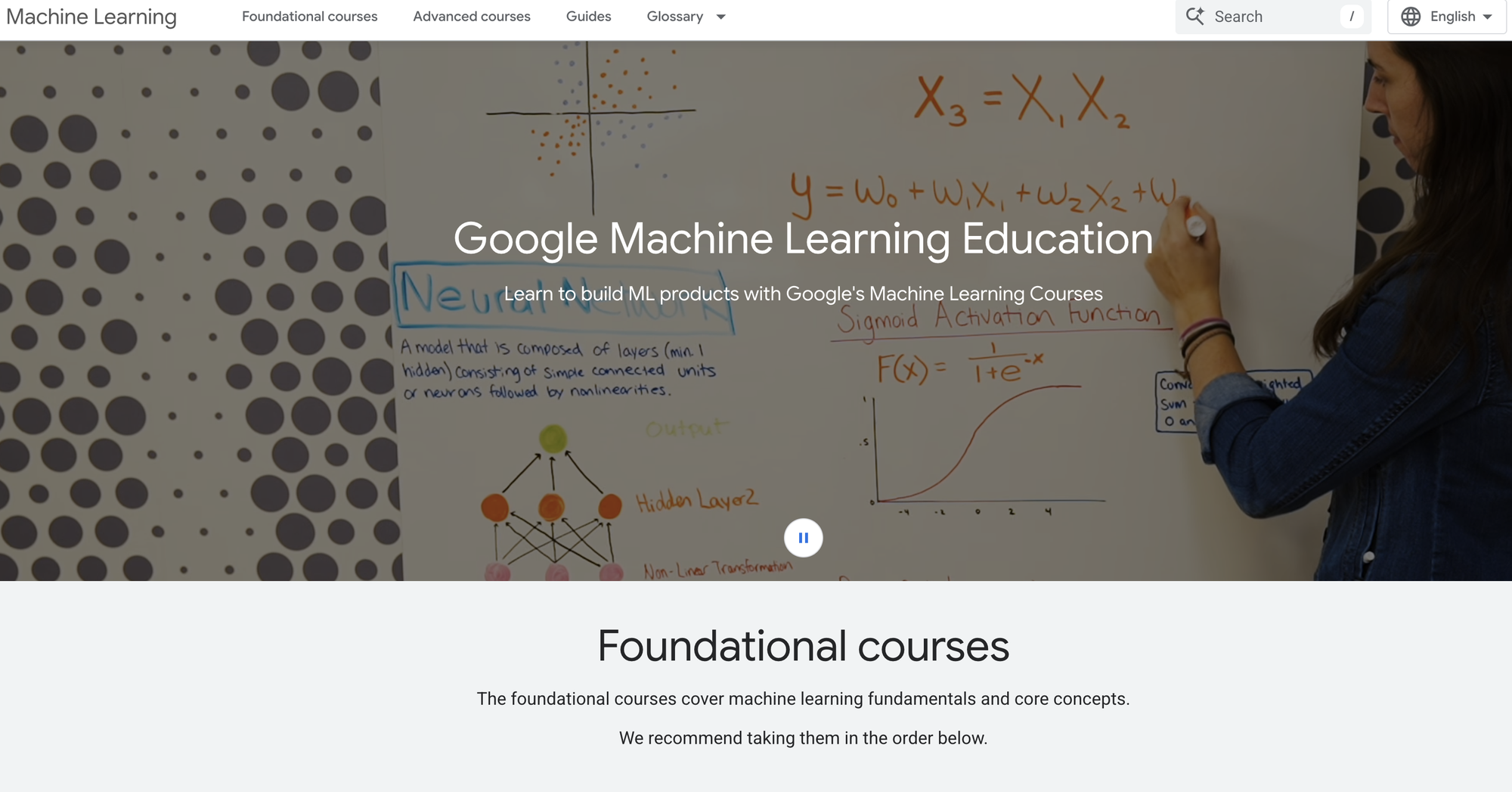
Google describes it as a practical introduction built around animated videos, interactive visualizations, and hands-on exercises.
The refreshed version also covers newer topics including embeddings, large language models, and production ML systems alongside core machine learning concepts.
The course covers familiar foundations such as regression, classification, datasets, overfitting, and neural networks. It then moves into topics such as embeddings, LLMs, production ML, and fairness.
The practical exercises are another useful part of it. Programming exercises can run directly in Google Colab, so learners don't necessarily need to set up a local environment before they can start experimenting.
There are prerequisites, though. Google recommends familiarity with Python, NumPy, and pandas, along with some algebra, linear algebra, and statistics.
So while the course is accessible, it is not necessarily the first thing I would give to someone who has never coded before.
Good choice if: You already know some Python and basic math and want a practical way to get into machine learning.
8. Hugging Face
Best for: LLMs and open-source AI.
If your interest in AI has moved from traditional machine learning toward large language models, Hugging Face becomes much more relevant.
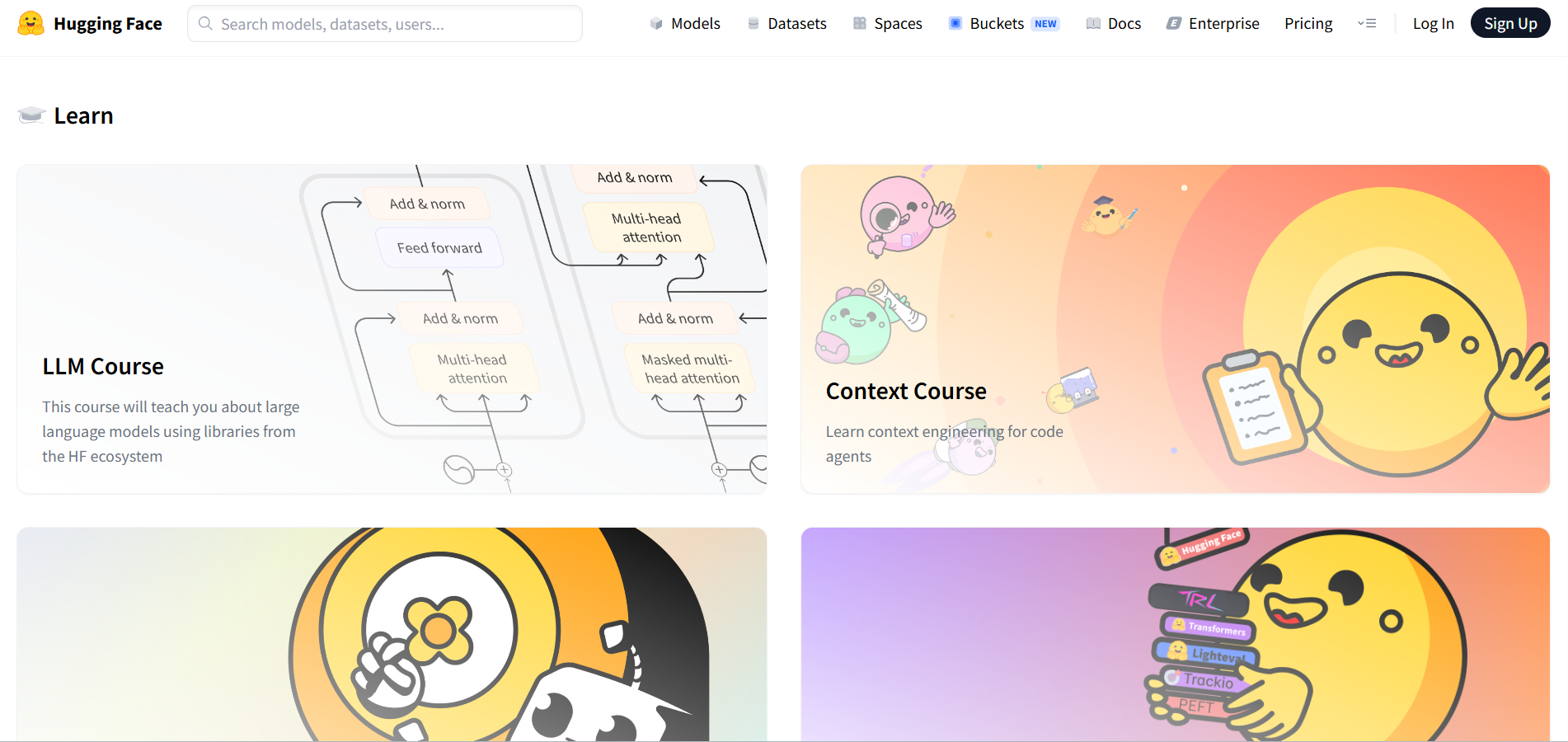
Its LLM Course covers the Transformers ecosystem and gives learners a practical environment for working with modern language models.
The course also walks learners through setting up an environment using Python, with Google Colab recommended as a beginner-friendly option. This is not really where I would send someone who has never heard of machine learning before.
It makes more sense once you have some programming and ML knowledge and want to understand how modern language models and related tools work.
That distinction matters because "AI learning" now covers a huge range of topics.
Learning how a regression model works and learning how to work with Transformers are not the same thing.
Hugging Face is much more useful once you're ready to explore that newer part of the AI ecosystem.
Good choice if: You want to learn about LLMs, Transformers, and the open-source AI ecosystem.
9. Microsoft Learn
Best for: Azure-focused AI/ML learning.
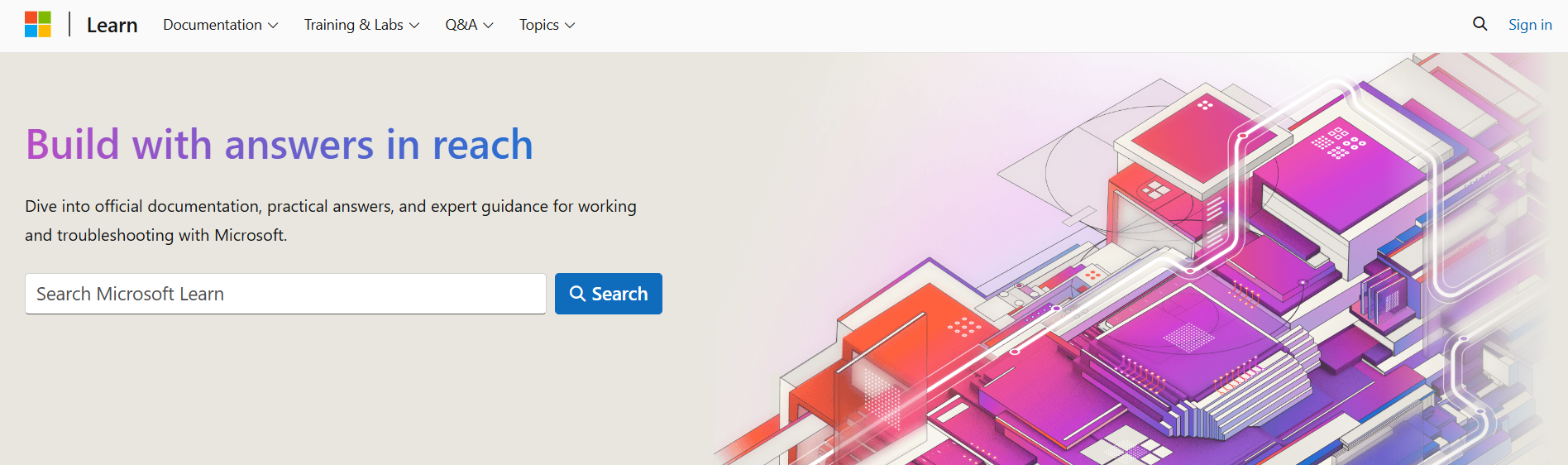
Microsoft Learn is particularly useful if you want your AI and machine learning knowledge to connect with Microsoft's technology ecosystem.
Its current learning paths cover machine learning concepts, data exploration, model training and evaluation, and Azure Machine Learning.
For example, its Create machine learning models learning path covers the core principles of ML as well as tools and frameworks used to train, evaluate, and use models through Azure Machine Learning.
There are also learning paths that go beyond simply training a model.
Microsoft Learn includes material around deploying and managing machine learning models through Azure Machine Learning, including model metrics and deployment options.
This makes the platform useful if you're interested in the practical side of working with ML in a cloud environment.
It is less of a general "learn everything about AI" destination and more useful when Microsoft and Azure are part of the environment you want to work in.
Good choice if: You want to learn AI/ML with a strong focus on Azure and Microsoft's tools.
10. MIT OpenCourseWare
Best for: Academic depth.
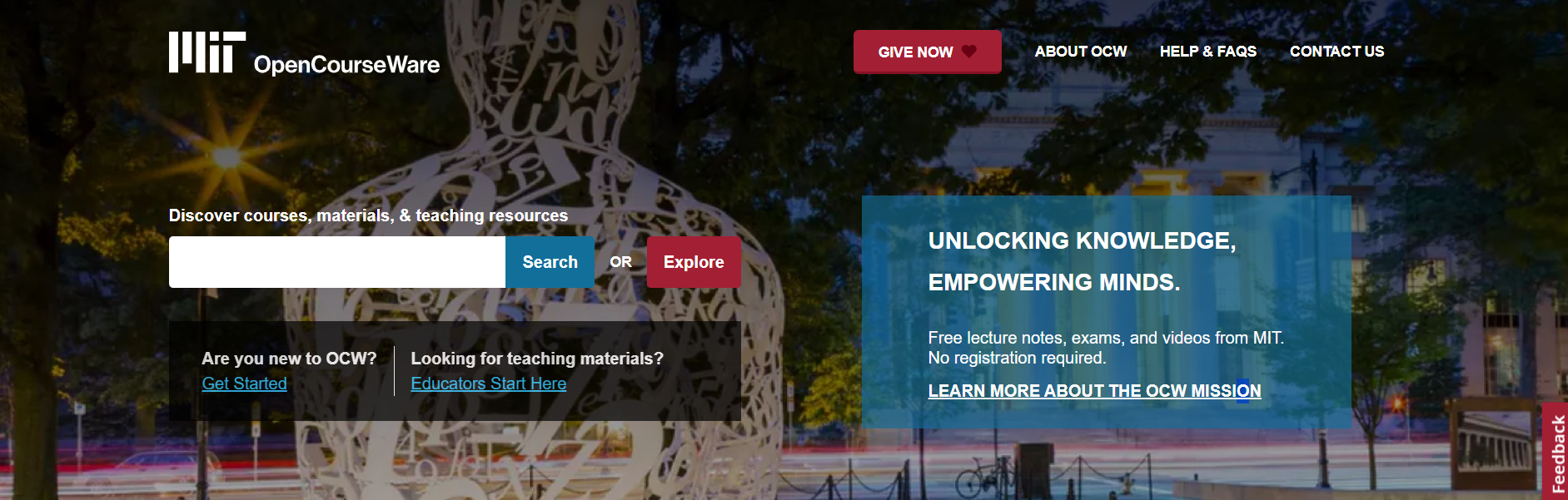
MIT OpenCourseWare is probably the option on this list for people who want to go deep into the academic side of machine learning.
Instead of trying to make everything short and beginner-friendly, MIT courses can give you access to university-level lectures, notes, assignments, and problem sets.
The level of depth offered by MIT can be valuable if you genuinely want to understand the mathematical and statistical foundations behind machine learning.
But I wouldn't automatically recommend it to every beginner. If your immediate goal is to get comfortable with Python and build your first ML model, an interactive or more guided platform may be easier to start with.
MIT OpenCourseWare becomes more interesting when you want to understand the subject at a deeper academic level.
Good choice if: You want university-level material and are comfortable with a more rigorous approach to machine learning.
Conclusion
After going through these platforms, one thing stood out to me: learning AI is starting to look less like taking a course and more like building your own toolkit.
You’ll probably end up using more than one website anyway.
Maybe one course explains something well, but another one makes more sense when you get stuck. Then you try it yourself on Kaggle and realize the actual dataset is a lot messier than the examples in the course.
That kind of trial and error is part of learning AI too.
And I don't think that's necessarily a bad thing. AI is moving too quickly for any single platform to cover everything equally well.
A course that feels completely current today can start feeling dated surprisingly quickly.
New models, tools, and techniques keep showing up, while the fundamentals continue sitting underneath all of them.
So if you're starting out, don't put too much pressure on yourself to find the perfect website before you begin.
Pick something that makes you want to actually sit down and learn.
Finish a course. Break something. Build something small.
Then figure out what you want to learn next. For me, that's a much more useful way to look at AI learning than collecting a dozen course certificates and never opening half of them.