

If you're trying to learn artificial intelligence, especially, Generative AI right now, you've probably noticed one problem pretty quickly: there are way too many courses to choose from.
One course promises to teach you everything about LLMs. Another focuses on LangChain. Another is all about RAG and AI agents.
Then there are courses from NVIDIA, Microsoft, IBM, Databricks, and a dozen other platforms, all claiming to be worth your time.
So how do you know which ones are actually good?
We have gone through a bunch of these courses and narrowed them down to ones that teach real GenAI skills, not just the basics of how to use ChatGPT or other artificial intelligence tools.
The list includes options for learning how LLMs work, building GenAI, applications, working with RAG and agents, and getting hands-on with tools.
What to Look for in a Generative AI Course
Before picking a course, it helps to know what you're actually looking for. A good GenAI course should go above and beyond explaining what AI tools or LLMs are.
It should give you a reasonable understanding of how artificial intelligence systems work and ideally, give you opportunities to use that knowledge in practice.
Here are some things we looked at when choosing the courses on this list.
- Technical depth: Does the course actually teach you how GenAI systems work, or does it stay at a surface level?
- What you'll learn: Does it cover useful skills such as LLMs, prompt engineering, RAG, fine-tuning. AI agents or model evaluation?
- Hands-on learning: Are you actually building or experimenting with something, rather than just watching lectures?
- Provider: Is the course from a provider with a strong reputation in AI, cloud computing, data or developer education?
- Difficulty and prerequisites: Do you need Python, machine learning or other technical knowledge before starting?
- Time and Cost: How much time and money will you need to put into the course?
Most importantly, think about what you want to do after finishing the course.
A short introductory course and a 100-hour engineering program can both be useful, but they are useful for very different reasons.
List of Best Generative AI Courses
Here is the list of GenAI courses we covered in this blog.
- Building LLM Applications With Prompt Engineering (NVIDIA)
- Generative AI Engineering (Databricks)
- Generative AI Engineering Professional Certificate by IBM (Coursera)
- Generative AI for Beginners (Microsoft)
- Generative AI With Large Language Models (DeepLearning.AI)
- Complete Generative AI Course With LangChain and Hugging Face (Udemy)
- Generative AI Concepts (DataCamp)
Now let's get to know each course in detail.
1. Building LLM Applications With Prompt Engineering by NVIDIA
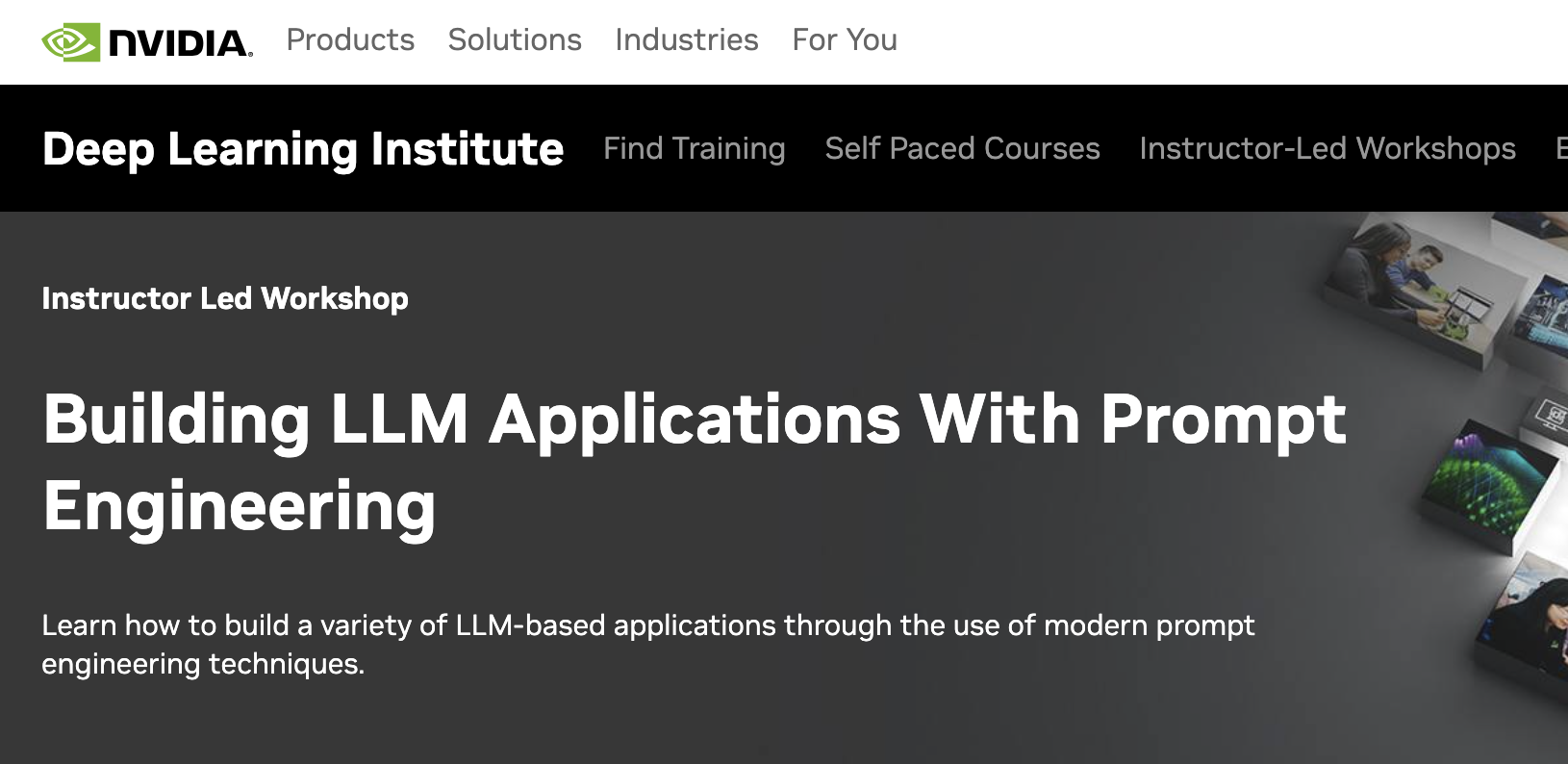
If you want to learn how to actually build applications using large language models, NVIDIA's Building LLM Applications With Prompt Engineering is a strong place to start.
The course focuses on using prompt engineering to create LLM-powered applications, giving you practical experience with artificial intelligence applications and also introduces tools such as LangChain, and Llama 3.1.
What you'll learn
In this course, you can learn
- To use LLMs for different language-based tasks.
- Prompt engineering techniques and how to improve prompts.
- To write application code that works with LLMs.
- To build LLM applications for tasks such as document analysis and chatbots.
- To use LangChain for organizing and connecting different parts of an LLM workflow.
- To apply prompt engineering to different generative AI tasks.
- To use LLMs within applications instead of simply interacting with them directly.
- To organize and compose different components of an LLM workflow using LangChain.
Prerequisites
You should have some basic programming knowledge and a general understanding of AI and machine learning. You don't need to be an LLM expert before starting.
| Duration | 8 Hours |
| Cost | $90 |
| Level | Beginner to intermediate |
| Language | English |
| Certificate | Yes |
| Course | Building LLM Applications With Prompt Engineering (NVIDIA) |
2. Generative AI Engineering with Databricks
If you want to get into the more practical side of GenAI engineering, Generative AI Engineering with Databricks is a strong option.
Rather than spending most of the course explaining what GenAI is, it focuses on building, evaluating, and deploying GenAI applications.
What you'll learn
This course will teach you how to:
- To build RAG agents using Databricks Agent Bricks.
- To parse and chunk unstructured documents and create Vector Search indexes.
- To build single-agent and multi-agent applications using the OpenAI Agents SDK.
- To create agent tools using Unity Catalog and MCP.
- To evaluate AI agents using MLflow's evaluation framework.
- To use built-in, guideline and custom judges to evaluate agent performance.
- To deploy, trace and monitor production-grade AI agents.
- To observe agent execution using MLflow and collect human feedback.
Prerequisites
You'll need basic Python and SQL knowledge, along with some familiarity with Databricks and Unity Catalog, and a basic understanding of LLMs and prompt engineering.
| Duration | Around 16 hours |
| Cost | Varies based on training options |
| Level | Associate |
| Language | English |
| Certificate | Check website |
| Course | Generative AI Engineering with Databricks |
3. Generative AI Engineering Professional Certificate (IBM/Coursera)
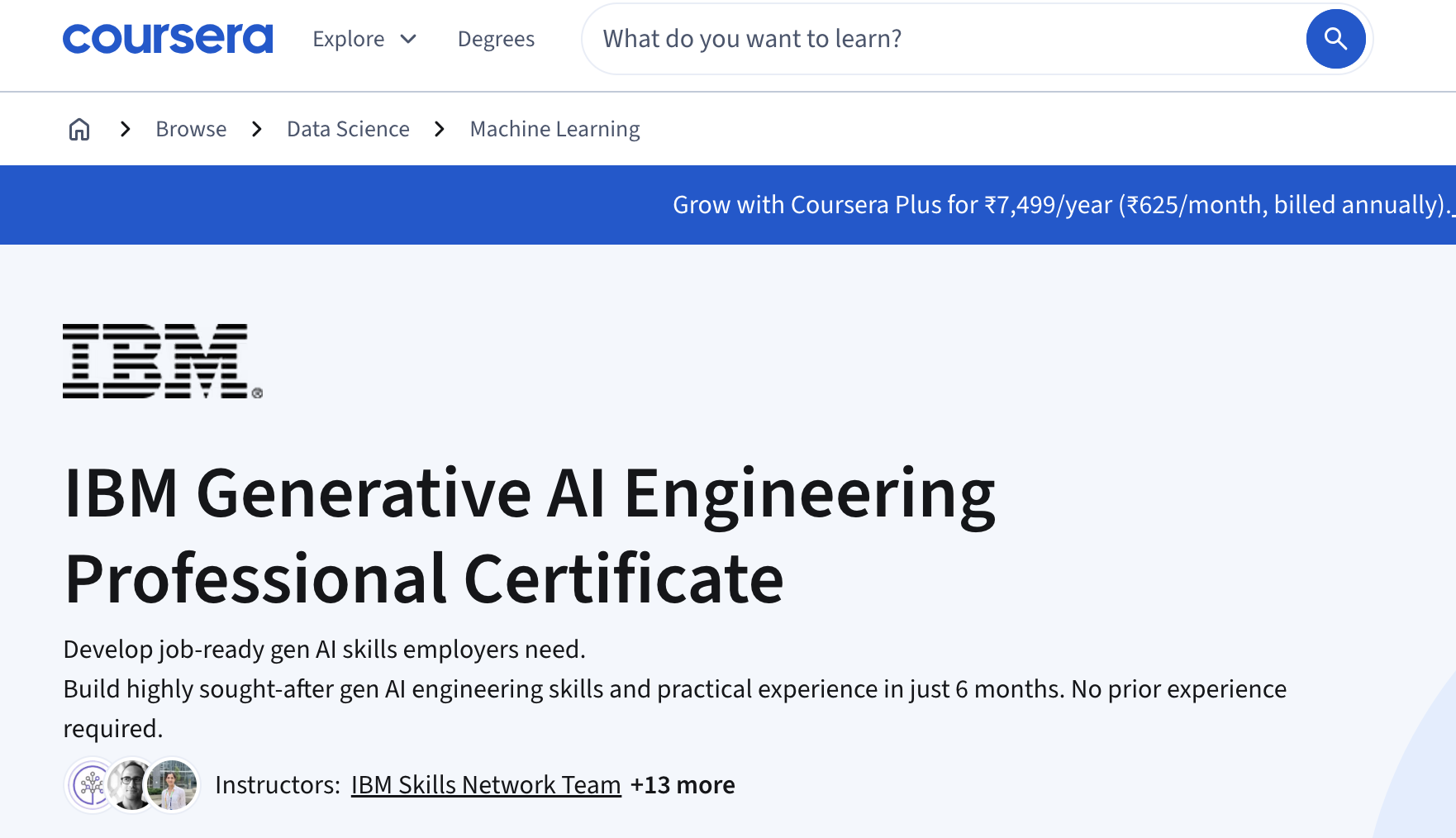
If you want something more comprehensive than a short GenAI course, IBM's Generative AI Engineering Professional Certificate is worth considering. It is a 16 course program designed to take you from the fundamentals to building and deploying GenAI applications.
What you'll learn
In this course you can learn
- Generative AI and LLM fundamentals, including different generative AI architectures.
- How transformers, GANs, VAEs and diffusion models work.
- Prompt engineering and different prompting techniques.
- How to build and fine-tune generative AI models using tools such as Hugging Face and PyTorch.
- How to use techniques such as LoRA and QLoRA for fine-tuning.
- How to build RAG applications using vector databases and LangChain.
- How to build AI agents and connect them with tools and external data.
- How to evaluate, deploy and work with GenAI applications using Python and other development frameworks.
Prerequisites
No prior GenAI experience is required. Coursera lists it as a beginner-level program, although having some programming experience will make the technical parts easier.
| Duration | Around 6 months at 6 hours per week |
| Cost | Coursera subscription, around $49/month |
| Level | Beginner |
| Language | English |
| Certificate | Yes |
| Course | Generative AI Engineering Professional Certificate (IBM / Coursera) |
4. Generative AI for Beginners (Microsoft)
Microsoft's Generative AI for Beginners is a free course designed to help developers get started with building GenAI applications. The current version has 21 lessons, with a mix of concept-based lessons and hands-on coding lessons.
What you'll learn
This course will teach you
- How generative AI and large language models work.
- Prompt engineering, including different ways to structure prompts.
- How to build applications that use generative AI models.
- How embeddings and vector databases work.
- How to build RAG applications.
- How AI agents work and how they can use tools.
- How to work with open-source models and fine-tune models for specific use cases.
- How to build GenAI applications through practical coding lessons and examples.
Prerequisites
Basic Python or TypeScript knowledge is helpful. You'll also need a GitHub account to work through the course, and some coding lessons require access to an AI API or Microsoft Foundry.
| Duration | Self-paced |
| Cost | Free |
| Level | Beginner |
| Language | English, with multiple translations |
| Certificate | No |
| Course | Generative AI for Beginners (Microsoft) |
5. Generative AI With Large Language Models (DeepLearning.AI)
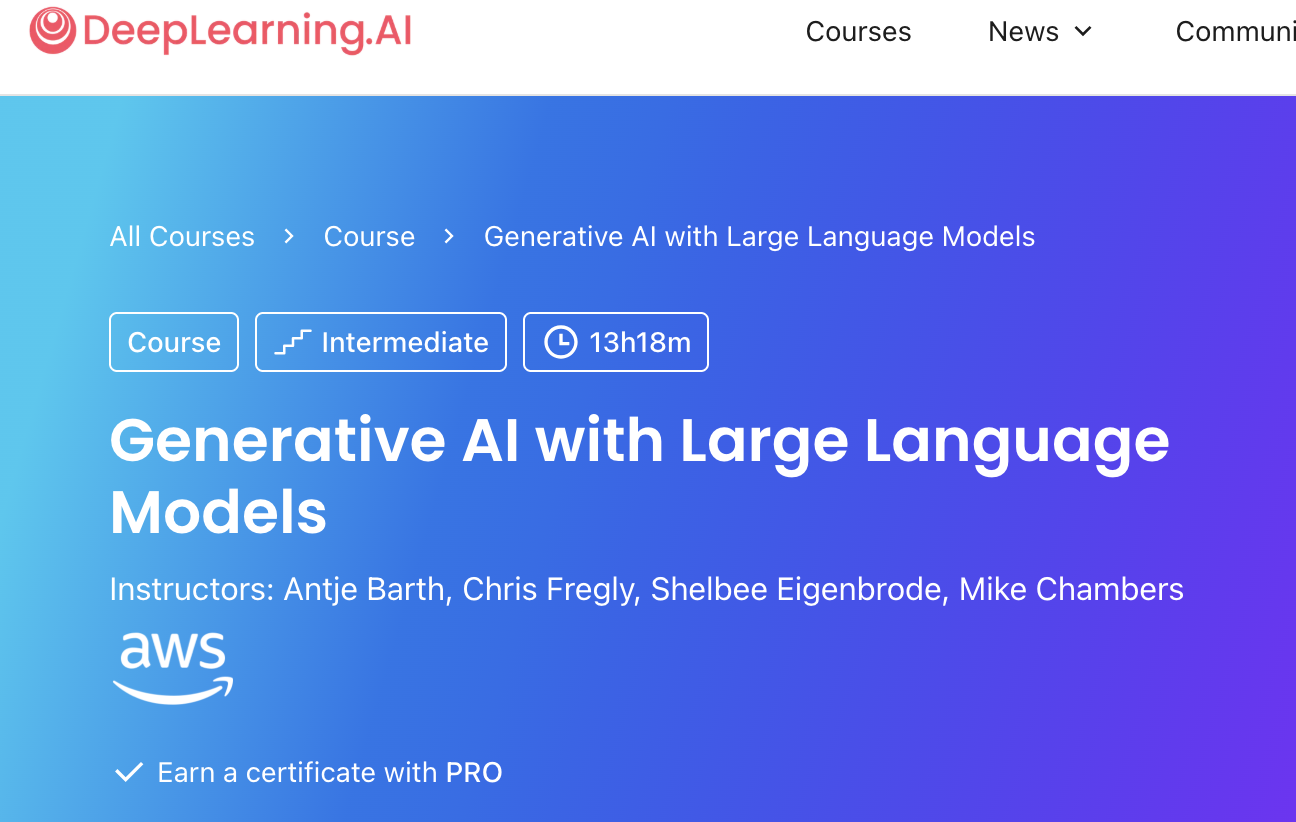
If you want to understand LLMs beyond simply knowing how to use them, Generative AI With Large Language Models from DeepLearning.AI is a good option.
It focuses on the LLM lifecycle and gives you a better idea of what happens behind the scenes when these models are developed and deployed.
What you'll learn
In this course you can learn
- How the LLM development lifecycle works, from data gathering and model selection to deployment.
- How transformer architecture works and how transformers are trained.
- How LLMs are pre-trained and adapted for specific use cases.
- How to use prompt engineering to get better results from LLMs.
- How to fine-tune LLMs for specific tasks.
- How to evaluate LLM performance and compare different model outputs.
- How to approach the practical challenges involved in training, tuning and deploying LLMs.
Prerequisites
This is an intermediate-level course, so some knowledge of Python and machine learning is recommended.
| Duration | Around 10 hours |
| Cost | Available on Coursera, currently at $49/month |
| Level | Intermediate |
| Language | English |
| Certificate | Yes, with the paid version |
| Course | Generative AI With Large Language Models (DeepLearning.AI) |
6. Complete Generative AI Course With LangChain and Hugging Face (Udemy)
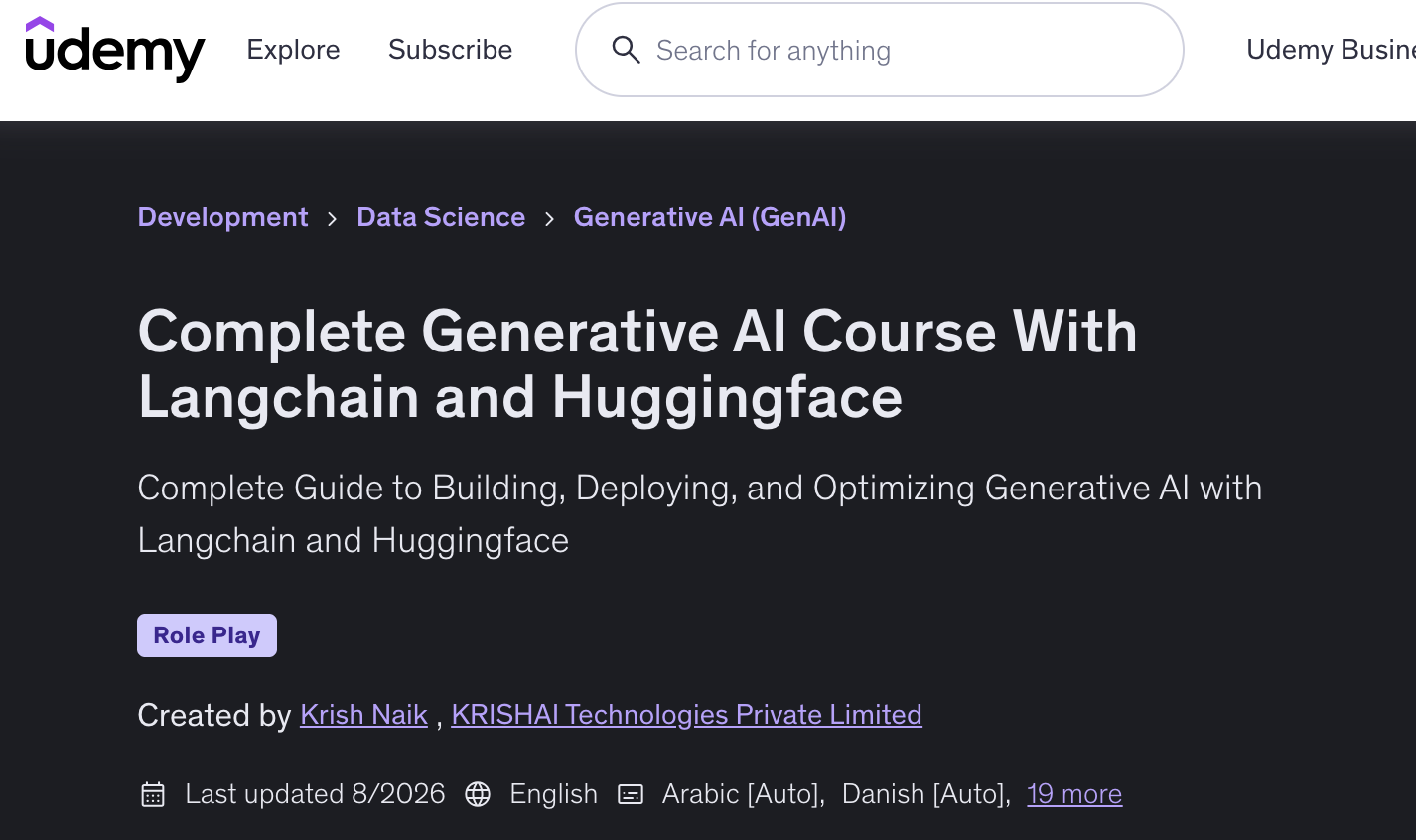
If you want a course that goes deep into actually building GenAI applications, Complete Generative AI Course With LangChain and Hugging Face is one of the more extensive options on this list.
It has almost 70 hours of content, so you’ll need more than a weekend to get through it. It was also updated in August 2026, which is worth noting for a field that changes as quickly as GenAI.
What you'll learn
This course will teach you
- Generative AI and NLP fundamentals needed to work with LLM applications.
- How to build applications using LangChain.
- How to work with Hugging Face's pre-trained models.
- How to customise and fine-tune Hugging Face models.
- How to build RAG pipelines and use retrieval to improve LLM responses.
- How to build applications such as chatbots, content generation tools and data augmentation systems.
- How to deploy GenAI applications across cloud and on-premise environments.
- How to work through real-world projects that bring these different GenAI tools and techniques together.
Prerequisites
You'll need basic Python, machine learning, and API knowledge. Some familiarity with deep learning and frameworks such as TensorFlow or PyTorch is helpful, but not strictly required.
| Duration | Around 70 hours |
| Cost | Varies by Udemy pricing and promotions |
| Level | Beginner to advanced |
| Language | English |
| Certificate | Yes, Udemy certificate of completion |
| Course | Complete Generative AI Course With LangChain and Hugging Face (Udemy) |
7. Generative AI Concepts (DataCamp)
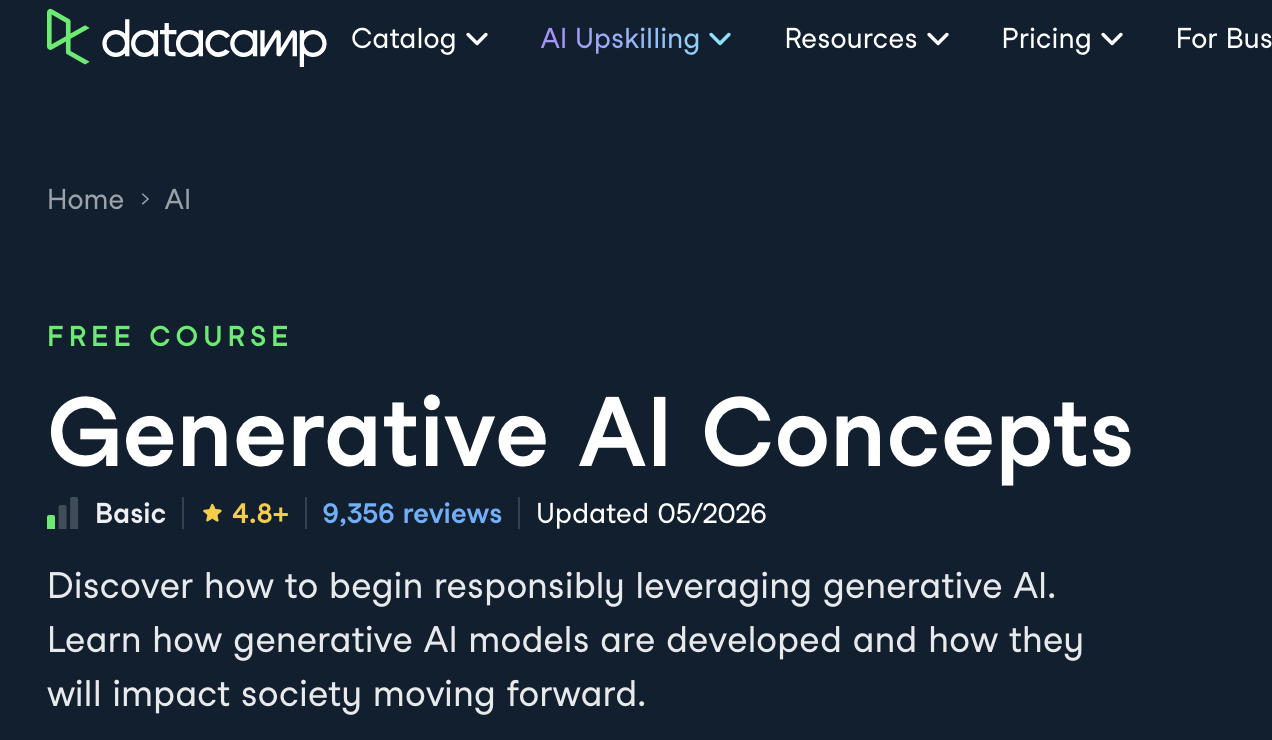
Generative AI Concepts is a short course from DataCamp that introduces the basic ideas behind generative AI. It is only around two hours long and covers both how these models work and some of the issues surrounding their use.
What you'll learn
This course will teach you
- What generative AI is and how it fits into the broader AI and machine learning landscape.
- The difference between generative and discriminative models.
- How models such as GANs and transformers work.
- What reinforcement learning from human feedback (RLHF) is and how it is used.
- The main stages involved in developing and evaluating generative AI models.
- How generative AI models are improved and adapted for different use cases.
- Key issues around bias, copyright, privacy and responsible AI.
- How to think about the opportunities and limitations of generative AI.
Prerequisites
DataCamp describes this as a non-technical course, although it recommends having some understanding of machine learning.
| Duration | 2 hours |
| Cost | Available through DataCamp, with the course available to start for free |
| Level | Beginner |
| Language | English |
| Certificate | Yes, Statement of Accomplishment |
| Course | Generative AI Concepts (DataCamp) |
Conclusion
There is no shortage of GenAI courses right now, but they are not all trying to teach you the same thing.
If you want to understand LLMs more deeply, a course like DeepLearning.AI's Generative AI With Large Language Models makes more sense.
If you want to build applications, NVIDIA and Udemy offer more application-focused options. If you're interested in RAG, agents, and production systems, Databricks goes much further into that side of GenAI.
If you're working toward becoming an AI engineer, focus on courses that give you practical experience building, rather than just explaining the concepts.
The main thing is to look at what you actually want to learn before signing up. You don't need to take the longest course just because it has more hours, and you don't need to choose a course simply because a big tech company created it.
What matters is whether the course teaches the skills you want to use and gives you enough practical experience to actually apply them.
Here are the best Generative AI certifications I’ve listed to help you get started.
Bonus: Here is a list of the best Agentic AI courses to help you develop Agentic AI skills. To show this skill, you can take Agentic AI certification exam.