

You have probably written a prompt without even thinking about it.
You ask AI to write something, explain a topic, summarize a document, or help you come up with an idea.
And sometimes, the response is exactly what you wanted. Other times, you read it and probably think, "That's not quite what I meant."
This is where prompt engineering helps.
Prompt engineering is about writing and refining prompts to get more effective responses from AI models.
And with multiple Generative AI systems becoming part of everyday work, learning how to write better prompts can be very useful.
There are quite a few prompt engineering courses out there. Some are short introductions, while others go much deeper into prompt patterns, APIs, coding, and different prompting techniques.
So if you are looking to learn prompt engineering, I have shortlisted seven courses that are worth looking into.
List of Prompt Engineering Courses
Below is the list of prompt engineering courses we'll be looking at in this blog:
- Understanding Prompt Engineering (DataCamp)
- ChatGPT Prompt Engineering for Developers (DeepLearning.AI)
- The Complete Prompt Engineering for AI Bootcamp (Udemy)
- Anthropic's Prompt Engineering Interactive Tutorial (GitHub)
- Prompt Engineering: How to Talk to the AIs (LinkedIn Learning)
- Prompt Engineering for ChatGPT (Coursera)
- Generative AI: Prompt Engineering Basics (Coursera)
Now let's get into them one by one
1. Understanding Prompt Engineering by DataCamp
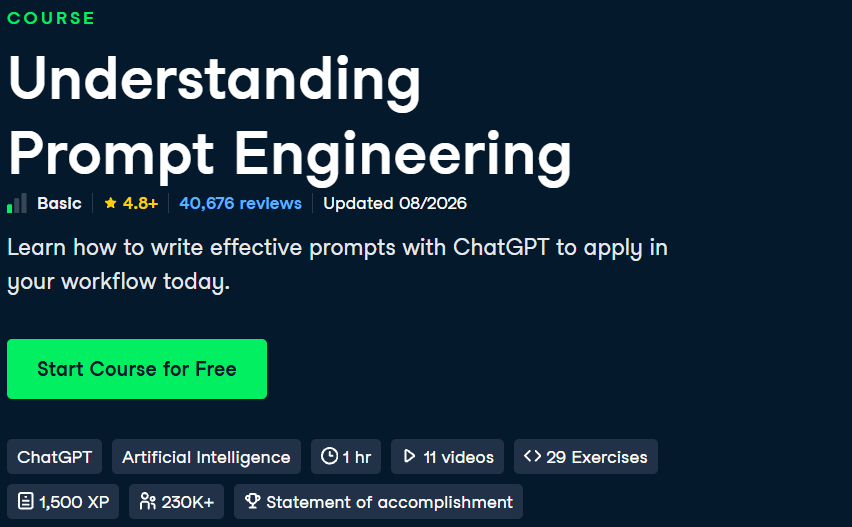
If you are looking for a short introduction to prompt engineering, DataCamp's Understanding Prompt Engineering is a beginner-level course that you can explore.
This course focuses on writing effective prompts with ChatGPT and covers prompting techniques, prompt structuring, and response evaluation, among other things.
You’ll gain essential skills that you can immediately apply to your creative or business processes.
What You Will Learn:
This course will help you,
- Define prompt engineering and recognize its importance in optimizing interactions with large language models.
- Identify different prompting techniques such as zero-shot, one-shot, and few-shot prompting.
- Understand how prompt structure, along with the clarity and context you provide, can affect the response you get.
- Differentiate between effective and ineffective prompts by assessing response accuracy and relevance.
- Evaluate ethical and practical considerations when applying prompt engineering in business and research contexts.
Course Details
The following are the course details:
| Course Details | Information |
|---|---|
| Platform | DataCamp |
| Level | Basic |
| Duration | 1 hour |
| Exercises/Assignments | 29 exercises |
| Certificate | Statement of Accomplishment |
2. ChatGPT Prompt Engineering for Developers by DeepLearning.AI
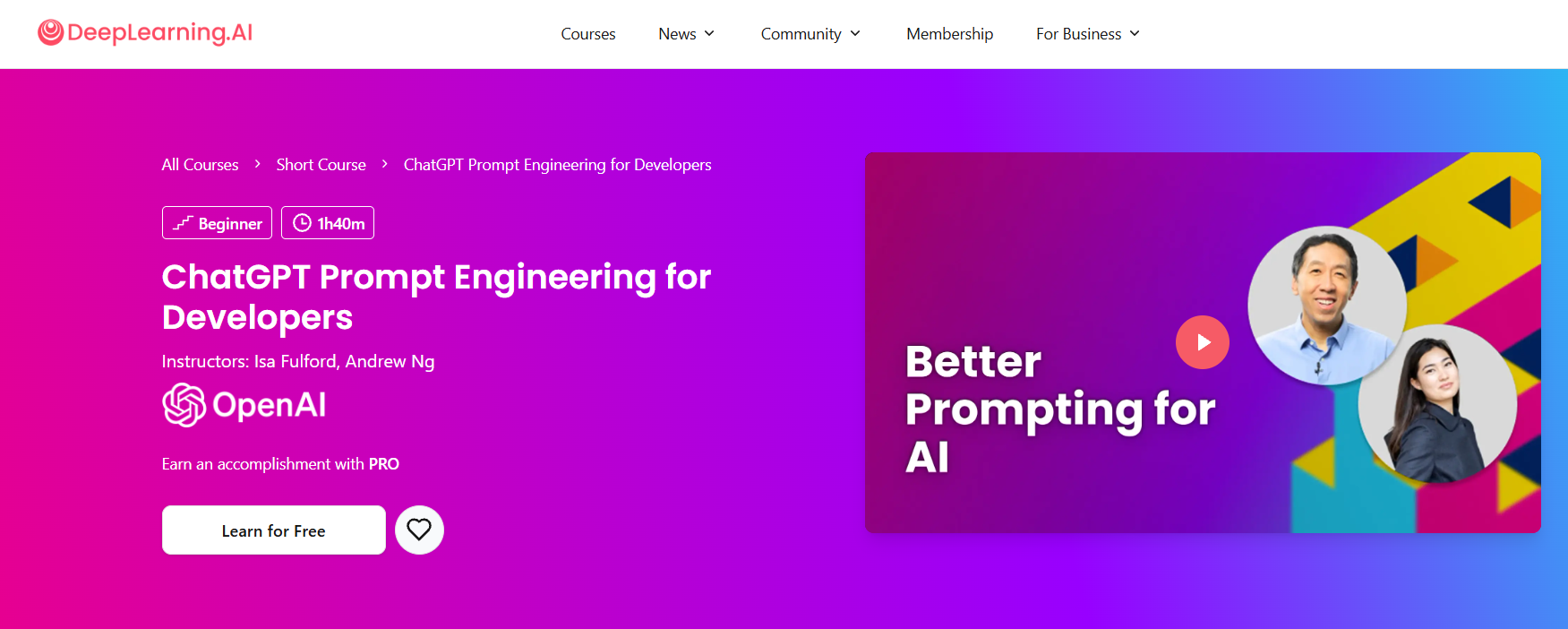
DeepLearning.AI's ChatGPT Prompt Engineering for Developers is a beginner-level short course that focuses on using large language models (LLMs) to quickly build new and powerful applications.
This course describes how LLMs work, provides best practices for prompt engineering, and shows how LLM APIs can be used in applications for a variety of tasks.
What You Will Learn
This course helps you,
- Learn prompt engineering best practices for application development.
- Discover new ways to use LLMs, including how to build your own custom chatbot.
- Gain hands-on practice writing and iterating on prompts yourself using the OpenAI API.
- Learn two key principles for writing effective prompts.
- Learn how to systematically engineer good prompts.
- Build a custom chatbot.
Course Details
In the table below, I have listed the basic course details you should know.
| Course Details | Information |
|---|---|
| Platform | DeepLearning.AI |
| Level | Beginner |
| Duration | 1 hour 30 minutes |
| Exercises/Assignments | 1 graded assignment with PRO |
| Certificate | Accomplishment with PRO |
3. The Complete Prompt Engineering for AI Bootcamp (2026) by Udemy
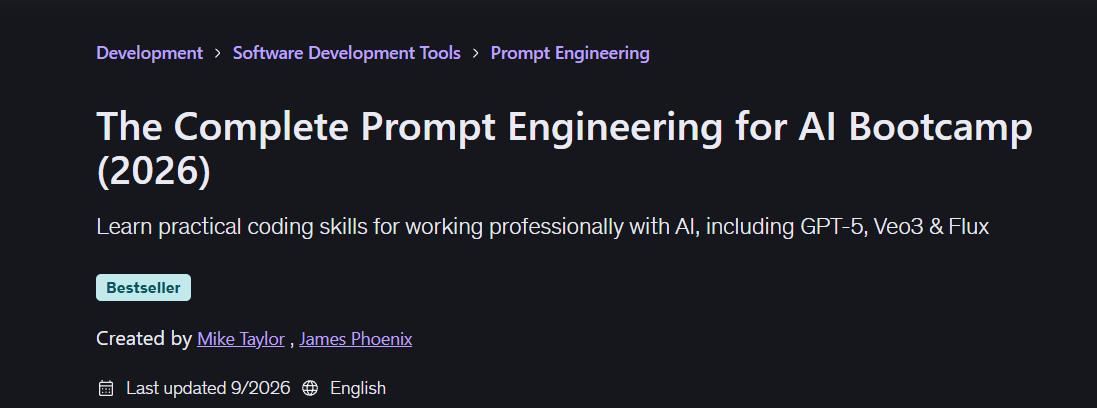
The Complete Prompt Engineering for AI Bootcamp (2026) by Udemy is a much longer course than some of the others on this list. This course is suitable for AI power users, Developers, and AI Engineers.
Another important point to note is that many of the course's coding lessons require reading and modifying Python code.
What You Will Learn
Upon completion of this course, you will
- Learn the strengths and weaknesses of ChatGPT, GPT-5, Midjourney, GitHub Copilot, Veo3, and other major models.
- Recognize the "Five Principles of Prompting" and common tips and tricks for professional-grade output.
- Apply what you have learned to generate new AI products in 20+ real-world projects for text and image generation use cases.
- Understand the Python coding patterns needed to run and scale AI reliably in production.
Course Details
Here is the basic information you should know about this course.
| Course Details | Information |
|---|---|
| Platform | Udemy |
| Level | Not specified |
| Duration | 18 hours 11 minutes |
| Exercises/Assignments | 20+ real-world projects |
| Certificate | Certificate of Completion |
4. Anthropic's Prompt Engineering Interactive Tutorial by GitHub
Anthropic's Prompt Engineering Interactive Tutorial is structured to allow you many chances to practice writing and troubleshooting prompts within Claude.
This course has nine chapters with exercises, along with an appendix covering more advanced methods.
What You Will Learn
You will be able to,
- Master the basic structure of a good prompt.
- Recognize common failure modes and learn the "80/20" techniques to address them.
- Understand Claude's strengths and weaknesses.
- Build strong prompts from scratch for common use cases.
- Work through exercises to practice writing and troubleshooting prompts.
- Learn about separating data from instructions.
- Learn about formatting output and speaking for Claude.
- Build complex prompts for industry use cases.
- Learn about chaining prompts, tool use, search, and retrieval.
Course Details
The following are the course details:
| Course Details | Information |
|---|---|
| Platform | GitHub |
| Level | Beginner to Advanced |
| Duration | Not specified |
| Exercises/Assignments | Included with chapters |
| Certificate | Not specified |
From there, it gets into things like separating data from instructions, formatting output, thinking step by step, and using examples.
The more advanced part deals with avoiding hallucinations and creating complex prompts.
5. Prompt Engineering for ChatGPT by Coursera
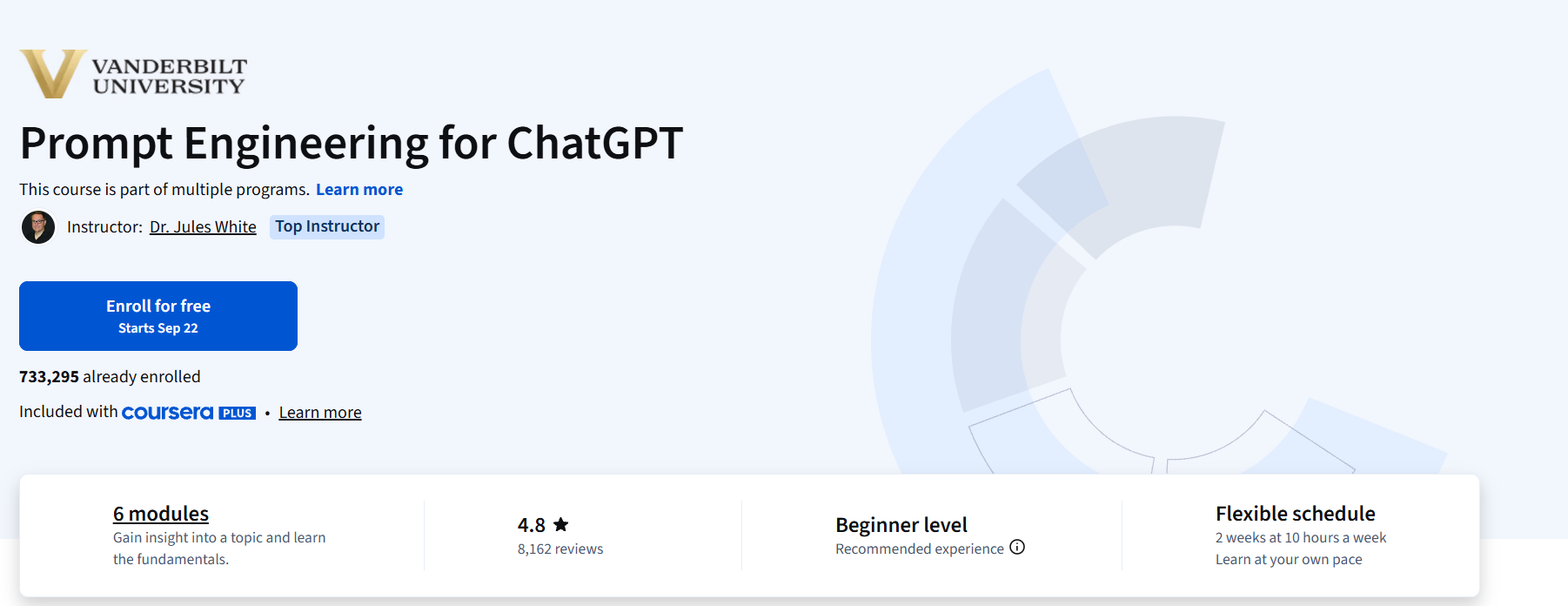
Prompt Engineering for ChatGPT is a beginner-level course from Vanderbilt University that has six modules and uses prompt patterns to teach learners how to work with large language models like ChatGPT.
What You Will Learn
You will learn to,
- Apply prompt engineering and effectively work with large language models like ChatGPT.
- Use prompt patterns to tap into capabilities within large language models.
- Create complex prompt-based applications for life, business, or education.
- Work with basic prompts and build towards sophisticated prompts.
- Use large language models for tasks such as writing, summarization, gameplay, and planning.
Course Details
Here is some information about the course you should know before starting this course.
| Course Details | Information |
|---|---|
| Platform | Coursera |
| Level | Beginner |
| Duration | 2 weeks at 10 hours a week |
| Exercises/Assignments | 7 assignments |
| Certificate | Shareable certificate |
6. Generative AI: Prompt Engineering Basics by Coursera
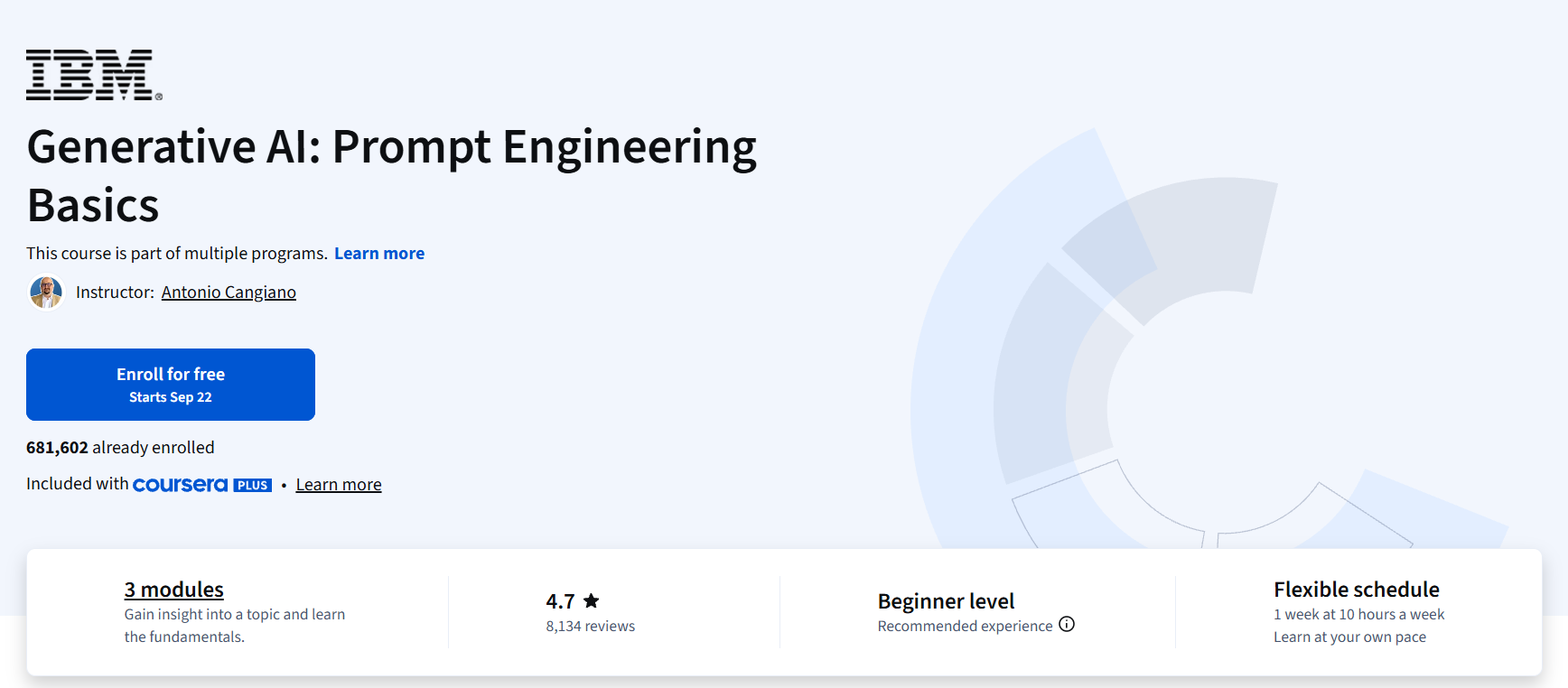
The second Coursera course on this list is Generative AI: Prompt Engineering Basics, which is a course offered by IBM. It is a beginner-level course with three modules and a flexible schedule.
This course is also available in 27 languages. The course also includes labs, discussions, readings, and a final project.
What You Will Learn
You will learn to,
- Explain the concept and relevance of prompt engineering in generative AI models.
- Apply best practices for creating prompts.
- Assess commonly used tools for prompt engineering.
- Apply common prompt engineering techniques and approaches for writing effective prompts.
- Explore zero-shot and few-shot prompting.
- Learn the Interview Pattern, Chain-of-Thought, and Tree-of-Thought approaches.
- Work with multimodal prompting.
- Learn the Playoff Method.
- Work with image generation.
- Evaluate AI outputs for precision and usefulness.
Course Details
I have listed the basic information about this course you should know.
| Course Details | Information |
|---|---|
| Platform | Coursera |
| Level | Beginner |
| Duration | 1 week at 10 hours a week |
| Exercises/Assignments | 5 assignments |
| Certificate | Shareable certificate |
Conclusion
There is something interesting about learning prompt engineering. You don't really learn it by watching someone explain it.
A lot of the learning happens when you actually start writing prompts, getting responses that don't quite work, changing what you wrote, and trying again.
And that just makes prompt engineering one of those skills where experimenting can be just as important as taking a course. The courses above can give you the structure and techniques to get started.
But once you understand the basics, the next step is probably to spend some time actually using them.
Try different prompts. See what changes the response. Figure out what works for the kind of tasks you do.
You might be surprised by how much you learn just by playing around with it.
Other Useful Resources: