

If you’ve been looking at the job market lately, you’ve probably noticed one thing.
It’s the fact that AI is everywhere.
But here’s what makes this shift a little easier. The AI job market is a lot broader than it first appears.
There's more to a career in AI than building models or writing code.
AI is changing what companies expect from their employees. Some new roles are emerging, while many existing jobs have started to incorporate AI in their day-to-day activities.
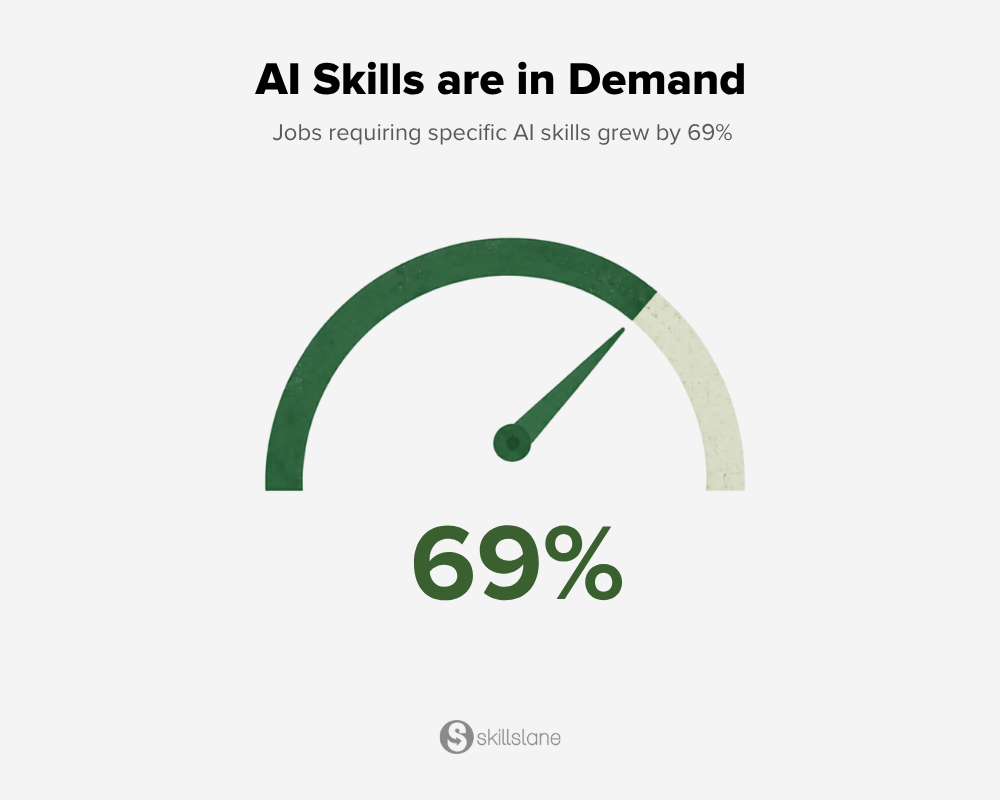
And the demand is already showing up in the job market: according to PwC’s 2026 AI Jobs Barometer, jobs requiring specific AI skills grew by 69%.
The tricky part is actually figuring out where you fit into all of this.
You could work on building AI systems. You could work with data, help companies bring AI into their products, manage the technology behind it, or even focus on making sure AI is being used responsibly.
So if you’re wondering, “What kind of AI career should I actually pursue?”, you’re not alone.
In this guide, we’ll break down the top AI career paths in 2026, what each role actually involves, the skills you’ll need, and the expected salary range.
By the end, you should have a much clearer idea of where to start.
What is Driving Demand for AI careers in 2026?
One of the biggest reasons careers in AI are getting so much attention right now is pretty simple. Companies are not just discussing AI, they're actually figuring out how to use it.
And once a company decides to bring AI into its workflow, products, or even day-to-day tasks, it needs people who can make that decision come to life.
The numbers back this up too.
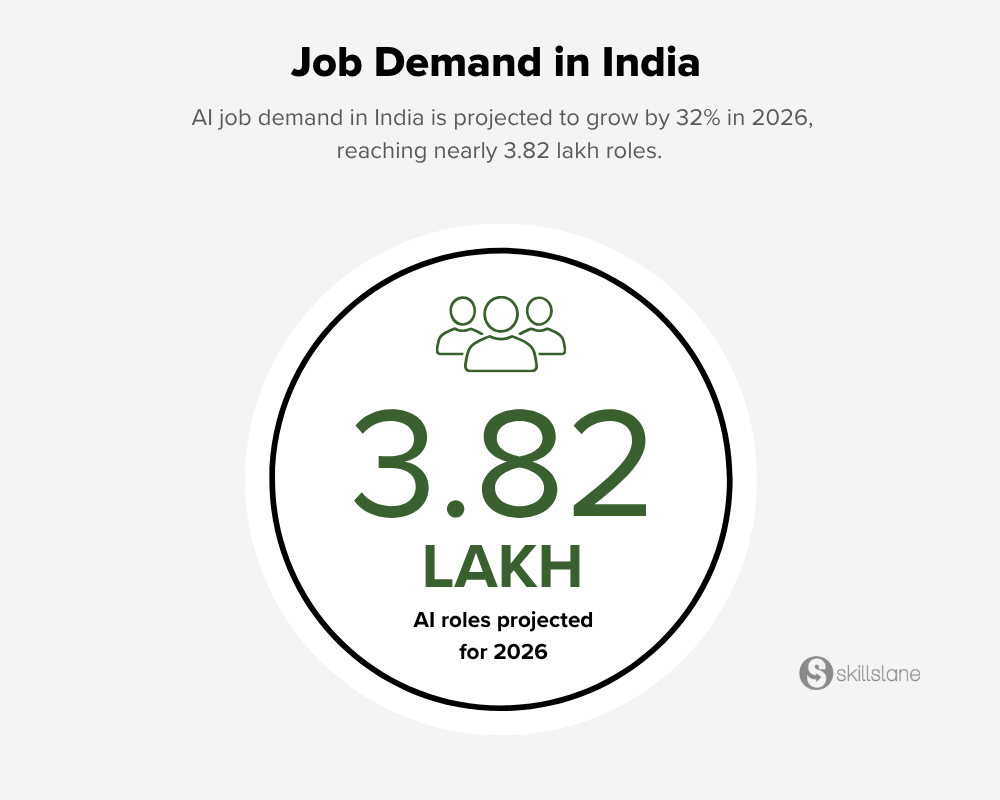
So, the good news for you is, if you've been considering a career in AI, the demand is real, the opportunities are concrete, and 2026 is genuinely a great time to start!
The Top AI Career Paths to Consider in 2026
When you hear "AI careers", don't think of just one job title. There are many directions you can take, and the right one for you will depend on what you already know and what kind of work you actually enjoy doing.
Let's take a look at some of the most promising paths and what each one looks like in practice.
1. AI/ML Engineer
If you enjoy solving problems with technology and don't mind getting a little technical, AI/ML is probably one of the first AI career paths you'll come across.
AI and Machine Learning Engineers build systems that can learn from data and make predictions or decisions. Depending on the role, they might work on anything from recommendation systems and fraud detection to AI-powered applications.
These AI systems are designed to handle specific tasks using data and trained models. If you already have a background in software development, computer science, or mathematics, the transition could be much easier.
Tools and technologies you need to learn:
- Programming: Python, SQL
- Data Analysis: NumPy, pandas
- Machine Learning: XGBoost, LightGBM, scikit-learn
- Cloud: AWS/Azure/GCP
- Deployment: Docker & Kubernetes
- Version control: Git, GitHub
- Development Environment: VS code, Jupyter Notebook
- Deep Learning: Neural Networks, PyTorch, TensorFlow
2. Generative AI / LLM Engineer
If you're more interested in what you can do with AI than building models from scratch, this could be a good path for you.
Generative AI and LLM Engineers build applications using models like large language models. They work with technologies such as LLM APIs, RAG, embeddings, prompt engineering, and AI agents.
Tools and technologies you need to learn:
- Programming: Python
- LLM APIs: OpenAI, Anthropic, AWS Bedrock
- LLM frameworks: LangChain, LlamaIndex
- Vector databases: Pinecone, Weaviate, Qdrant
- RAG: Embeddings, Chunking, Retrieval-Augmented Generation
- Open-source models: Hugging Face
- Deployment: Docker, FastAPI
Also, here are some Generative AI courses, it might help you to learn GenAI.
3. Data Scientist
If you enjoy working with numbers, spotting patterns, and figuring out what the data is telling you, data science could be a good fit. A data scientist’s job is to figure out what the data is telling us and turn those findings into something useful.
Their work can include everything from data analysis and statistics to machine learning and predictive modeling. They may also work on improving the data and models that AI systems rely on.
Tools and technologies you need to learn:
- Programming: Python, SQL
- Data analysis: pandas, NumPy
- Visualization: Matplotlib, Seaborn, Plotly
- Machine learning: scikit-learn, XGBoost
- Deep learning: PyTorch, TensorFlow
- BI tools: Power BI, Tableau
4. Data Engineers
If you are someone who likes to work behind the scenes, building systems that keep data moving, data engineering could be a good choice.
A lot of what a company does with data starts with the data engineer. They set up the systems that collect and move data, manage the databases where it’s stored, and fix things when the data doesn’t flow as it should.
Tools and technologies you need to learn:
- Programming: Python, SQL
- Databases: PostgreSQL, MySQL
- Data processing: Apache Spark
- Data pipelines: Airflow, dbt
- Cloud: AWS, Azure, Google Cloud
- Data warehouses: Snowflake, BigQuery
- Version Control: Github
5. MLOps / AI Infrastructure Engineer
If you're interested in the technical side of AI, but prefer making systems run smoothly rather than building models, MLOps could be worth exploring.
MLOps Engineers handle the deployment, monitoring, maintenance, and scaling of machine learning models. They help move AI systems from development into real-world use.
A background in DevOps, cloud, or software engineering can also be a good launch point.
Tools and technologies you need to learn:
- Programming: Bash, Python
- Containers: Docker, Kubernetes
- Cloud: AWS, Azure, Google Cloud
- CI/CD: GitHub Actions, Jenkin, ArgoCD
- Infrastructure as Code: Terraform, Helm
- ML lifecycle: MLflow, Kubeflow, Airflow, Feast, Kserve
- Monitoring: Prometheus, Grafana, Loki
6. AI Product Manager
If you enjoy working with both technology and business, this role could be a good fit for you. AI Product Managers decide where AI can add value to a product, what needs to be built, and how it should solve a real user problem.
They work closely with engineers, designers, and business teams, without necessarily building AI themselves. They also need to understand how AI systems will fit into the product and the user's experience.
Tools and technologies you need to learn:
- Generative AI: ChatGPT, Claude, Gemini
- AI fundamentals: LLMs, RAG, AI agents
- Product management: Jira, Linear
- Analytics: Amplitude, Mixpanel
- Prototyping: Figma
- Data: Basic SQL and analytics
7. AI Consultant
If you like solving business problems and helping companies make better decisions, you could work as an AI Consultant.
AI consultants help businesses figure out where AI can be useful, which solutions to use, and how to put them into practice. The role usually involves working with both technical and business teams.
Tools and technologies you need to learn:
- Generative AI: ChatGPT, Claude, Gemini
- AI platforms: AWS Bedrock, Azure AI, Google Vertex AI
- AI fundamentals: LLMs, RAG, AI agents
- Data analysis: Excel, SQL, Python
- BI: Power BI, Tableau
- Automation: Power Automate, Zapier
8. AI Research Scientist
If you're curious about how AI actually works and enjoy experimenting with new ideas, AI research could be a good fit.
AI Research Scientists work on developing new AI methods, improving existing models, and exploring what these systems can do. The work is usually more research-heavy than other AI roles and can involve a lot of experimentation, testing, and problem-solving.
Tools and technologies you need to learn:
- Programming: Python, C++
- Deep learning: PyTorch, TensorFlow, JAX
- ML libraries: scikit-learn, Hugging Face
- Research & experimentation: Jupyter, Weights & Biases
- Computing: GPUs, CUDA
- Version control: Git, GitHub
What Can You Realistically Earn?
Now let's talk numbers because every career decision deserves financial clarity.
| Role | Average Salary Range (INR) |
|---|---|
| AI / ML Engineer | 6-18 LPA |
| Generative AI / LLM Engineer | 8-48LPA |
| Data Scientist | 15-16 LPA |
| Data Engineer | 7-42 LPA |
| MLOps / AI Infrastructure Engineer | 6-35+ LPA |
| AI Product Manager | 8-20 LPA |
| AI Consultant | 20-50 LPA |
| AI Research Scientist | 5-26 LPA |
These are not just attractive numbers, they actually reflect a massive skill shortage that is only widening. Companies are willing to pay premium salaries for the right talent, and that talent could be you!
The salary figures are rough estimates, not exact numbers. You might see a different figure when you actually start applying.
How to Start Building a Career in AI?
If you’re wondering where to begin, I’d keep it simple. You don’t need to spend months trying to learn every new AI tool before you can start applying for jobs.
1. Pick a career path
Start by choosing the role that actually interests you. Look at the skills it requires and see how they line up with what you already know.
2. Find your skill gaps
Once you know where you want to go, figure out what you’re missing. This could be anything from Python and machine learning to product skills or a basic understanding of how AI works.
3. Learn by building
Courses are useful for learning the basics, but you’ll learn a lot more once you start building things yourself. Pick something related to the role you want and use it to show what you can actually do.
For example, someone pursuing a machine learning career could build a simple prediction model and document how it works.
4. Keep up with the field
What you learn today might not be enough a year from now. AI tools are changing all the time, and companies will keep adopting new ones. That means you’ll have to stay curious and be willing to learn new things as they come up.
The goal isn't to know everything about AI. It's to build the right skills for the career you want and keep building from there.
Conclusion
There’s no single way to build a career in AI, and I think that’s what makes this field so interesting.
You could build AI systems, work with data, bring AI into products, help businesses use it, or focus on research and responsible AI.
The right path really comes down to your existing skills, what you enjoy doing, and where you want to take your career. You don’t need to learn everything at once.
Start with one path, build the skills it actually requires, and give yourself room to grow as the field changes.
The AI job market will keep evolving. The best thing you can do is make sure your skills evolve with it.