
Tech has never had a shortage of opportunities, but in 2026, choosing the right one can feel a little overwhelming.
You hear about AI engineers, data scientists, cloud engineers, cybersecurity professionals, MLOps engineers, and a dozen other roles.
Then there are all the new AI tools showing up every few months.
It can be hard to tell which careers are actually worth pursuing and which ones are simply trending on the internet.
So, let's make this simple.
A high-paying tech career in 2026 is not necessarily the job with the biggest salary number attached to it.
I think it makes more sense to look at three things together:
- How much the role can pay.
- Whether companies actually need these professionals.
- Whether the skills are likely to stay useful as technology changes.
That is what we will look at here.
List of 10 High-Paying Tech Jobs
These roles cover some of the areas that are shaping the tech industry right now.
They also offer different paths depending on whether you prefer building systems, working with data, solving security problems, or managing technology infrastructure.
In India, AI/ML, cloud, and cybersecurity account for approximately 65% of tech hiring demand, according to foundit’s 2026 IT Trends report.
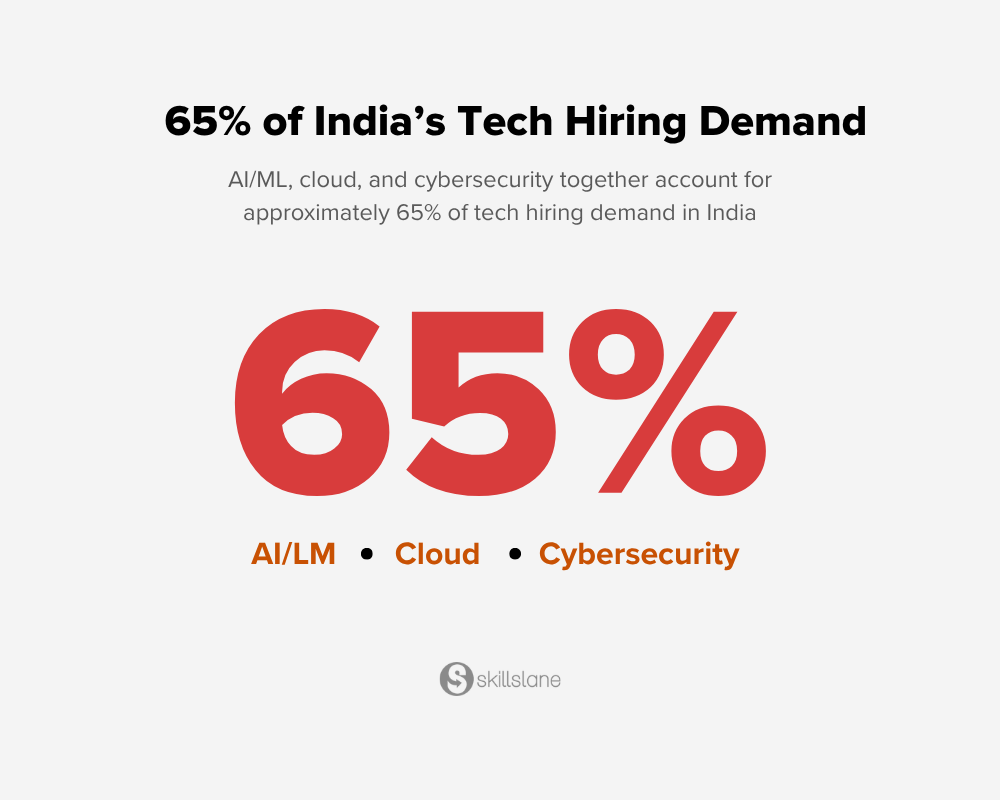
This gives you a good idea of where some of the strongest opportunities are concentrated.
Now let's get into the actual list.
1. AI/ML Engineer
An AI or machine learning engineer builds systems that allow computers to learn from data and make predictions, recommendations or decisions. They take AI concepts and turn them into working systems and products.
Their work can include recommendation engines, computer vision systems, large language models, and AI-powered applications. It’s one of the most prominent AI careers in 2026.
Salary Range:
In the table below, I have listed the experience-wise salary range for this role.
| Experience | Salary Range |
|---|---|
| 1-3 years | ₹9.2-10.2 LPA |
| 3-6 years | ₹13.1-14.5 LPA |
| 6-9 years | ₹19.2-21.2 LPA |
2. AI Research Scientist
An AI research scientist works on finding new ways to make AI systems better.
They may develop new algorithms, experiment with model architectures or study how AI systems learn.
Their work is usually more focused on research and experimentation than building everyday AI applications. It’s a highly specialized career for people interested in pushing AI forward.
Salary Range:
The experience-wise salary range for this role is mentioned in the table below
| Experience | Salary Range |
|---|---|
| 1-3 years | ₹16.3-70.3 LPA |
| 4-6 years | ₹25.6-27.4 LPA |
3. Data Scientist
A data scientist uses data to find useful answers to business and technical problems.
They might investigate why customers are leaving, predict demand, or identify patterns in large datasets.
Their work helps companies turn large amounts of information into useful insights. It’s a good fit if you enjoy working with data and solving practical problems.
Salary Range:
The table below shows the salary range for this role based on experience.
| Experience | Salary Range |
|---|---|
| 1-3 years | ₹11.3-12.5 LPA |
| 3-6 years | ₹14.9-16.5 LPA |
| 6-9 years | ₹20.4-22.5 LPA |
4. Data Engineer
Data engineers build the systems that collect, organize, store, and move data inside a company.
They make sure data is available when other teams need to analyze or use it.
Their work can support everything from business reporting to AI systems. Without reliable data infrastructure, many modern technology systems simply wouldn't work.
Salary Range:
The experience-wise salary range for this role is mentioned in the table below:
| Experience | Salary Range |
|---|---|
| 1-3 years | ₹7.7-8.5 LPA |
| 3-6 years | ₹11.3-12.5 LPA |
| 6-9 years | ₹17.7-19.5 LPA |
5. Cybersecurity Engineer
Cybersecurity Engineers work to protect a company's systems, applications, networks, and data from security threats.
They help identify vulnerabilities and respond when something goes wrong.
Their work can cover everything from protecting employee accounts to securing cloud environments.
As businesses become more dependent on technology, keeping those systems secure becomes increasingly important.
Salary Range:
Check the table below to know about the experience-based salary range for this role.
| Experience | Salary Range |
|---|---|
| 1-3 years | ₹7.5-8.3 LPA |
| 3-6 years | ₹8.7-9.6 LPA |
| 6-9 years | ₹14.4-16.2 LPA |
6. Cloud Engineer/Architect
Cloud Engineers build and maintain the cloud environments companies use to run their applications and services. Cloud architects focus on designing how these systems should fit together.
They help companies build infrastructure that can support applications, data, and other technology systems.
This makes cloud infrastructure an important part of modern tech.
Salary Range:
The experience-wise salary range for this role is mentioned in the table below:
| Experience | Salary Range |
|---|---|
| 1-3 years | ₹5.2-5.8 LPA |
| 3-6 years | ₹8-8.8 LPA |
| 6-9 years | ₹12-13.3 LPA |
7. DevOps Engineer
DevOps Engineers help companies build, test, and deploy software more efficiently. They connect development work with the systems needed to run that software reliably.
Their work involves automation, deployment, monitoring, and maintaining production environments.
The goal is to make software delivery faster and more dependable.
Salary Range:
I have listed the DevOps Engineer salary range in the table below.
| Experience | Salary Range |
|---|---|
| 1-3 years | ₹5.7-6.3 LPA |
| 3-6 years | ₹8.3-9.1 LPA |
| 6-9 years | ₹12.7-14 LPA |
8. Platform Engineer
Platform Engineers build internal tools and platforms that make it easier for developers to build and ship software.
Instead of having every developer manage infrastructure independently, they create systems that teams can share.
They essentially build the internal "roads" developers use to deliver software.
The role sits between software development, infrastructure, and operations.
Salary Range:
The experience-wise salary range for this role is mentioned in the table below:
| Experience | Salary Range |
|---|---|
| 1-3 years | ₹7-13 LPA |
| 4-6 years | ₹10-20 LPA |
| 7-9 years | ₹14-25 LPA |
9. MLOps Engineer
MLOps Engineers help take machine learning models from development into real-world production environments. They make sure models can be deployed, monitored and updated as needed.
Their work connects machine learning with the infrastructure needed to run it reliably. This becomes increasingly important as companies move AI systems from experimentation into actual products.
Salary Range:
If you want to know the experience-based salary range for MLOps engineer, just check the table below.
| Experience | Salary Range |
|---|---|
| 1-3 years | ₹6-12.7 LPA |
| 4-6 years | ₹10.3-21.8 LPA |
| 7-9 years | ₹13.8-25 LPA |
10. Computer Network Architect
Computer network architects design the systems that allow computers, applications, and devices to communicate with each other.
They may work on networks supporting cloud environments, data centers, and large organizations. Their work helps ensure that different systems can communicate reliably and securely.
It’s a less talked-about career, but an important part of modern technology infrastructure.
Salary Range:
The experience-based salary range for this role is mentioned in the table below:
| Experience | Salary Range |
|---|---|
| 1-3 years | ₹3.24-10.8 LPA |
| 4-6 years | ₹6-21.3 LPA |
| 7-9 years | ₹7-28.5 LPA |
What Makes a Tech Job High-Paying in 2026?
Before we get into the jobs themselves, let's take a step back.
What actually makes a tech job "high-paying"?
Salary is obviously part of it, but it isn't the whole story.
Demand, specialized skills, and your ability to grow in the role can all affect how much you earn over time.
High Earning Potential
Let's start with the obvious one: money.
Technology has some of the better-paying jobs in the market, especially when you move into areas like AI, cybersecurity, data, and cloud infrastructure.
Of course, that doesn't mean every person working in tech will earn six figures, there are some factors that have an effect on the pay, we'll look into these factors as we progress in the blog.
Strong Job Demand
Here's where things get more interesting.
A high salary is great, but you also want to know whether companies are actually hiring people with those skills.
Did you know that data scientists are projected to see 33.5% employment growth between 2024 and 2034.
That makes data science one of the fastest-growing areas in tech.
The World Economic Forum also lists AI and machine learning specialists, big data specialists, and software and application developers among the fastest-growing jobs through 2030.
So when you're comparing high-paying jobs in tech, don't just ask, "How much does this job pay?"
Ask: "Are companies going to need people who can do this work?"
Specialized Technical Skills
There is another pattern you might notice across many of the top-paying tech jobs.
Specialized skills tend to be valuable.
Someone who understands basic computer software and someone who can design a machine learning system are bringing very different levels of expertise to an employer.
The same applies to cybersecurity, cloud architecture, and data engineering.
This is why learning a specific technical skill can make such a big difference to your earning potential.
Long-Term Career Growth
Finally, think beyond your first job.
You might start as a junior engineer, gain experience, specialize in a particular area, and eventually move into senior or lead positions.
That's important because your first salary isn't necessarily the salary you'll have five years from now.
If I were choosing between two jobs, I'd look at where each one could take me next.
A good tech job should give you room to learn, specialize, and take on more responsibility.
There is a famous quote by Robert Greene that says,
"The future belongs to those who learn more skills and combine them in creative ways."
You don't have to know exactly where your career will take you today.
What matters is building skills that give you more options as the industry changes.
What Factors Affect Your Salary?
Now let's talk about what can actually affect how much you earn.
A high-paying tech job isn't automatically the best choice for everyone.
Research-focused roles.
For example, may offer high salaries but often require more advanced education and specialized skills.
Another role might pay slightly less but have more job openings and a more accessible path into the industry. There's also no single salary figure that applies to everyone.
Your country, company, experience, location and specific job title can all make a difference.
So, when you're comparing high-paying tech jobs, don't just look at the salary range. Look at the factors that can influence how much you could earn over time.
How Experience Affects Your Salary?
This one is pretty straightforward.
A beginner and someone with ten years of experience aren't usually going to earn the same amount, even if they have the same job title.
As you gain experience, you can take on harder problems, lead projects, specialize in a particular area or move into senior and management positions.
That's why I wouldn't get too obsessed with your starting salary.
Instead, ask yourself these questions:
- Can I become really good at this?
- Can I specialize?
- Will there be more advanced roles for me later?
These can tell you a lot more about your long-term earning potential.
How Location Affects Your Salary?
Where you work matters too.
A software engineer in one country may earn very differently from a software engineer doing almost identical work somewhere else.
Even within the same country, salaries can vary depending on the city, industry and employer.
This is especially important if you're considering remote jobs.
A company may hire globally but use different salary ranges depending on where an employee lives.
So whenever you see a salary figure online, check where that figure comes from.
Do You Need a Fancy Degree for a High-Paying Tech Job?
This is one of the first questions I would ask if I were starting from scratch.
And unfortunately, there isn't a one-word answer. Some jobs are much more education-heavy than others.
The important thing is to understand what your particular job expects.
Careers That Typically Require Advanced Degrees
AI research is the clearest example.
If you want to work on advanced AI research, a master's degree or PhD can be very useful and may be expected for many research positions.
The same basic idea applies to other highly specialized research roles.
So if you're looking at a job like AI research scientist, don't assume that a few online courses will put you on the same path as someone with years of advanced study.
Careers You Can Enter With a Bachelor's Degree
Many technical jobs can be entered with a bachelor's degree in computer science, information technology, engineering, mathematics or a related field.
Software development, data science, cybersecurity, cloud engineering, and other technical paths can fall into this category, although individual employers have different requirements.
And a degree isn't the only thing employers look at.
They also want to see whether you can actually do the work.
Certifications and Practical Experience
This is where projects, internships, certifications and hands-on experience can make a difference.
Let's say you're interested in cloud engineering.
It's one thing to say, "I completed a cloud course."
It's another thing to show a project where you actually built something using a cloud platform.
The same applies to cybersecurity, data engineering, software development, and many other jobs.
Your portfolio doesn't have to be huge.
A few thoughtful projects that show what you can actually do can be much more useful than a long list of courses you barely remember.
Conclusion
If you're looking for high paying tech jobs in 2026, you have plenty of options.
AI and machine learning are growing quickly, but they aren't the only opportunities. Data, cybersecurity, cloud infrastructure, software development and other technical areas continue to offer strong opportunities too.
I think the biggest mistake would be choosing a job simply because you saw a big salary attached to it. Instead, look at the whole picture.
Does the job have strong demand?
Can you build specialized skills?
And can you keep learning as the technology changes?
Because that last part matters more than ever.
The tech job you start with in 2026 may not look exactly the same five or ten years from now.
That's not necessarily a bad thing.
If you build strong technical foundations, learn how to solve problems and get comfortable working with new technology, you give yourself room to adapt.
And in an industry that changes as quickly as tech, I think the ability to keep learning may be one of the highest-paying skills of all.