AI is changing cybersecurity in two different ways.
Security teams are using AI to find threats, analyze large amounts of data, and speed up incident response.
At the same time, AI systems themselves have become something that security teams need to protect.
That second part is what I found particularly interesting while researching these courses.
You are no longer just learning how to use AI in cybersecurity.
You can also learn how to secure LLMs, test AI agents, protect RAG systems, and think about risks that do not really fit into traditional application security.
There is no single tool that solves the problem. You need to understand how these systems work, where they can go wrong, and what you can do when something does go wrong.
So, if you are looking to build skills in this area, I went through a range of current courses and picked options that cover different sides of AI cybersecurity.
List of AI Cybersecurity Courses
Here are the courses I would look at first:
- AI for Cybersecurity - Coursera
- AI & Cyber Security Mastery 2026 - Udemy
- LLM & Agentic AI Security - Udacity
- AI Threat Modeling and Operational Defense - Udacity
- AI Security and Risk Management - DataCamp
- Generative AI Risks & Cybersecurity: LLM Security - Udemy
- Artificial Intelligence (AI) Advantage: Elevating Cyber Defense - Mandiant Academy
- Security for Gen AI Integrations - Pluralsight
- AI for SOC Analysts - Pluralsight
- AI Agents for Cybersecurity - LinkedIn Learning
The courses are not all aimed at the same learner. Some start with the basics of AI and machine learning, while others assume you already understand cybersecurity and take you into LLM attacks, AI agents, and threat modeling.
Now let's take a look at each course in detail.
1. AI for Cybersecurity (Coursera)
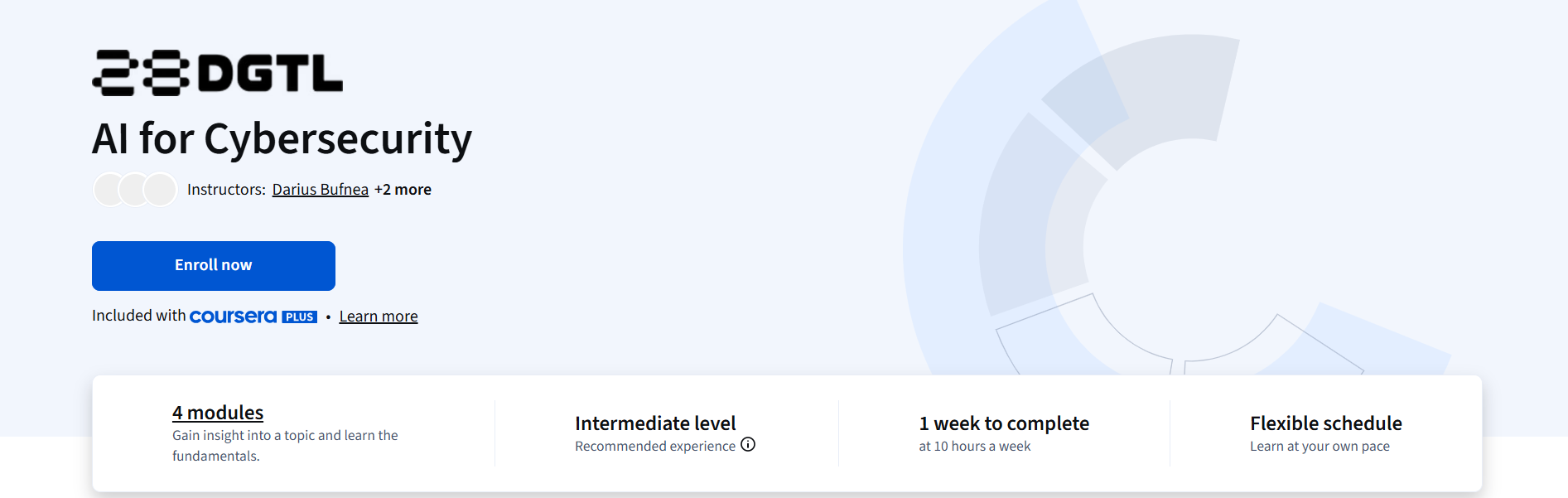
If you are looking for a course that explains the connection between AI and traditional cybersecurity properly, AI for Cybersecurity by Coursera is probably the one I would start with.
The course begins with AI and cybersecurity fundamentals before moving into machine learning techniques that can actually be used for security problems. What I liked here is that it does not stop at explaining what AI can do.
You get practical examples involving malware detection, intrusion detection, and spam filtering, with Python used to build and evaluate models.
What You Will Learn
- You will learn the fundamentals of artificial intelligence and machine learning and how they can be applied to cybersecurity problems.
- You will understand supervised, unsupervised, and reinforcement learning and where each approach can be useful in security.
- You will learn how machine learning can be used for tasks such as malware detection, intrusion detection, and spam filtering.
- You will get practical experience using Python to train and evaluate machine learning models.
- You will also build a better understanding of common cyber threats and the security controls used to defend against them.
Course Details
In the table below, I have listed some details about this course.
| Detail | Information |
|---|---|
| Level | Intermediate |
| Duration | Approximately 1 week |
| Format | 4 modules, flexible schedule |
| Price | Starts at $49 |
| Main Focus | AI and machine learning for cybersecurity |
Best for: Learners who want a solid foundation in using AI and machine learning for traditional cybersecurity problems.
2. AI & Cyber Security Mastery (Udemy)
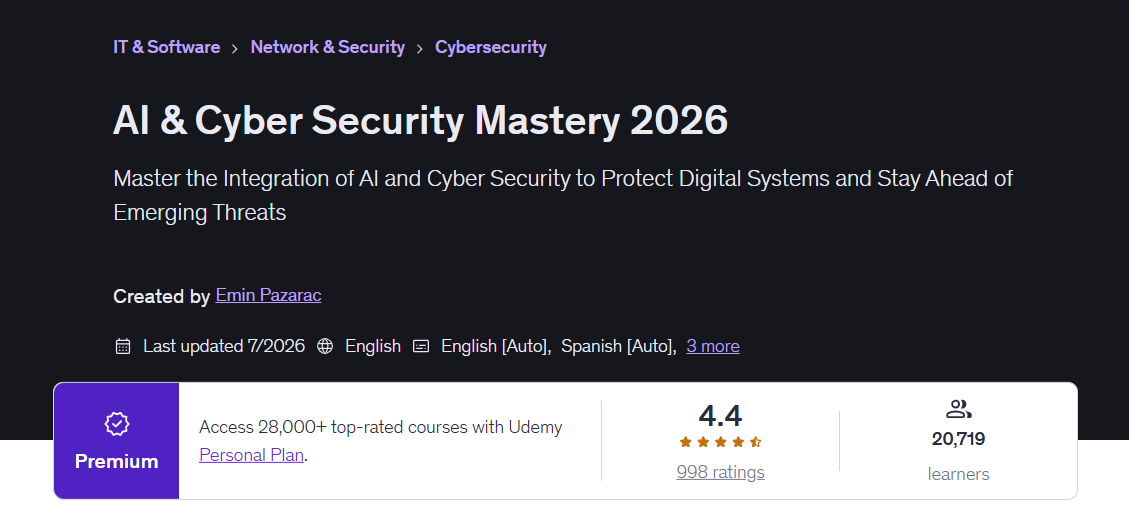
AI & Cyber Security Mastery by Udemy takes a much broader approach. Instead of focusing on just one part of AI security, it brings together AI, machine learning, and several cybersecurity tools.
It covers the use of AI for threat detection, prevention, and response, while also introducing tools such as TensorFlow, PyTorch, ChatGPT, Wireshark, Splunk, AWS GuardDuty, and VirtualBox.
Honestly, this makes it a more tool-heavy option than the Coursera course above. If you like learning by seeing where different technologies fit into an actual security workflow, this could be a better match.
What You Will Learn
- You will learn how AI can be used to support cybersecurity tasks such as threat detection, prevention, and response.
- You will be introduced to machine learning tools, including TensorFlow and PyTorch and see how they can be applied to security.
- You will explore cybersecurity tools such as Wireshark, Splunk, and AWS GuardDuty alongside AI-based techniques.
- You will learn how ChatGPT can be used for cybersecurity tasks, including automation and anomaly detection.
- You will also build foundational knowledge of AI and its role in cyber defense.
Course Details
In the table below, I have listed some details about this course.
| Detail | Information |
|---|---|
| Level | Suitable for Beginners |
| Duration | 3 hours 20 minutes |
| Format | Video-based online course |
| Price | $19.99 |
| Main Focus | AI, machine learning and practical cybersecurity |
Best for: Learners who want broad exposure to both AI technologies and hands-on cybersecurity tools.
3. LLM & Agentic AI Security (Udacity)
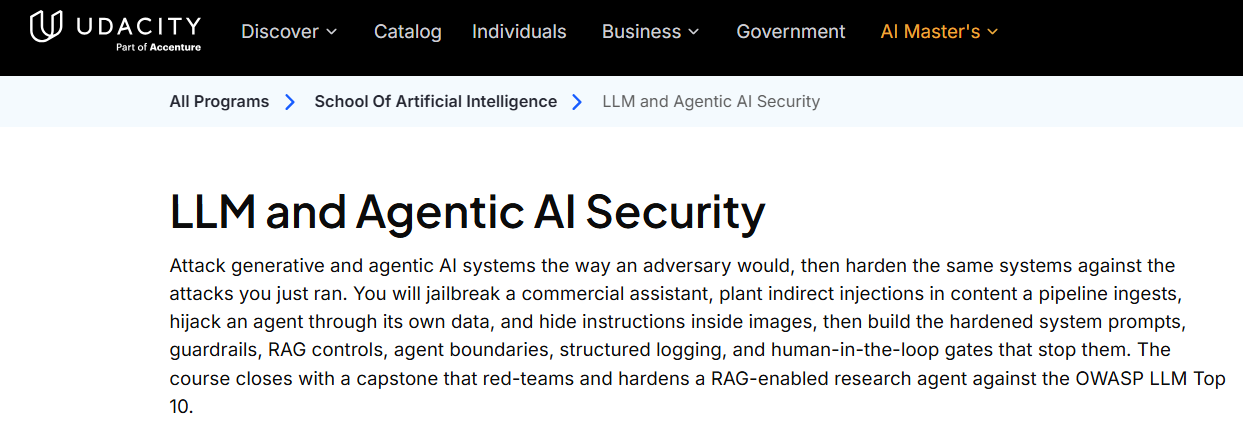
This is where the subject starts getting much more specific.
Instead of asking how AI can help a security team, LLM & Agentic AI Security by Udacity asks a different question: What happens when the AI system itself becomes the thing you need to secure?
You work through attacks such as jailbreaks, prompt injection, task hijacking, and token smuggling. The course then moves into defenses including guardrails, RAG access controls, agent boundaries, logging, and human approval workflows.
It ends with a project where you red-team and harden a RAG-enabled AI agent. What I found useful is that the course pairs attacks with defenses. You are not just reading about a vulnerability and moving on.
What You Will Learn
- You will learn how attackers can exploit LLMs through techniques such as jailbreaking, prompt injection, and task hijacking.
- You will explore ways to separate external content from system instructions so that untrusted data cannot easily manipulate an AI system.
- You will learn how to apply guardrails, RAG access controls, and agent boundaries to make AI applications safer.
- You will understand how human approval workflows and structured logging can be used when AI agents perform sensitive actions.
Course Details
In the table below, I have listed some details about this course.
| Detail | Information |
|---|---|
| Level | Intermediate |
| Duration | 23 hours |
| Format | Online course with hands-on project |
| Price | $249/month |
| Main Focus | LLM and agentic AI security |
Best for: Cybersecurity professionals and technically inclined learners who want hands-on experience securing LLM and AI-agent systems.
4. AI Threat Modeling and Operational Defense (Udacity)
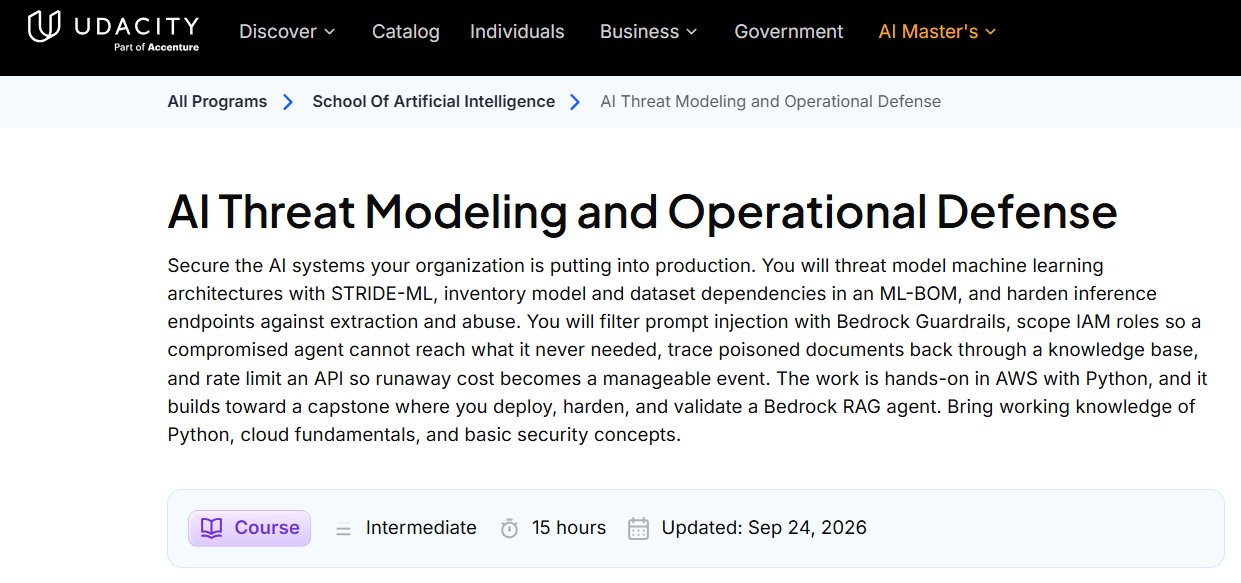
If the previous course is about attacking and hardening LLM and agentic systems, AI Threat Modeling and Operational Defense by Udacity takes a broader security-engineering approach.
You learn how to threat model machine learning systems, track model and dataset dependencies, secure inference endpoints, and control access to AI services.
The practical work uses AWS and Python, and the course builds towards a project involving an AWS Bedrock RAG agent. I would put this one slightly further along the learning curve.
It makes more sense once you already understand basic security and cloud concepts.
What You Will Learn
- You will learn how traditional threat modeling can be adapted to machine learning systems using STRIDE-ML.
- You will learn how to track models and datasets through an ML-BOM and understand where dependencies can create security risks.
- You will explore ways to protect AI inference endpoints from attacks such as model extraction and abuse.
- You will learn how IAM, least-privilege access, and input controls can reduce the damage caused by compromised AI agents.
- You will work with AWS, Python, and Bedrock while building and securing an AI system.
Course Details
In the table below, I have listed some details about this course.
| Detail | Information |
|---|---|
| Level | Intermediate |
| Duration | 15 hours |
| Format | Online course with hands-on project |
| Price | $249/month |
| Main Focus | AI threat modeling and operational defense |
Best for: Security engineers and cloud professionals who want to learn how to secure AI systems in production environments.
5. AI Security and Risk Management (DataCamp)
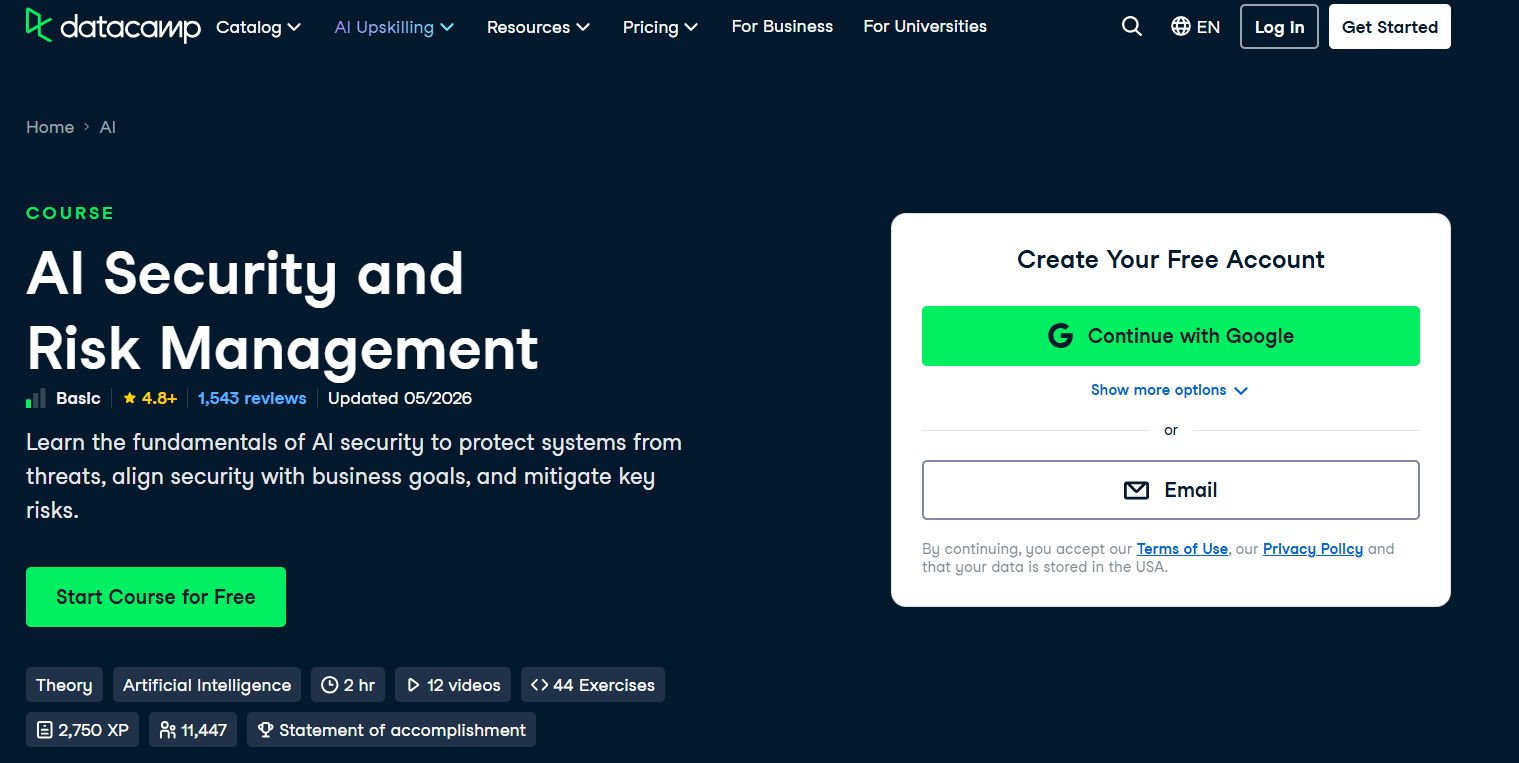
Not everyone needs to jump straight into prompt injection attacks and AI agents. AI Security and Risk Management by DataCamp takes a much more approachable route.
It introduces the security risks that come with AI and looks at how organizations can connect AI security with broader business goals and risk management.
There are no prerequisites, which makes it a good starting point if you are new to the subject. I think that makes this course useful for people who work around AI systems but do not necessarily have a deep technical security background.
What You Will Learn
- You will learn about security risks that are specific to artificial intelligence systems.
- You will explore how AI security decisions can be connected to wider business goals.
- You will learn how to assess AI risks from different perspectives rather than looking at technical vulnerabilities alone.
- You will explore practical ways organizations can identify and reduce AI-related security risks.
- You will build a basic understanding of how AI security fits into an organization's overall security approach.
Course Details
In the table below, I have listed some details about this course.
| Detail | Information |
|---|---|
| Level | Basic |
| Duration | Approximately 2 hours |
| Format | Online course with exercises |
| Price | Free |
| Main Focus | AI security and risk management |
Best for: Beginners, managers, and professionals who want to understand AI security risks before moving into more technical training.
6. Generative AI Risks & Cybersecurity: LLM Security (Udemy)
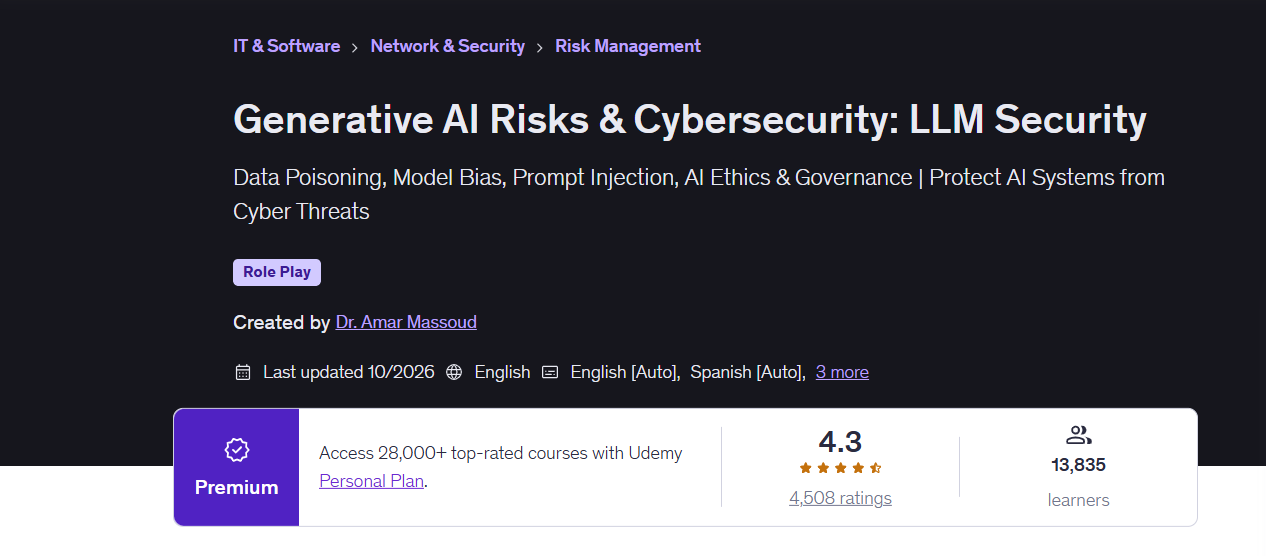
Generative AI has created a new set of security questions, and Generative AI Risks & Cybersecurity: LLM Security by Udemy focuses directly on them.
The course covers risks such as data poisoning, model bias, and prompt injection, while also looking at AI ethics, governance, and security controls.
If your interest is specifically GenAI and LLM security, you do not have to spend the entire course going back through general cybersecurity concepts.
What You Will Learn
- You will learn the core concepts behind generative AI and the cybersecurity risks associated with these systems.
- You will learn how to identify vulnerabilities that can affect AI systems.
- You will explore security measures for risks such as data poisoning and model bias.
- You will learn about ethical considerations and responsible practices when developing and using AI.
- You will explore AI governance frameworks and security controls for protecting generative AI deployments.
Course Details
In the table below, I have listed some details about this course.
| Detail | Information |
|---|---|
| Level | Intermediate |
| Duration | Approximately 5 hours |
| Format | Video-based online course |
| Price | $49.99 |
| Main Focus | Generative AI and LLM security |
Best for: Learners who want to focus specifically on cybersecurity risks in generative AI and LLM systems.
7. Artificial Intelligence (AI) Advantage: Elevating Cyber Defense (Mandiant Academy)
Artificial Intelligence (AI) Advantage: Elevating Cyber Defense - Mandiant Academy takes a different angle from most of the options on this list. Instead of mainly teaching you how to attack AI systems, it focuses on using AI as a cybersecurity defender.
The training looks at practical applications for cyber defenders and threat intelligence analysts, including intelligence collection, IOC analysis, preliminary malware analysis, and vulnerability identification.
There is one detail worth pointing out here. Mandiant describes this as an 8-hour training track divided into three courses, rather than one single course.
What You Will Learn
- You will learn the differences between artificial intelligence, generative AI, machine learning, and large language models.
- You will explore how prompt engineering can be used for cybersecurity work and where its limitations are.
- You will see how tools such as Gemini, NotebookLM, and Colab can support cyber defense tasks.
- You will learn how AI can help with tasks such as IOC analysis, intelligence research, malware analysis, and vulnerability identification.
- You will also explore some of the risks associated with using AI and LLMs within an organization.
Course Details
In the table below, I have listed some details about this course.
| Detail | Information |
|---|---|
| Level | Not specified |
| Duration | 8 hours |
| Format | On-demand training track |
| Price | Free |
| Main Focus | AI for cyber defense |
Best for: Cybersecurity professionals who want to use AI to improve everyday defensive and threat-intelligence work.
8. Security for Gen AI Integrations (Pluralsight)
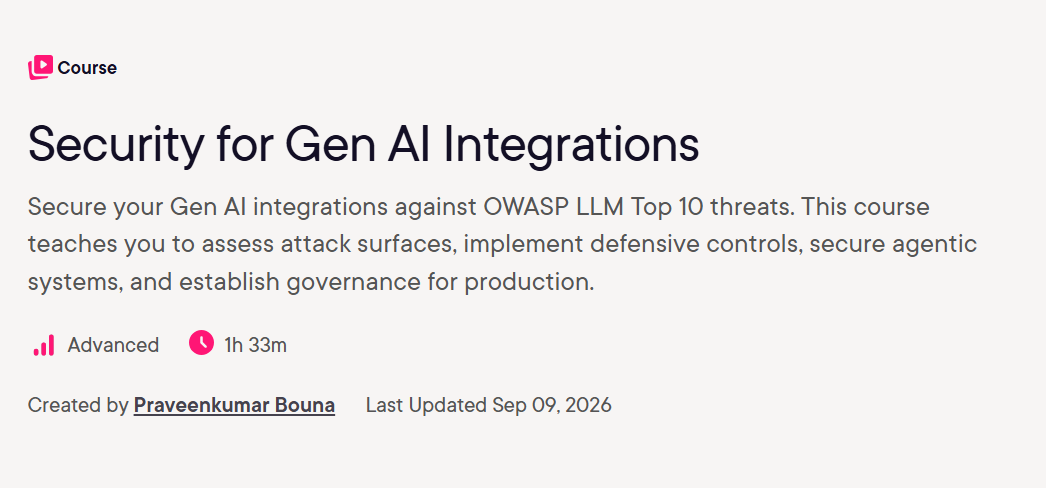
Security for Gen AI Integrations by Pluralsight is one of the more technically focused courses on the list. The course looks at the security problems created when organizations integrate generative AI into applications.
It uses the OWASP LLM Top 10 as part of its approach and covers threat modeling, prompt injection, sensitive information disclosure, defensive controls, and agentic systems.
The course also gets into practical controls. You learn about input validation, output filtering, data masking, system prompt hardening, and permission scoping rather than just learning what the vulnerabilities are.
What You Will Learn
- You will learn how to assess the security threat surface of generative AI integrations using the OWASP LLM Top 10.
- You will explore ways to defend against prompt injection and sensitive information disclosure.
- You will learn how input validation, output filtering, data masking, and system prompt hardening can improve LLM security.
- You will understand how agentic systems introduce additional risks around permissions and excessive agency.
- You will learn how logging, monitoring, and incident response can be adapted for generative AI security events.
Course Details
In the table below, I have listed some details about this course.
| Detail | Information |
|---|---|
| Level | Advanced |
| Duration | 1 hour 33 minutes |
| Format | Online course |
| Price | Free Trial with Membership options available* |
| Main Focus | GenAI security, threat modeling and agentic systems |
Note: To know more about Pluralsight's pricing packages, check it out!
Best for: Experienced developers and security professionals who want to secure generative AI applications and integrations
9. AI for SOC Analysts (Pluralsight)
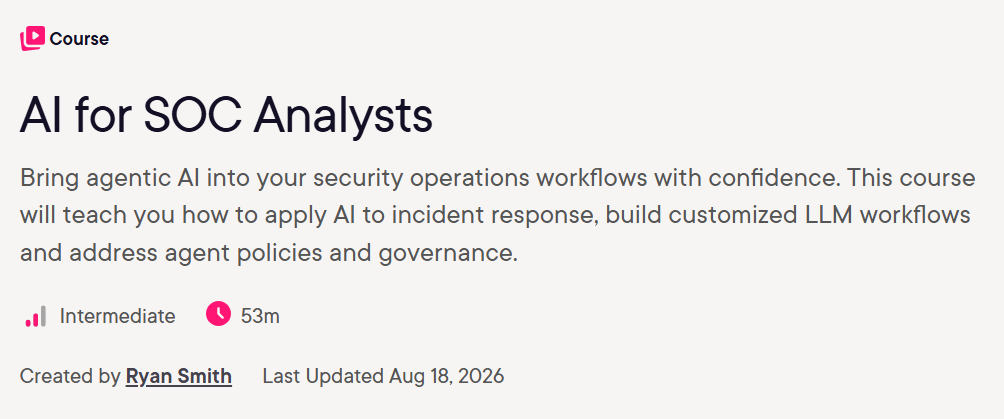
Security Operations Centers deal with a huge amount of information, so this is an area where AI can have a very practical role. AI for SOC Analysts by Pluralsight focuses on bringing agentic AI into SOC workflows, particularly incident response.
It also looks at customized LLM workflows and the policies and governance needed when AI agents become part of security operations.
What You Will Learn
- You will learn where agentic AI can fit into the security operations and incident response process.
- You will explore how AI can support SOC teams without treating the technology as a replacement for the entire security workflow.
- You will learn how customized LLM workflows can be built for security operations.
- You will explore how Delta, an open-source cybersecurity automation platform, can be used with customized LLM workflows.
- You will learn about AI-agent policies and governance in a SOC environment.
Course Details
In the table below, I have listed some details about this course.
| Detail | Information |
|---|---|
| Level | Intermediate |
| Duration | 53 minutes |
| Format | Online course |
| Price | Free Trial with Membership options available |
| Main Focus | Agentic AI in SOC operations |
Best for: SOC analysts and security professionals who want a practical introduction to using agentic AI in security operations.
10. AI Agents for Cybersecurity (LinkedIn Learning)
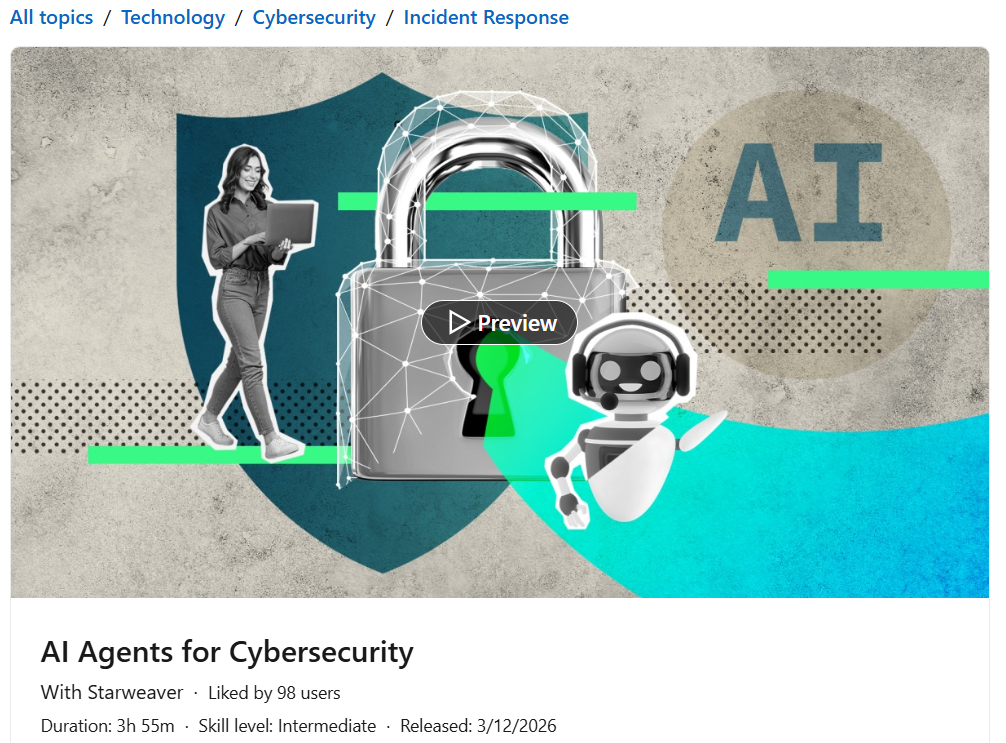
AI agents are becoming a bigger part of the conversation around cybersecurity, and AI Agents for Cybersecurity by LinkedIn Learning focuses specifically on that area. It starts with the fundamentals of AI agents and then moves into their use in Security Operations Centers.
The course covers threat detection, vulnerability analysis, incident response, and threat hunting, while also discussing the security and ethical considerations involved in using autonomous AI systems.
What You Will Learn
- You will learn what AI agents are and how they differ from more basic AI-assisted security tools.
- You will explore how AI agents can support threat detection and vulnerability analysis.
- You will learn how AI agents can assist with incident response and proactive threat hunting.
- You will understand how these systems can be integrated into Security Operations Centers.
- You will also explore the security and ethical considerations that come with deploying autonomous AI systems in cybersecurity.
Course Details
In the table below, I have listed some details about this course.
| Detail | Information |
|---|---|
| Level | Intermediate |
| Duration | 3 hours 55 minutes |
| Format | Online course |
| Price | $379.88/license/year |
| Main Focus | AI agents for cybersecurity |
Best for: Security analysts, SOC managers, and cybersecurity professionals who want to understand how AI agents can be used in defensive security work.
Conclusion
One thing I kept thinking about while researching these courses is how quickly the definition of an AI cybersecurity skill is changing.
A few years ago, you could probably get away with thinking about AI in cybersecurity mainly in terms of machine learning models spotting unusual activity.
Now, someone working in this area may need to understand prompt injection, RAG systems, AI agents, model security, threat modeling, and even how much autonomy an AI system should be allowed to have.
That makes me think the smartest way to choose a course is not to chase the newest AI term. Look at where you want to work first. If you want to work in a SOC, learn how AI fits into security operations.
If you are interested in application security, LLM security will probably be more useful. If you are moving towards security engineering, threat modeling and AI infrastructure deserve more attention.
And if you are interested in governance or risk, you do not necessarily need to start by learning how to build an AI agent.
Personally, I would rather complete one course that gives me a skill I can actually use than collect five course certificates that all cover the same basic AI concepts. The field is moving too quickly for passive learning to be enough.
The more useful question is not “What AI course should I take?” but “What security problem do I want to be able to solve with AI?”
That is the question I would keep in mind before picking one.