

If you have already started learning prompt engineering, you might eventually find yourself looking at certifications. Learning the skill is one thing, but having something to show for it is another.
Many prompt engineering certifications are available now, but they don't all follow the same format. Some focus specifically on prompt engineering, while others include it as part of a broader AI certification.
The exam format, learning requirements, cost, and topics covered can also vary quite a bit.
So, if you are looking to get certified in prompt engineering, I have shortlisted four certifications worth looking into.
List of Prompt Engineering Certifications
Below is the list of prompt engineering certifications we'll be looking at in this blog:
- Prompt Engineering Foundation - CPEFPC by CertiProf
- AI+ Prompting Practitioner by AI CERTs
- Certified Prompt Engineering Certification by GSDC
- Star Prompt Engineering Certification by STAR Certification
Now let's get into them one by one.
1. Prompt Engineering Foundation - CPEFPC by CertiProf
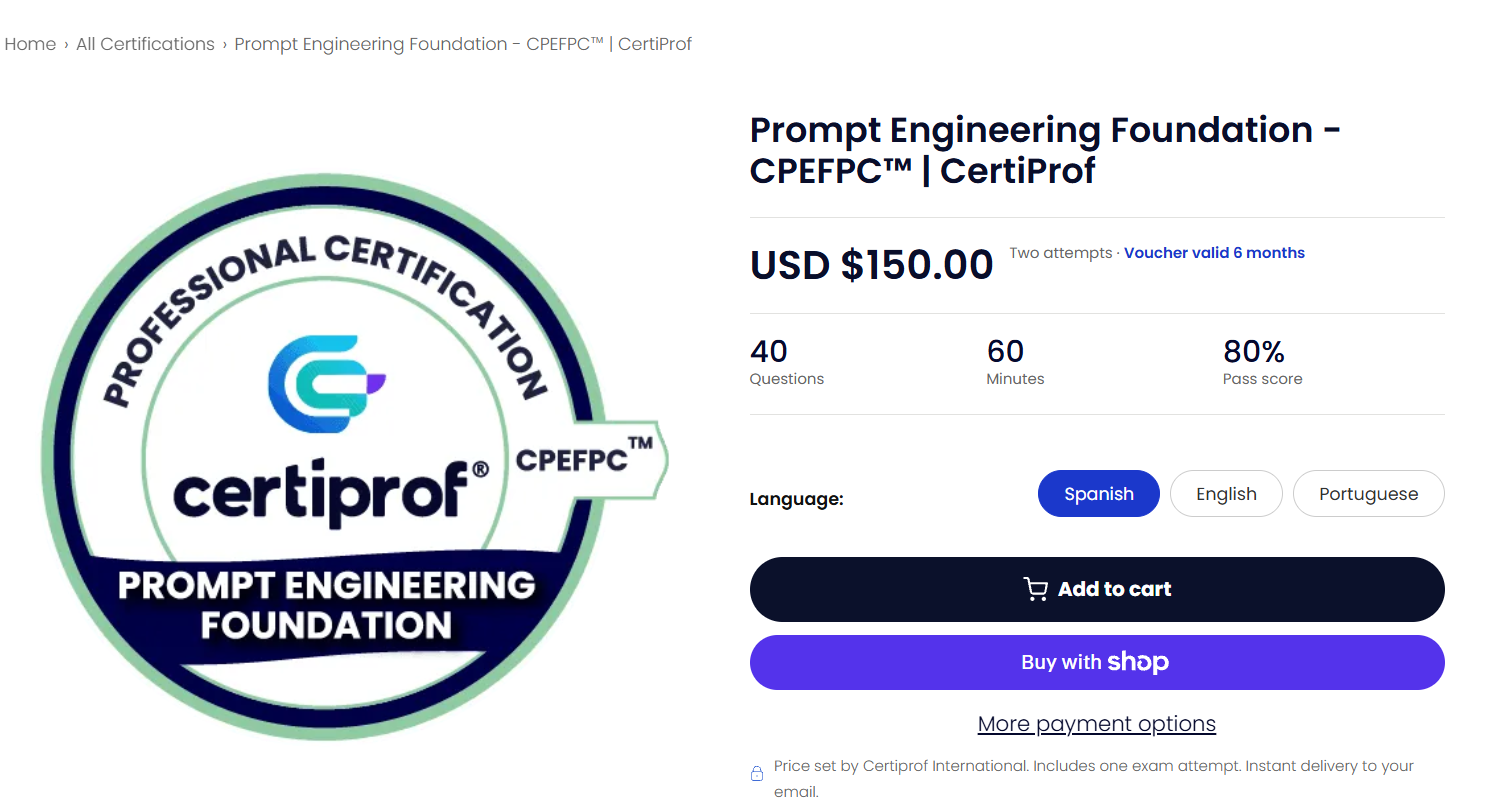
CertiProf's Prompt Engineering Foundation Professional Certification (CPEFPC) focuses specifically on prompt engineering and working with AI systems.
The certification covers designing, optimizing, and managing prompts for large language models and generative AI tools. It also looks at applying prompt engineering to areas like automation, content generation, and data analysis.
What the Certification Covers
Here's what you'll cover in the certification:
- How to put together clear, structured prompts for large language models.
- Ways to improve your prompts so the responses are more accurate, relevant, and useful.
- How to tweak your prompts when you want more control over what the AI gives you.
- Ways to use prompt engineering across business, marketing, and technical use cases.
- How to structure instructions to get consistent and repeatable AI responses.
- Ways to reduce ambiguity and improve output quality.
- Ways to adapt prompts for different AI models and environments.
The certification assesses prompt engineering fundamentals, techniques, applications, and prompt optimization.
Exam Details
The following are the certification details:
| Details | Information |
|---|---|
| Platform | CertiProf |
| Level | Foundation |
| Exam | 40 multiple-choice questions |
| Duration | 60 minutes |
| Passing Score | 80% |
| Certificate | Digital certification and LinkedIn badge |
The exam is conducted online with remote proctoring. CertiProf states that candidates have six months from the date of purchase to take the exam.
2. AI+ Prompting Practitioner™ by AI CERTs
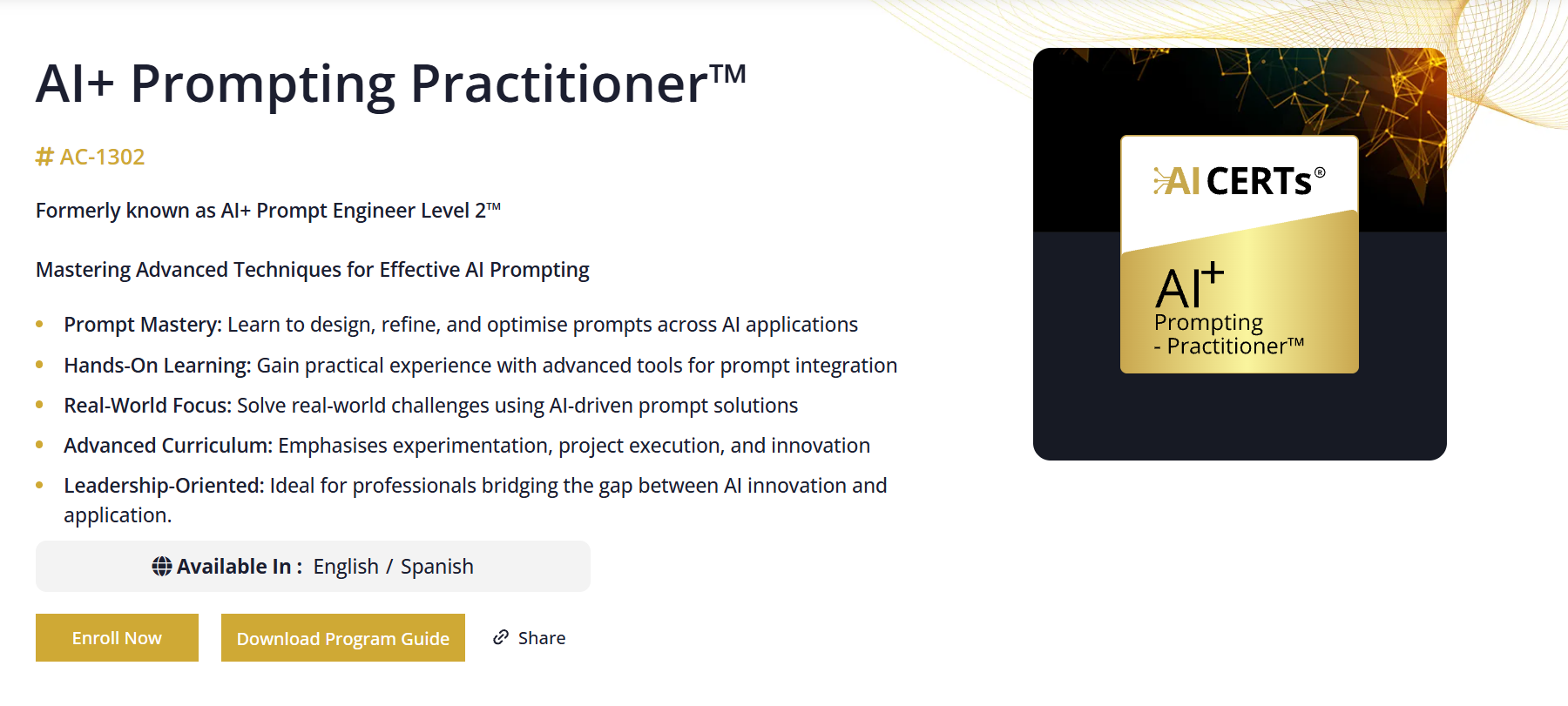
The AI+ Prompting Practitioner certification from AI CERTs focuses on advanced prompt engineering techniques and their practical application.
The certification covers prompt creation and optimization, experimentation, development tools, AI solutions, and project-based work.
What the Certification Covers
Here are the things this certification will cover.
- Explore more advanced ways of working with prompts.
- Learn how to create and fine-tune prompts for different needs.
- Work with development tools to bring prompts into your projects.
- See how prompting can be used in different fields and situations.
- Try out different approaches and see how you can improve your prompts.
- Use prompting to build AI-based solutions.
- Get practical experience through AI projects.
The program also covers areas like prompt structures, multi-turn interactions, contextual and conditional prompting, domain-specific prompts, prompt optimization, and project-based learning.
Exam Details
The following are the certification details:
| Details | Information |
|---|---|
| Platform | AI CERTs |
| Level | Advanced |
| Exam | 50 multiple-choice/multiple-response questions |
| Duration | 90 minutes |
| Passing Score | 70% |
| Certificate | Industry-recognized credential and digital badge |
The program is available in instructor-led and self-paced formats. It also includes labs, projects, and case studies.
3. Certified Prompt Engineering Certification by GSDC
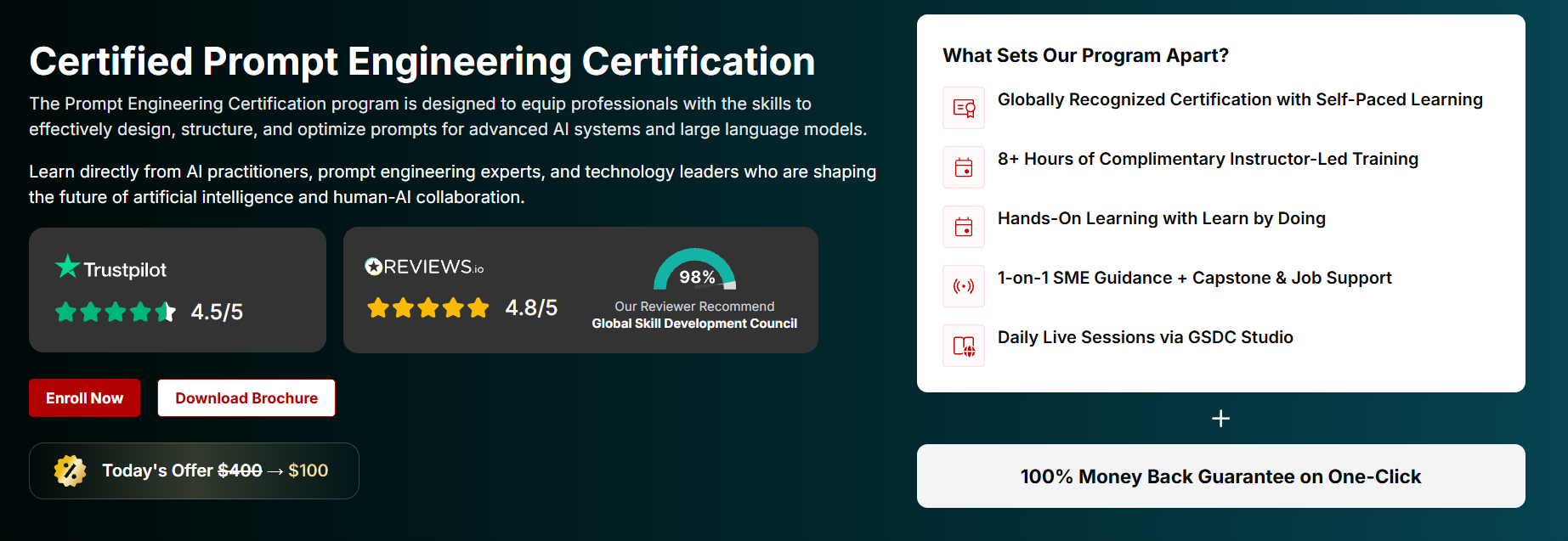
GSDC's Certified Prompt Engineering Certification focuses on designing, structuring, and optimizing prompts for advanced AI systems and large language models.
The program combines self-paced learning with live sessions, hands-on learning, subject matter expert sessions, and a capstone project.
What the Certification Covers
The certification starts with the basics and then moves into different ways of building and working with prompts. You will
- Get familiar with the basics of prompt engineering.
- Understand how large language models respond to the instructions you give them.
- Learn how to write prompts that can produce more accurate results.
- Understand the different parts that make up a prompt and how to use them effectively.
- Try out zero-shot, one-shot, and few-shot prompting.
- Learn about structured prompts and different prompt frameworks.
- Work with context and control how the final output is formatted.
- Explore more advanced prompting techniques.
- Look at where prompt engineering can actually be used in practice.
- Understand some of the ethical considerations around using AI.
- See how prompt engineering can be applied in enterprise settings.
The program also includes topics like role prompting, step-by-step prompting, self-reflection, self-critique, prompt chaining, and other prompting techniques.
Exam Details
The table below lists the key exam details.
| Details | Information |
|---|---|
| Platform | GSDC |
| Level | Not specified |
| Exam | 40 multiple-choice questions |
| Duration | 90 minutes |
| Passing Score | 65% |
| Certificate | Certified Prompt Engineering Certification |
The exam is in English and is closed-book. GSDC also lists one complimentary retake with the certification.
4. Star Prompt Engineering Certification by STAR Certification
The Star Prompt Engineering Certification from STAR Certification focuses on the fundamentals of prompt engineering, language models, prompting techniques, model evaluation, practical applications, and ethical considerations.
It is designed for beginners in both IT and non-IT domains who have limited or no prior knowledge of AI.
What the Certification Covers
Here are the topics that will be covered in this certification exam.
- Get a basic understanding of how machine learning and deep learning work.
- Explain what prompt engineering is and where it could be headed in the future.
- Work with language models using different prompts.
- Understand the four pillars of prompt perfection.
- Create effective prompts and try image-prompting techniques.
- Explore different OpenAI applications and evaluate the responses they produce.
- Experiment with different prompts and work on making their results more reliable.
- Understand how prompt engineering can be used in real-world situations.
The course outline contains 23 topics, starting with the basics of large language models and AI.
Then it moves into prompt engineering techniques, OpenAI applications, prompt reliability, model evaluation, advanced prompt engineering, fine-tuning, responsible AI, and practical applications.
Exam Details
The following are the certification details:
| Details | Information |
|---|---|
| Platform | Star Certification |
| Level | Beginner |
| Exam | 60 multiple-choice questions |
| Duration | 90 minutes |
| Passing Score | 70% |
| Certificate | Global Certificate |
The exam code is S03-101, and the exam is conducted in English. STAR Certification lists the recommended experience as beginner level.
Conclusion
There is a lot more to prompt engineering than simply learning how to write a good prompt for an AI tool. Once you start looking at certifications, you can see how differently the field is being approached.
Some programs stay close to the fundamentals, while others bring in development, advanced prompting techniques, practical projects, or topics like model evaluation and responsible AI.
So before signing up for a certification, I'd actually spend some time looking through the syllabus and exam details. Think about what you want to get out of it.
Are you trying to understand the basics? Do you want something more advanced? Or are you looking for a program that gives you a chance to actually practice what you're learning?
The certificate itself is useful to have, but the skills you pick up while preparing for it are probably what you'll end up using the most.
Other useful certifications and courses: