

You don't have to be a programmer to start learning AI. Maybe you want to understand how it works, get familiar with generative AI, or see how AI-powered applications are built.
Whatever your interest, edX has courses that let you explore these areas without having to figure out where to begin on your own.
There are six handpicked edX courses in this blog, containing both standalone courses and Professional Certificate programs. Let's look at what you'll learn in each one and see what best fits your interests.
List of the Best AI Courses on edX
Here is the list of the 6 best AI Courses on edX.
- IBM: AI for Everyone: Master the Basics
- CodeSignal: AI Literacy 101
- Pragmatic AI Labs: Introduction to Generative AI
- IBM: Generative AI for Software Developers Professional Certificate
- IBM: Generative AI for Data Engineering Professional Certificate
- Georgia Tech: Foundations of Generative AI
Let's look into each course in detail.
1. IBM: AI for Everyone: Master the Basics
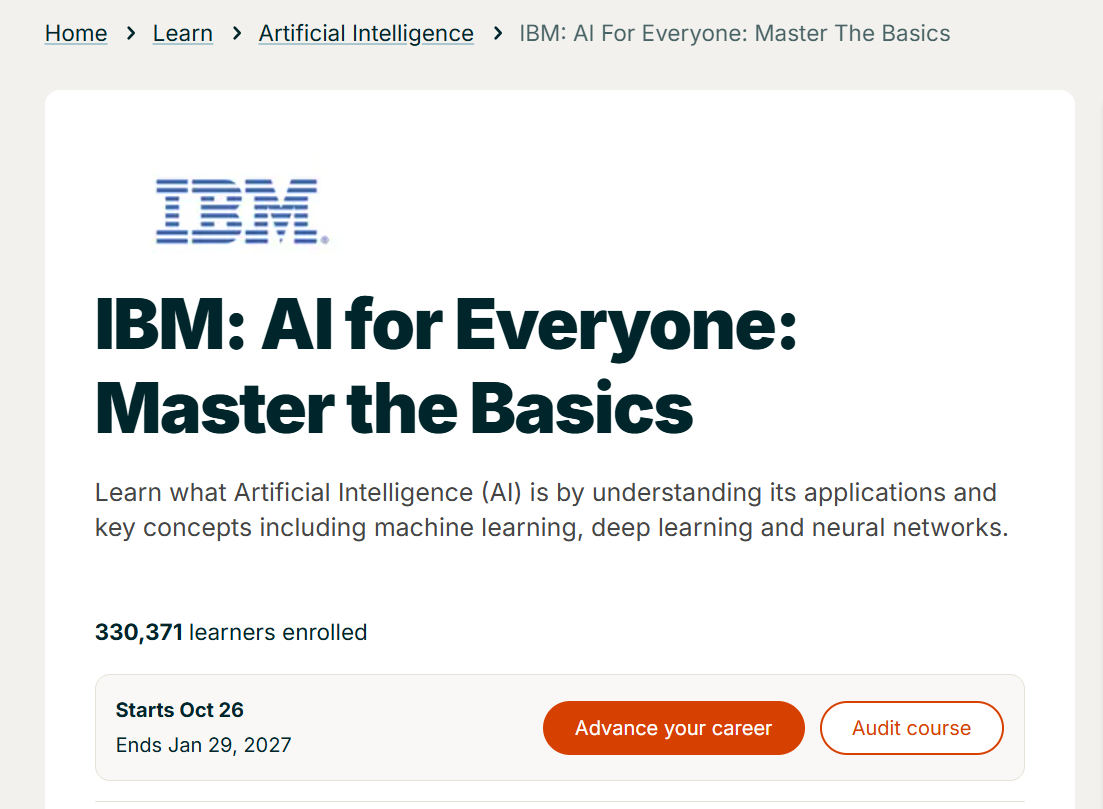
If you're new to AI, you don't need to start with programming or complicated mathematical concepts. IBM's AI for Everyone: Master the Basics introduces the subject through its applications, core concepts, and impact on everyday life.
The course covers artificial intelligence, machine learning, deep learning, and neural networks. It also explores ethical concerns, including bias and AI's impact on society.
What I like about this course is that it doesn't assume you have a technical background. You can use it to understand what AI can do, where it's being used, and what you might want to learn next.
Course Details
| Detail | Information |
|---|---|
| Level | Introductory |
| Duration | 4 weeks, 1 to 2 hours per week |
| Cost | $99 |
| Format | Self-paced online course |
| Certificate | Yes |
What You'll Learn
- Understand what artificial intelligence is and how it's used in different industries.
- Learn the difference between machine learning, deep learning, and neural networks.
- Explore ethical concerns surrounding AI, including bias and its effects on society.
- Get advice on learning AI and exploring possible career paths.
- Work through a mini project that demonstrates AI in action.
Best for: Beginners who want to understand AI without needing programming experience.
2. CodeSignal: AI Literacy 101
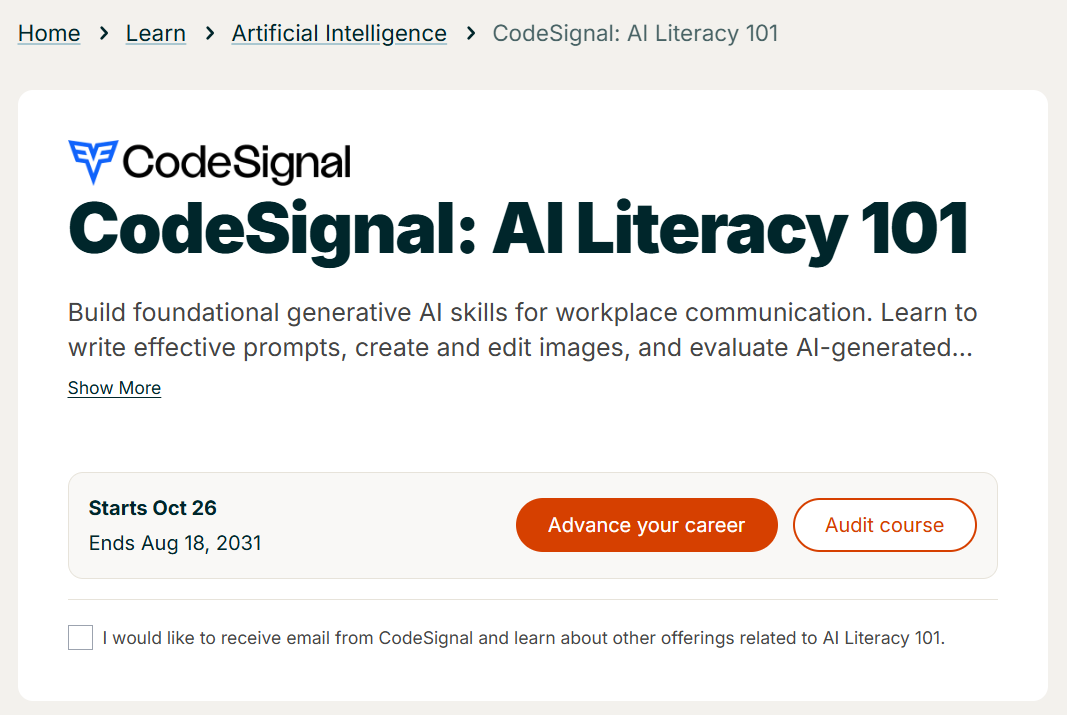
You don't have to become an AI engineer to benefit from learning about artificial intelligence.
If you use AI tools for studying, writing, research, or work, understanding how they function and where they fall short can help you use them more effectively.
CodeSignal's AI Literacy 101 is an introductory course designed to build foundational AI knowledge. It is part of CodeSignal's collection of practical, skills-focused courses available on edX.
CodeSignal uses an interactive, browser-based learning environment across its course offerings, allowing learners to practice concepts rather than relying entirely on video lessons.
Course Details
| Detail | Information |
|---|---|
| Level | Introductory |
| Duration | 1 week |
| Cost | Check the current course listing |
| Format | Online learning through CodeSignal's interactive learning environment |
| Certificate | Yes |
What You'll Learn
- Understand what AI is and where it's used in everyday life.
- Get comfortable with common AI terms and concepts without getting lost in the technical side of things.
- Build a starting point for learning more advanced AI topics later on.
- See how AI can be useful in everyday tasks, both at work and outside it.
Best for: Students and working professionals who want to understand the basics of AI without spending weeks on a lengthy course.
3. Pragmatic AI Labs: Introduction to Generative AI
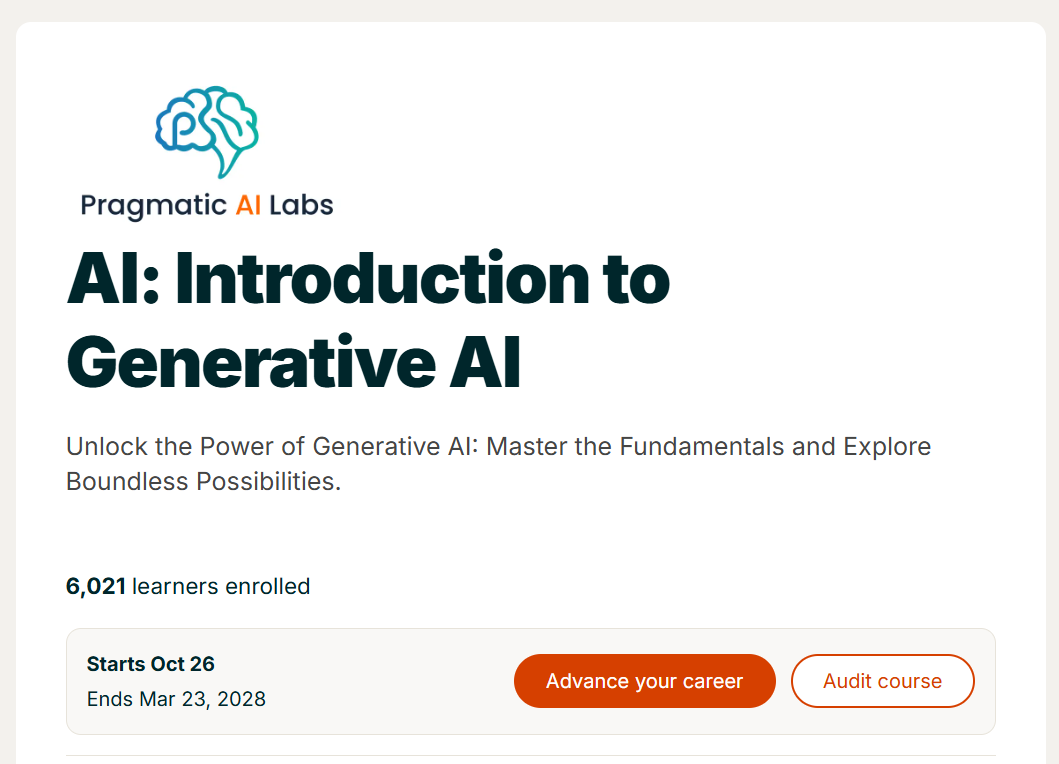
There's a lot more to generative AI than what you see on the screen. Behind every response or image is a process that involves training models on data and learning patterns from it.
That's what Introduction to Generative AI by Pragmatic AI Labs sets out to explore. The course introduces you to the ideas behind generative AI and helps you understand the technology beyond just using the tools.
It's part of Pragmatic AI Labs' broader collection of courses on edX, which also covers topics such as machine learning and software development.
If you've been wanting to learn how generative AI works but find advanced topics a bit overwhelming, this course is a good place to start. It helps you get comfortable with the basics before moving on to more specialized areas of AI.
Course Details
| Detail | Information |
|---|---|
| Level | Introductory |
| Duration | 3 weeks |
| Cost | Verify the price |
| Format | Online course |
| Certificate | Yes |
What You'll Learn
- Explore the fundamentals of generative AI and how it differs from other AI approaches.
- Understand common uses of generative AI across different fields.
- Build a foundation for learning more about generative models and AI applications.
- Prepare for more specialized topics such as large language models and AI development.
Best for: Learners who want to explore generative AI before moving on to technical or application-focused training.
4. IBM: Generative AI for Software Developers Professional Certificate
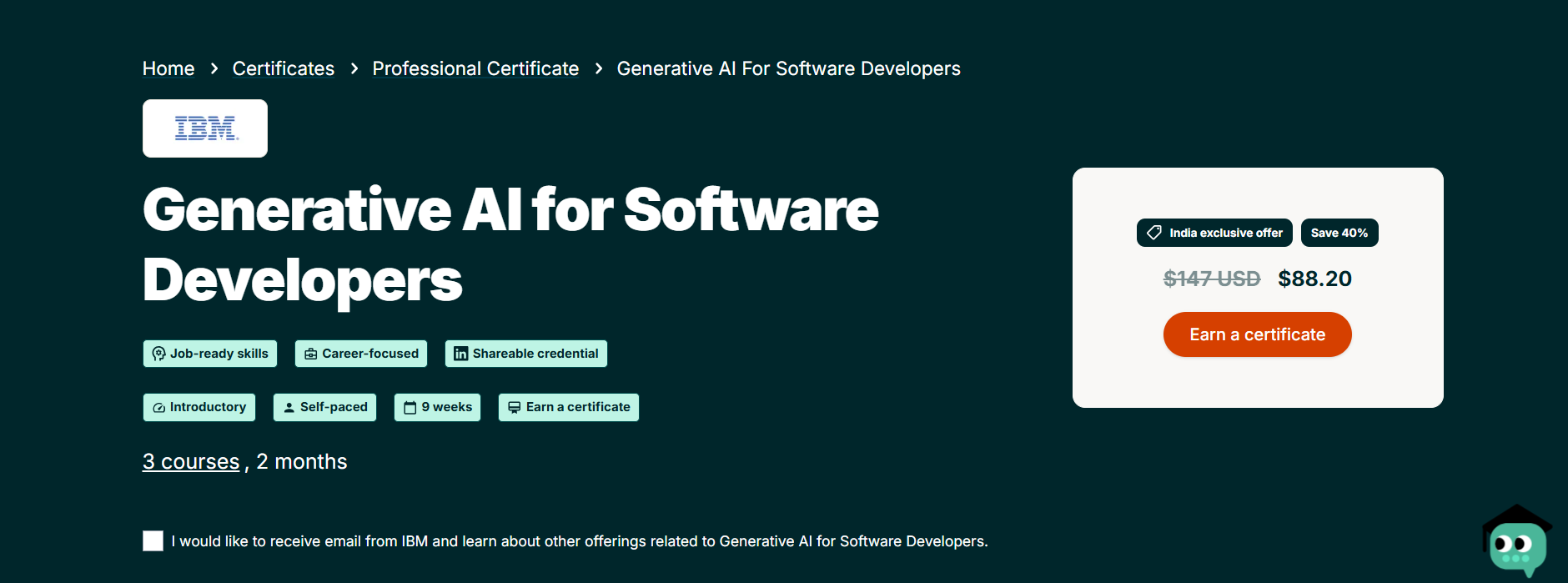
If you're already working in software development, generative AI can be useful for more than answering questions or generating snippets of code. It can also help with writing tests, exploring solutions, and building applications.
IBM's Generative AI for Software Developers Professional Certificate looks at how developers can use generative AI in their work.
It includes three courses that cover generative AI basics, prompt engineering, and building software with AI. What I like about this program is that it connects AI concepts to actual software development tasks.
Instead of just learning about generative AI, you'll get an idea of how these tools can help with coding and other parts of the development process.
Program Details
| Detail | Information |
|---|---|
| Level | Introductory |
| Duration | 2 months |
| Cost | $147 |
| Format | Self-paced online program |
| Certificate | Yes |
Courses Included in the Program
The Professional Certificate contains three skill-building courses.
1. Introduction to Generative AI
This course introduces the fundamentals of generative AI and its applications.
- Understand the difference between generative and discriminative AI.
- Explore common generative AI tools and their real-world uses.
- Learn how generative AI is being applied across industries.
2. Introduction to Prompt Engineering
Prompt engineering involves writing instructions that help an AI model produce useful, relevant outputs.
- Understand the fundamentals of prompt engineering.
- Explore techniques for writing clearer and more effective prompts.
- Understand how to write prompts that get you more useful results from generative AI tools.
3. Mastering Generative AI for Software Development
This course focuses on applying generative AI to software engineering tasks.
- Explore how generative AI can help generate code, scripts, and test cases.
- Learn how AI tools and large language models can support software development.
- Understand how to apply generative AI to practical engineering problems.
Best for: Software developers who want to use generative AI tools more effectively in their development workflows.
5. IBM: Generative AI for Data Engineering Professional Certificate
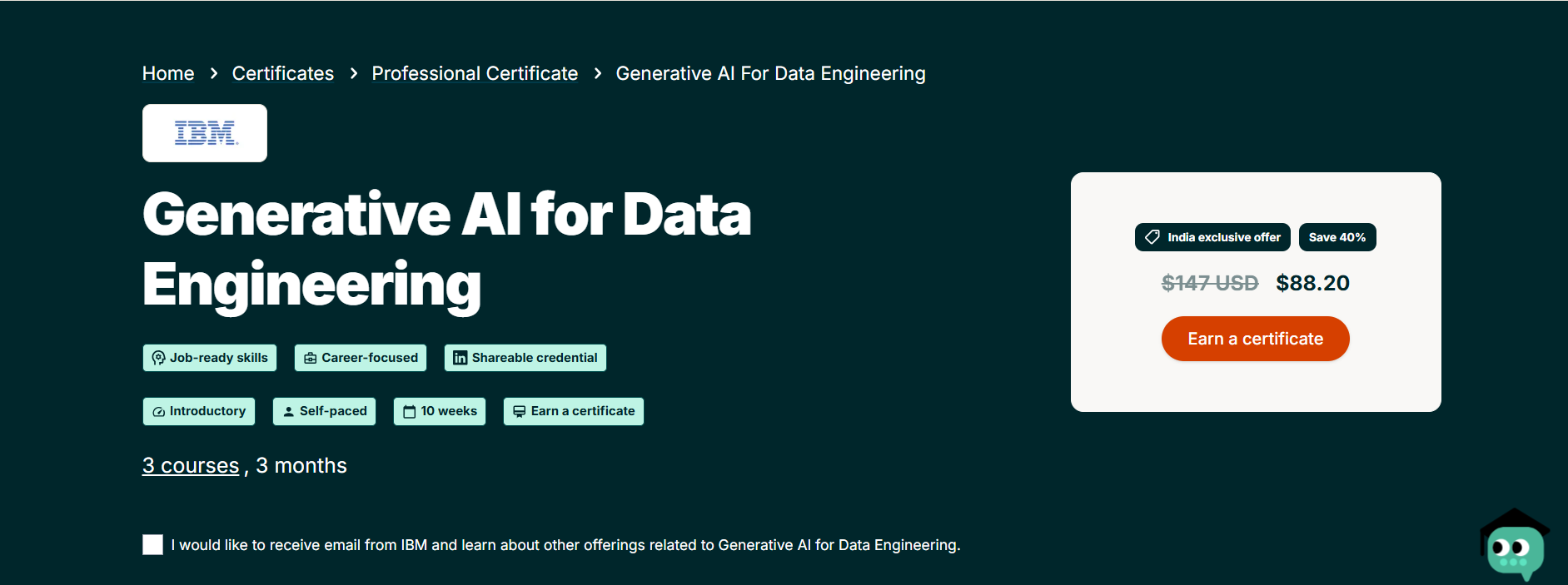
Generative AI has uses beyond chatbots and content creation. It can also help with everyday data engineering work, from preparing data to generating test data and working with data pipelines.
IBM's Generative AI for Data Engineering Professional Certificate looks at how these applications work in practice.
It consists of three courses that cover generative AI basics, prompt engineering, and ways to use generative AI in data engineering. If you're already learning data engineering, this program gives you a chance to explore how AI fits into the field.
Rather than covering AI applications across every industry, it focuses on data-related tasks, making it a more relevant option for those who want to bring generative AI into their data engineering work.
Program Details
| Detail | Information |
|---|---|
| Level | Introductory |
| Duration | 3 months |
| Cost | $147 |
| Format | Self-paced online program |
| Certificate | Yes |
Courses Included in the Program
The program contains three skill-building courses.
1. Introduction to Generative AI
This course establishes the basics of generative AI before you explore its applications in data engineering.
- Understand how generative AI works and how it differs from discriminative AI.
- Explore generative AI tools for producing text, code, images, audio, and video.
- Learn about common applications of generative AI.
2. Introduction to Prompt Engineering
This course shows you how to write better prompts to get more relevant and useful responses from generative AI tools.
- Understand the basics of prompt engineering and why the way you phrase a prompt matters.
- Try different prompting techniques to get clearer, more accurate, and relevant results from AI tools.
- Understand how to apply prompting techniques to data-related tasks.
3. Mastering Generative AI for Data Engineering
This course explores how generative AI can support practical data engineering work.
- Learn how generative AI can support data generation, augmentation, and anonymization.
- Explore the use of AI tools in data engineering workflows.
- Understand how data warehouse design and infrastructure fit into these applications.
Best for: Data engineers and data professionals who want to explore practical uses of generative AI in their field.
6. Georgia Tech: Foundations of Generative AI
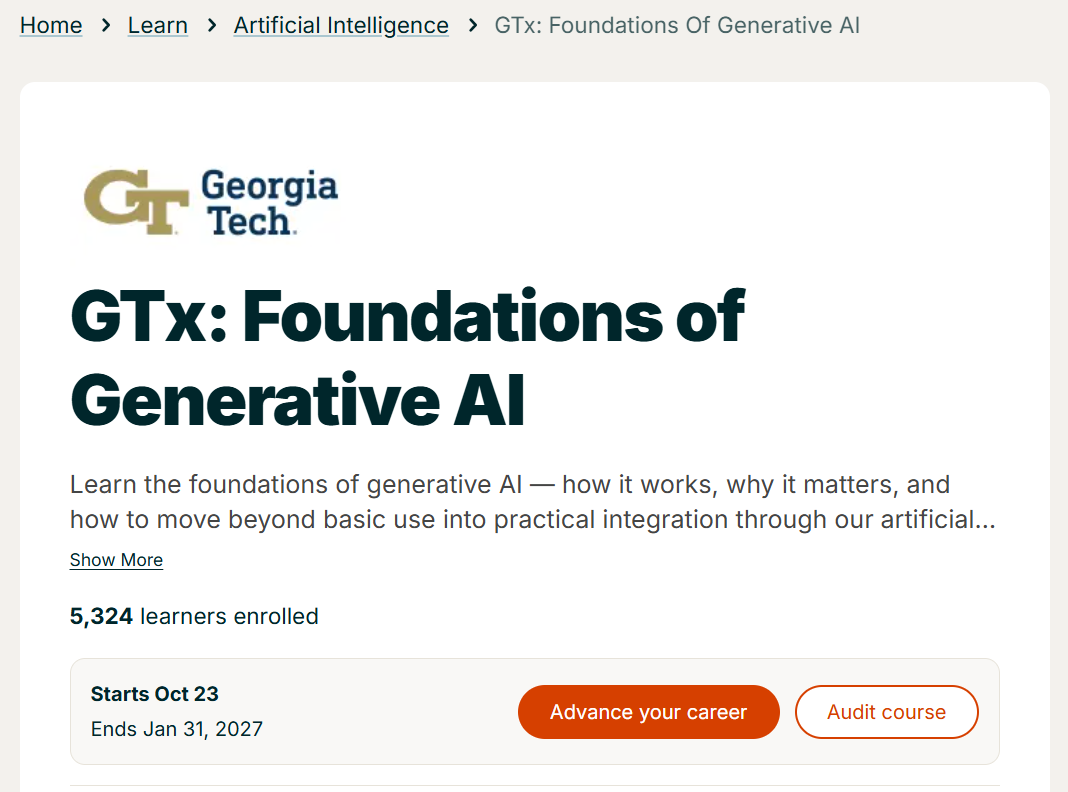
If you want to go beyond using generative AI tools and understand the technology behind them, Georgia Tech's Foundations of Generative AI is worth a look.
The course introduces generative AI through ten modules, starting with the history of AI and moving into the concepts that make modern generative models work.
You'll explore neural networks, transformers, attention mechanisms, model training, and fine-tuning.
The course also examines the strengths and limitations of generative AI, including the ethical questions that arise when these systems are used in real applications.
One detail worth mentioning is that the course itself uses generative AI tools for parts of its instruction, interactive exercises, and grading.
That makes it an interesting example of the technology being used in the learning experience, not just taught as a subject.
Course Details
| Detail | Information |
|---|---|
| Level | Introductory |
| Duration | 3 weeks |
| Cost | $90 for the certificate track |
| Format | Self-paced online course |
| Certificate | Yes |
What You'll Learn
- Trace the development of AI, from classical approaches to modern generative models.
- Understand how generative AI produces text, images, code, and other forms of content.
- Get familiar with tokens, context windows, and how AI models predict the words that come next.
- See how neural networks and transformer models work together to generate text and other content.
- Find out how AI models are trained, fine-tuned, and adjusted to give responses that better match what people need.
- Examine the practical applications, limitations, and ethical considerations of generative AI.
Best for: Learners who want a deeper understanding of generative AI without starting with an advanced technical course.
Conclusion
Learning AI can look a little different for everyone.
You might come across it because it's relevant to your job, because you've been curious about how it works, or simply because you want to understand what people are talking about when they bring it up.
I think it's worth looking beyond the usual buzz around AI and getting to know what the technology can actually do.
You don't need to understand every technical detail, but knowing its limitations as well as its uses can help you make better decisions about when to rely on it and when not to.
You might end up wanting to learn more about how AI works, or you might just want to get better at using it for your work. Either way, you can take it at your own pace and see what interests you along the way.
You never know which bit of knowledge might come in handy later.