
If you have spent any time looking at cybersecurity certifications, you have probably noticed something slightly frustrating: there are a lot of them, and they do not all prove the same thing.
One certification might test whether you understand security fundamentals. Another might expect you to investigate an incident. Another could put you in a simulated environment and ask you to actually find and exploit vulnerabilities.
Then there are certifications that are built around managing security at an organizational level or securing a particular cloud platform. That difference is easy to miss when you are just looking at certification names.
So, instead of putting together a list based only on popularity,
I looked at what these certifications actually test, who they are designed for, and where they fit into a cybersecurity career.
The result is a mix of certifications for different kinds of security work, from foundational knowledge and security operations to penetration testing, cloud security, and senior-level security management.
If you're trying to figure out which cybersecurity certification is actually worth pursuing, this should give you a much clearer place to start.
List of Top Cybersecurity Certifications
Here are the eight certifications covered in this guide:
- CISSP - Certified Information Systems Security Professional
- ISACA Certified Cybersecurity Operations Analyst (CCOA)
- CompTIA Security+ V7
- Certified Ethical Hacker (CEH)
- CompTIA CySA+
- OffSec Certified Professional (OSCP/OSCP+)
- AWS Certified Security - Specialty
- HTB Certified Defensive Security Analyst (CDSA)
These certifications are not meant to be taken in one particular order. The right starting point depends on your current experience and the kind of Cybersecurity role you want to move into.
Now let's get into each certification one by one.
1. CISSP - Certified Information Systems Security Professional
The CISSP is one of the most established certifications in cybersecurity, but it is not an entry-level credential.
ISC2 positions CISSP for experienced security professionals, managers, architects, consultants, and others who need a broad understanding of information security.
The certification covers eight areas, including security and risk management, asset security, security architecture, IAM, security operations, and software development security.
With CISSP, you are not preparing for a certification that focuses on just one technical skill. You are expected to understand how different parts of an organization's security program fit together.
CISSP also has an experience requirement. You need five years of full-time work experience across at least two of its eight security domains. If you have a relevant degree or an approved certification, you can get one year waived.
Candidates without the required experience can take the exam and become an Associate of ISC2 while they work toward the experience requirement.
Exam Topics Covered
- Security and risk management, including security policies, risk assessment, and business continuity.
- Asset security, including data classification, handling, and protection.
- Security architecture, engineering, networking, identity and access management, and security assessment.
- Security operations, including incident response, monitoring, and recovery.
- Software development security and security considerations throughout the development lifecycle.
Certification Details
I have provided the certification details in the following table.
| Detail | Information |
|---|---|
| Level | Advanced |
| Exam Format | Computerized Adaptive Testing (CAT) |
| Duration | Up to 3 hours |
| Price | $749 in the Asia Pacific and other listed regions |
| Main Focus | Enterprise security, risk management, architecture, operations, and leadership |
Best for: Experienced cybersecurity professionals who want a broad, senior-level security certification.
2. ISACA Certified Cybersecurity Operations Analyst (CCOA)
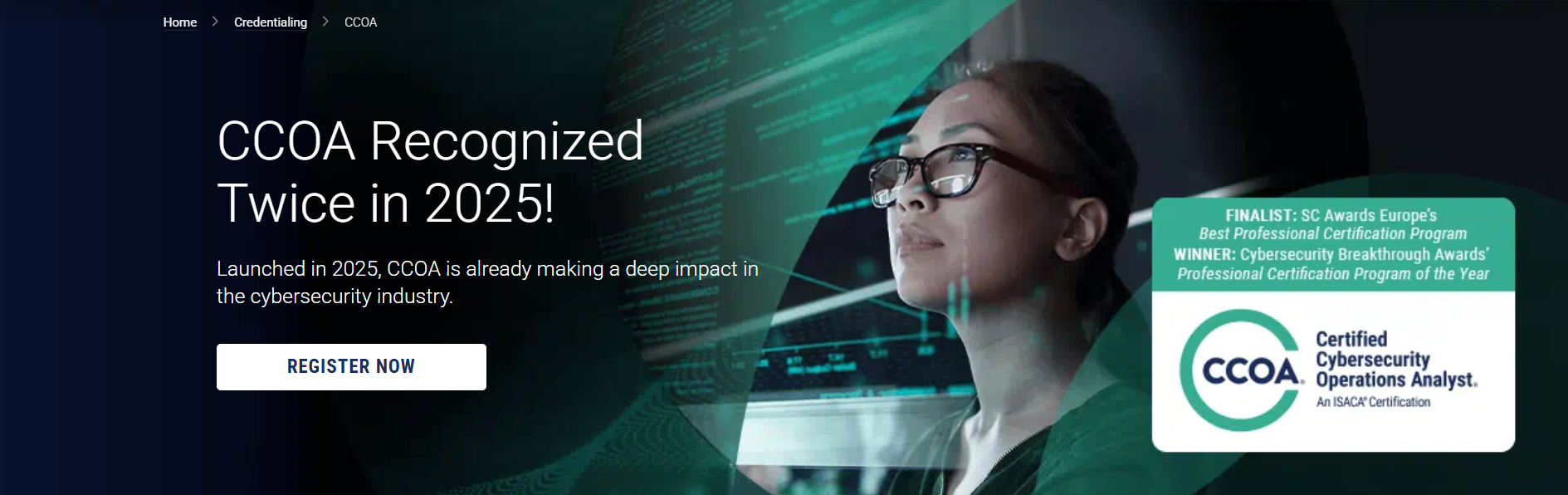
The CCOA is a newer certification from ISACA, and it takes a much more operations-focused approach.
Instead of concentrating mainly on broad security management, the certification looks at what cybersecurity analysts actually need to do when monitoring systems, investigating threats, responding to incidents, and protecting assets.
Along with the usual multiple-choice questions, you also have performance-based questions, so you actually have to show that you can use what you've learned.
The exam covers five domains, starting with technology essentials and cybersecurity principles before moving into adversarial tactics, incident detection and response, and securing assets.
Exam Topics Covered
- Technology essentials, including networking, databases, virtualization, containers, command-line interfaces, programming, and scripting.
- Cybersecurity principles and how security risks affect an organization's systems and assets.
- Adversarial tactics, techniques, and common approaches used by attackers.
- Incident detection and response, including investigation, triage, forensic support, and incident documentation.
- Asset security and the measures used to protect organizational systems and information.
Certification Details
Here are a few details you should know before taking this exam.
| Detail | Information |
|---|---|
| Level | Intermediate |
| Exam Format | Multiple-choice and performance-based questions |
| Duration | 4 hours |
| Price | US$399 for ISACA members; US$499 for non-members |
| Main Focus | Cybersecurity operations, threat detection, incident response, and asset security |
Best for: Aspiring and practicing security analysts who want a certification focused on hands-on cybersecurity operations.
3. CompTIA Security+ V7
If you are just getting started with cybersecurity, Security+ is probably the certification I would look at first.
The current Security+ V7 exam, SY0-701, covers the fundamentals you would expect from a broad cybersecurity certification, including threats, vulnerabilities, security architecture, security operations, identity and access management, and governance.
What I like about Security+ is that it does not force you into a niche too early.
You get exposure to several areas of security before deciding whether you want to move toward SOC work, cloud security, penetration testing, governance, or something else.
The exam can contain up to 90 questions and includes both multiple-choice and performance-based questions.
Exam Topics Covered
- General security concepts, including security controls, authentication, and security architecture.
- Threats, vulnerabilities, attack techniques, and appropriate mitigation measures.
- Secure network and system architecture, cloud concepts, virtualization, and infrastructure security.
- Security operations, including monitoring, incident response, vulnerability management, and identity and access management.
- Security governance, risk management, compliance, policies, and security program management.
Certification Details
I've listed some exam details below, take a look.
| Detail | Information |
|---|---|
| Level | Beginner to intermediate |
| Exam Format | Multiple-choice and performance-based questions |
| Duration | 90 minutes |
| Price | Around US$439 for the exam voucher |
| Main Focus | Core cybersecurity concepts, threats, security operations, and risk management |
Best for: Beginners and IT professionals who want a broad foundation before specializing in cybersecurity.
4. Certified Ethical Hacker (CEH)
If penetration testing and ethical hacking are what attracted you to cybersecurity in the first place, CEH is one of the certifications you are likely to come across.
The current CEH version includes 20 modules covering areas such as reconnaissance, scanning, system hacking, malware threats, social engineering, web application security, and cryptography.
The current version also incorporates AI-related skills and tools. The standard certification exam is a four-hour knowledge exam with 125 multiple-choice questions.
There is also an optional six-hour practical examination with 20 real-world challenges. Completing both exams can lead to the CEH Master credential.
I would separate the standard CEH certification from the CEH Master credential when comparing them. They demonstrate different levels of practical assessment.
Exam Topics Covered
- Reconnaissance and scanning techniques used to identify information about targets and potential attack surfaces.
- Enumeration, system hacking, vulnerability identification, and common attack methods.
- Malware threats, social engineering, web application security, wireless security, and cryptography.
- Hacking tools, methodologies, and techniques used to identify security weaknesses.
- Practical ethical hacking challenges involving the identification and exploitation of vulnerabilities, if attempting the optional practical exam.
Certification Details
I have mentioned the details in the following table.
| Detail | Information |
|---|---|
| Level | Intermediate |
| Exam Format | Multiple-choice knowledge exam, with an optional practical exam |
| Duration | 4 hours for the knowledge exam |
| Price | Varies by training and exam package |
| Main Focus | Ethical hacking, penetration testing, attack techniques, and defensive security |
Best for: Learners who want to move into ethical hacking, penetration testing, or offensive security.
5. CompTIA CySA+
Security+ gives you a broad foundation. CySA+ takes you further into the work of actually identifying and responding to security threats.
The certification is built around security operations, vulnerability management, incident response, and reporting. The current CySA+ V4 exam is CS0-004, which launched in June 2026.
If you're familiar with the basics of cybersecurity and want to get into security analysis, CySA+ is a natural next step.
It focuses on the kind of work security analysts do, from spotting suspicious activity to investigating threats and responding to incidents.
Exam Topics Covered
- Security monitoring, threat detection, and the identification of suspicious activity across systems and networks.
- Vulnerability management, including vulnerability identification, prioritization, and remediation.
- Incident response procedures, investigation techniques, and the handling of security incidents.
- Threat intelligence, security analytics, and techniques used to detect and investigate potential attacks.
- Security reporting, documentation, and communication of findings to relevant stakeholders.
Certification Details
In the following table, I have mentioned some information that you should know.
| Detail | Information |
|---|---|
| Level | Intermediate |
| Exam Format | Multiple-choice and performance-based questions |
| Duration | 165 minutes |
| Price | Around US$439 |
| Main Focus | Security operations, vulnerability management, incident response, and reporting |
Best for: Security analysts, SOC professionals, and cybersecurity practitioners moving beyond foundational knowledge.
6. OffSec Certified Professional (OSCP/OSCP+)
OSCP is a very different kind of certification from Security+ or CISSP. It is heavily practical and focuses on penetration testing.
Instead of simply answering questions about vulnerabilities, you are expected to identify and exploit vulnerabilities in a controlled environment and document what you did.
The current OSCP+ examination gives candidates 23 hours and 45 minutes to work through a simulated network environment.
The exam includes standalone machines and an Active Directory set, and candidates must submit professional documentation of their work. That makes OSCP particularly interesting if you learn better by doing rather than memorizing.
Exam Areas Assessed
- Identifying vulnerabilities in target systems and determining how they can be exploited.
- Gaining initial access to vulnerable machines and escalating privileges.
- Assessing standalone machines and Active Directory environments in a simulated network.
- Applying penetration-testing techniques to work through unfamiliar systems and security challenges.
- Documenting the testing process, exploitation steps, evidence, and findings in a professional penetration-testing report.
Certification Details
I have provided the details in the following table.
| Detail | Information |
|---|---|
| Level | Advanced |
| Exam Format | Practical, performance-based penetration-testing exam |
| Duration | 23 hours 45 minutes, plus 24 hours for documentation submission |
| Price | Varies by OffSec package |
| Main Focus | Penetration testing, vulnerability exploitation, privilege escalation, and Active Directory |
Best for: People who specifically want to work in penetration testing or offensive security.
7. AWS Certified Security - Specialty
Cloud security is its own area of cybersecurity, and this certification is aimed specifically at people working with AWS environments. AWS Certified Security - Specialty validates skills around securing workloads and architectures on AWS.
The exam covers areas such as data protection, encryption, secure internet protocols, and AWS security mechanisms. This is not the certification I would recommend to someone who has never worked with AWS.
It becomes much more useful when you already have some cloud experience and want to specialize in security.
Exam Topics Covered
- Securing AWS workloads and cloud architectures through appropriate security controls.
- Data protection, including data classification, encryption, and protection mechanisms available within AWS.
- Identity and access management, including access controls and permissions across AWS environments.
- Security monitoring, logging, and the detection and investigation of security-related events.
- Infrastructure protection, secure network configurations, and the use of AWS security services.
Certification Details
I have mentioned a few certification details in the following table.
| Detail | Information |
|---|---|
| Level | Advanced |
| Exam Format | Multiple-choice and multiple-response questions |
| Duration | 170 minutes |
| Price | US$300 |
| Main Focus | AWS cloud security, data protection, encryption, and secure cloud architectures |
Best for: Cloud professionals, security engineers, and cybersecurity practitioners working with AWS environments.
8. HTB Certified Defensive Security Analyst (CDSA)
Not every cybersecurity certification puts you in front of a set of multiple-choice questions. With HTB CDSA, you have to get your hands dirty and work through practical security tasks.
Hack The Box designed this certification around the kind of work security analysts do, including investigating threats, handling incidents, and working in a Security Operations Center (SOC).
The certification is aimed at entry-level security analysts, SOC analysts, incident handlers, and other professionals who want practical defensive-security skills. One of the biggest differences here is the examination itself.
HTB does not use multiple-choice questions for this certification. Candidates perform actual security analysis and incident-handling activities in a realistic environment and must also produce a professional security incident report.
Before taking the exam, candidates must complete the full SOC Analyst job-role path, which currently contains 15 modules and hands-on assessments.
Practical Skills Assessed
- Investigating security events and identifying indicators of malicious activity.
- SIEM operations, log analysis, and security analytics used in defensive security.
- Threat hunting, network traffic analysis, and Active Directory attack analysis.
- Malware analysis, digital forensics, and incident response activities.
- Preparing professional security incident reports that document investigative findings and supporting evidence.
Certification Details
I have provided details in the following table.
| Detail | Information |
|---|---|
| Level | Intermediate |
| Exam Format | Hands-on practical examination |
| Duration | Not specified as a fixed exam duration |
| Price | US$490 including the related path and exam |
| Main Focus | Security analysis, SOC operations, threat hunting, and incident handling |
Best for: Aspiring SOC analysts, security analysts, incident handlers, and professionals who want a practical blue-team certification.
Conclusion
While researching these certifications, one thing I kept coming back to was how much cybersecurity has expanded beyond simply knowing how to protect a network. You can see that just by looking at what the certifications are testing.
Some expect you to understand business risk and security leadership. Others want you to investigate an incident, analyze evidence, work with cloud infrastructure, or actually break into a system.
There are even certifications where you are expected to sit in a simulated environment and figure things out for yourself rather than select an answer from a list. I actually like that shift.
Cybersecurity is a field where you can spend years learning and still come across something you have never dealt with before. A strange log, an unfamiliar attack, a misconfigured cloud service, or a system behaving in a way you did not expect.
Being able to investigate that problem is a much more useful skill than simply remembering a definition from a textbook. That is also why I would not rush into collecting certifications.
Give yourself enough time to actually struggle with the material a little. Build a lab, break something, fix it, read a write-up when you get stuck, and try again. Those are the parts that tend to stay with you.
And honestly, if I were starting from scratch, I would keep one simple rule in mind: don't choose a certification because it looks impressive on a profile. Choose one that makes you better at something you actually want to do.
The certificate can prove that you passed. The skills you build while getting there are what you get to keep.