
Something I find interesting about machine learning is that getting a model to work is just the beginning. What happens after you've trained it? How do you make sure it keeps working well when people actually start using it?
These are the kinds of problems MLOps deals with. I feel it's a part of machine learning that's worth understanding, even if you're just starting to explore career options in AI.
I came across quite a few MLOps courses while researching this topic, and they don't all teach the same things.
I've picked courses that cover different parts of MLOps so you can find one that makes sense for where you are right now.
Let's look into it!
List of the Best MLOps Courses
- Fundamentals of MLOps - KodeKloud
- Machine Learning Operations (MLOps): Getting Started - Coursera
- MLOps: Automated Pipelines and Model Monitoring - Udacity
- MLOps Zero to Hero - Udemy
- MLOps Concepts - DataCamp
- Mastering Amazon SageMaker AI: Zero to Production MLOps - Educative
- Machine Learning Operations Professional Certificate - edX, comprising four individual courses
1. Fundamentals of MLOps (KodeKloud)
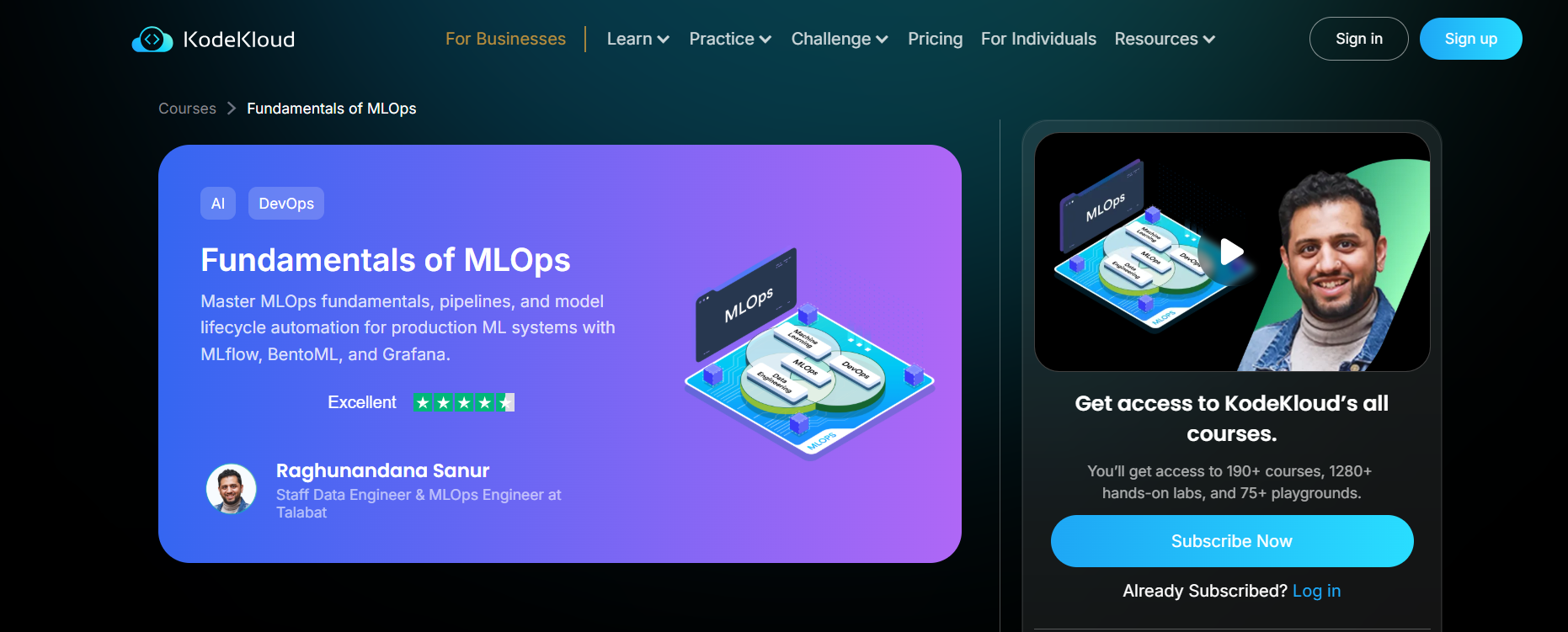
If you're familiar with DevOps and want to understand how its principles apply to machine learning, KodeKloud's Fundamentals of MLOps is a good place to start. What caught my attention about this course is the insurance claim project.
You'll use MLflow and BentoML to build an application that automates insurance claim reviews, so you get to see how the tools work together instead of learning about them separately.
Before getting to that, the course walks you through the basics of MLOps, including collecting data, training models, and getting them ready for deployment.
You'll also come across tools for tracking experiments and checking how well a model performs after it's deployed. The course touches on data security as well, including who can access the data and what rules need to be followed.
It's easy to focus only on building a model when you're learning, but working with actual customer information comes with a whole different set of responsibilities.
What You'll Learn
- You'll learn what MLOps means, how it differs from DevOps, and how the two approaches work together throughout the machine learning lifecycle.
- You'll explore data collection, cleaning, transformation, streaming, and pipeline orchestration using tools such as Pandas, Apache Kafka, Airflow, and Prefect.
- You'll learn how MLflow helps track experiments, manage model versions, and organize the model development process.
- You'll explore model deployment and serving with BentoML, along with monitoring tools such as Prometheus, Grafana, and Evidently.
- You'll apply these concepts in a practical insurance claims project and learn about data security, privacy, and governance.
Course Details
In the table below, I've listed the key details to help you decide whether this course fits your learning goals.
| Detail | Information |
|---|---|
| Level | Beginner |
| Duration | Approximately 5 hours and 20 minutes of video |
| Cost | Access through KodeKloud's available subscription options. |
| Format | Self-paced online lessons |
| Certificate | Course certificate available |
Best for: DevOps engineers and beginners who want a practical introduction to MLOps, including model deployment, experiment tracking, and monitoring.
2. Machine Learning Operations (MLOps): Getting Started - Coursera
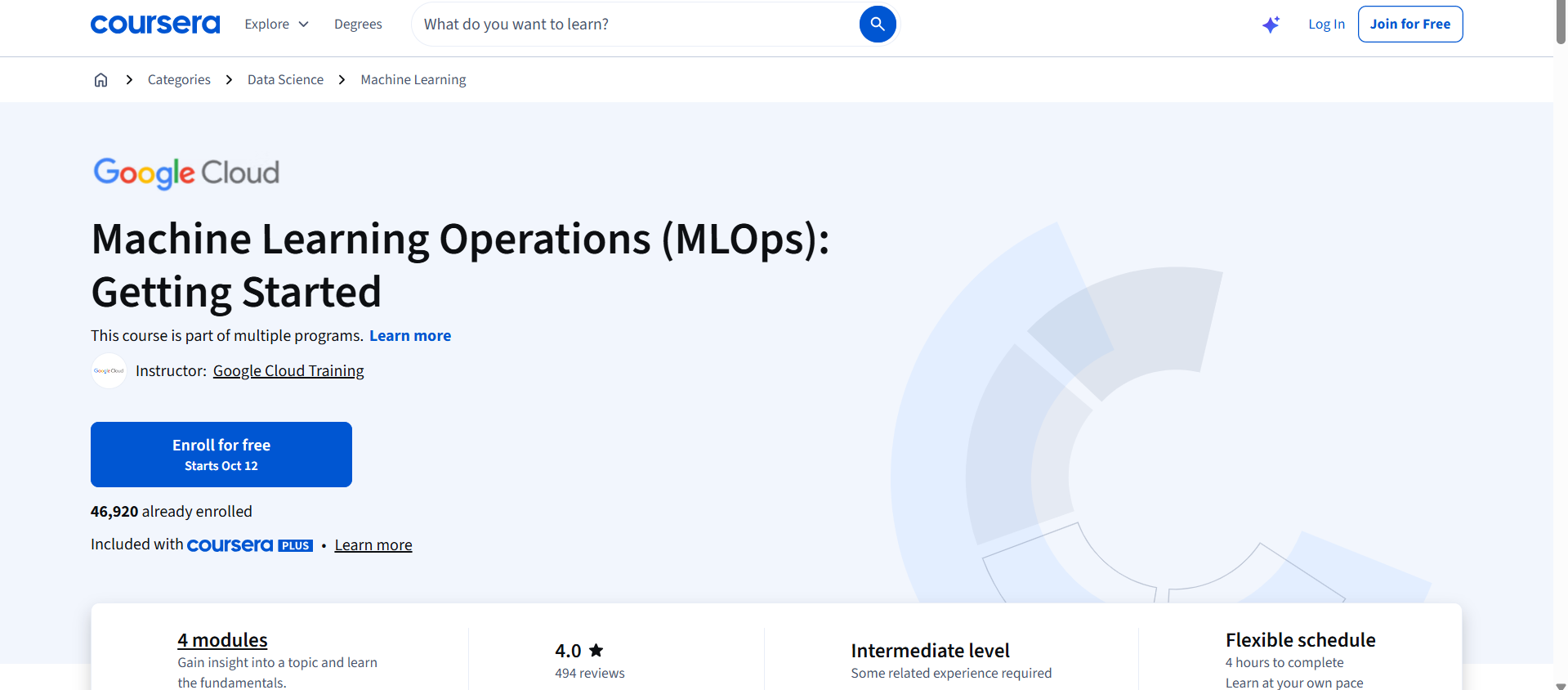
Google Cloud's Machine Learning Operations (MLOps): Getting Started on Coursera takes a cloud-focused approach to understanding the machine learning lifecycle.
The course begins by explaining why machine learning projects need operational practices beyond model development. It then introduces the different stages of the ML lifecycle and explores how automation can make the process more reliable.
A key part of the course is Vertex AI, Google's platform for building and managing machine learning workflows.
You'll learn how MLOps practices can be applied using Google Cloud and explore a lab focused on building end-to-end MLOps pipelines.
The course is relatively short, so it can be a useful starting point if you want to understand the concepts before moving on to a more detailed, project-heavy course.
What You'll Learn
- You'll understand the core technologies used in MLOps and why operational practices matter when deploying machine learning models.
- You'll explore CI/CD practices for machine learning systems and learn how automation supports more consistent development and deployment.
- You'll examine the machine learning lifecycle and the role of Vertex AI in managing ML workflows on Google Cloud.
- You'll learn how to configure Google Cloud architectures for MLOps and create repeatable model training and inference workflows.
- You'll get practical exposure to building an end-to-end MLOps pipeline through the course's Google Cloud lab.
Course Details
I've included the main course details below.
| Detail | Information |
|---|---|
| Level | Intermediate |
| Duration | Approximately 4 hours |
| Cost | Enrollment options and pricing depend on the selected Coursera offering |
| Format | Self-paced online videos, readings, assessments, and a practical lab |
| Certificate | Shareable course certificate available through the eligible paid enrollment option |
Best for: Learners who want a short introduction to MLOps and prefer exploring its concepts through Google Cloud and Vertex AI.
3. MLOps: Automated Pipelines and Model Monitoring (Udacity)
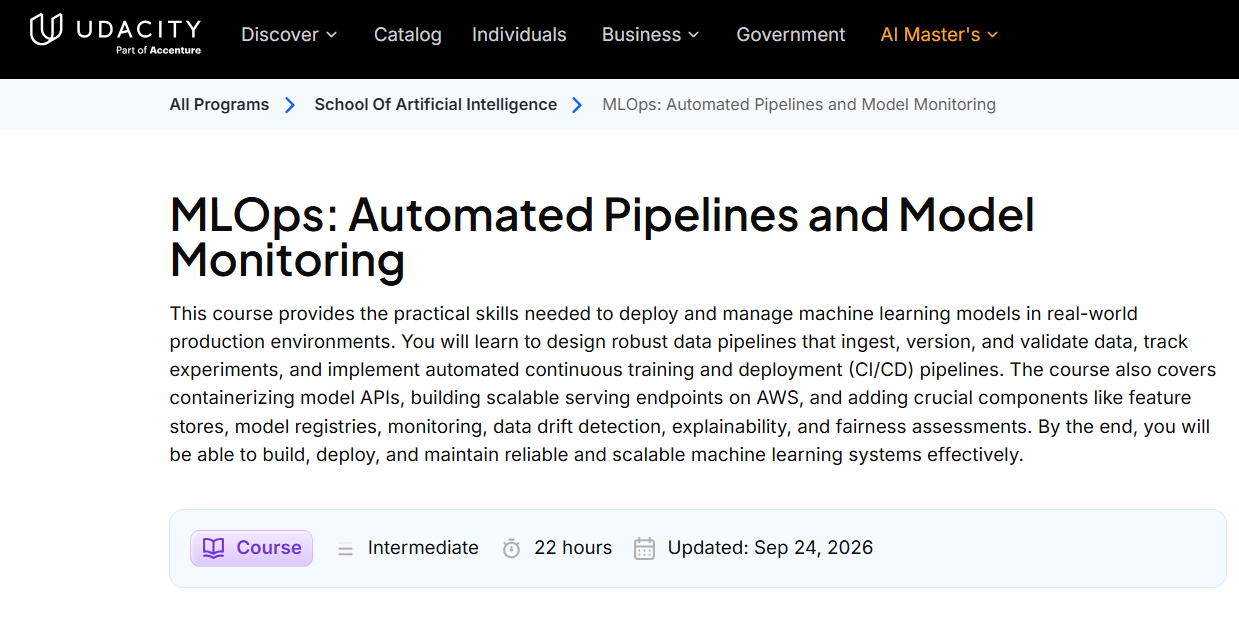
Once you understand the fundamentals, the next step is learning how to build and maintain an automated machine learning workflow. That's the focus of Udacity's MLOps: Automated Pipelines and Model Monitoring course.
This course goes beyond the basics and looks at what happens when machine learning models are deployed and used in production.
You'll work with data pipelines, experiment tracking, automated training, model registries, deployment, and monitoring. It also covers tools such as DVC, MLflow, Prefect, Docker, and AWS services.
A model can run just fine and still give you bad results over time. For example, if the data changes, the predictions might not be as accurate as they were when the model was first built.
This course looks at how to spot these changes, understand why a model makes certain predictions, and check whether its results are fair.
It also includes an end-to-end project involving a financial news sentiment service, bringing several of the concepts together in a practical workflow.
What You'll Learn
- You'll learn how to ingest, validate, and version datasets using tools such as DVC and Great Expectations.
- You'll explore experiment tracking with MLflow and learn how to manage model versions through a model registry.
- You'll build automated training and deployment workflows using orchestration tools and CI/CD practices.
- You'll learn how Docker helps package machine learning APIs and how to deploy models through scalable serving endpoints on AWS.
- You'll explore model monitoring, data drift detection, and fairness assessment to understand how production models can be evaluated and maintained.
- You'll apply these skills in an end-to-end project that operationalizes a machine learning model for financial news sentiment analysis.
Course Details
The following table covers some key details about the course.
| Detail | Information |
|---|---|
| Level | Intermediate |
| Duration | Approximately 22 hours |
| Cost | $249/month |
| Format | Online lessons and an end-to-end practical project |
| Certificate | Check the current course offering for credential eligibility |
Best for: Learners with basic Python and machine learning knowledge who want hands-on experience building automated pipelines and monitoring production models.
4. MLOps Zero to Hero (Udemy)
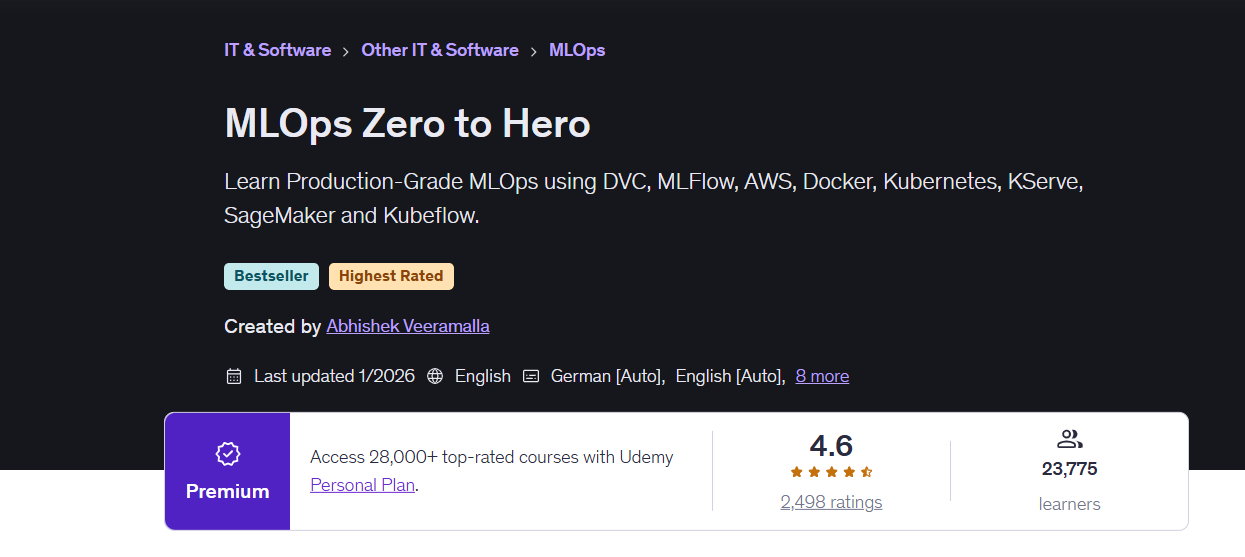
Udemy's MLOps Zero to Hero takes a practical approach to learning how machine learning systems are built, deployed, and managed. This course covers the transition from traditional DevOps practices to MLOps.
Udemy introduces machine learning concepts before moving into model deployment, monitoring, and pipeline orchestration.
It explores several tools used in production MLOps, including DVC, MLflow, AWS, Docker, Kubernetes, KServe, SageMaker, and Kubeflow.
What makes this a worthy option is its focus on connecting the different parts of an MLOps workflow.
Instead of looking at deployment or monitoring in isolation, learners can explore how these practices fit into the broader process of managing machine learning models.
However, the course does assume some familiarity with DevOps concepts, including Docker, Kubernetes, and CI/CD. Beginners without that background may want to review these topics first.
What You'll Learn
- You'll understand the fundamentals of MLOps and how the responsibilities of an MLOps engineer differ from those of a traditional DevOps engineer.
- You'll explore the machine learning lifecycle, from model creation and experiment tracking to deployment and ongoing maintenance.
- You'll learn how tools such as DVC and MLflow support data versioning, experiment tracking, and model management.
- You'll explore model deployment and monitoring using technologies such as Docker, Kubernetes, KServe, and AWS.
- You'll learn about end-to-end ML pipeline orchestration and apply the concepts through a practical MLOps project.
Course Details
Here are the details to check before enrolling.
| Detail | Information |
|---|---|
| Level | Beginner to intermediate, with basic DevOps knowledge expected |
| Duration | Approximately 12 hours and 19 minutes of video |
| Cost | Varies by region, promotions, and account-specific pricing |
| Format | Self-paced online video lessons |
| Certificate | Yes |
Best for: DevOps engineers who want to expand into MLOps and learn how to deploy, monitor, and manage machine learning models using commonly used tools.
5. MLOps Concepts (DataCamp)
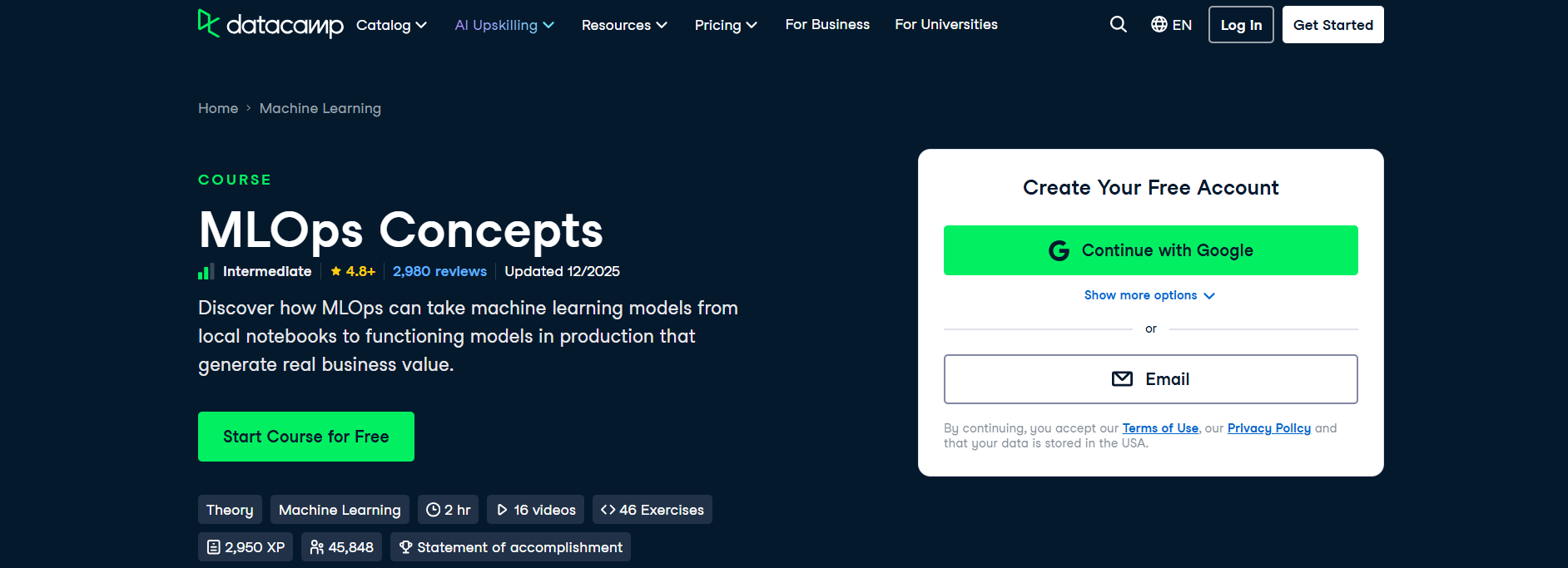
Not everyone needs to start with a lengthy technical course. If you want to understand what MLOps involves before working with more advanced tools, DataCamp's MLOps Concepts is a useful option.
The course explains how machine learning models move from local notebooks into production environments. It introduces the stages of the MLOps process and explains the different levels of MLOps maturity.
This matters because deploying a model is only one part of the job. Teams also need ways to manage changes, reduce manual work, and keep models functioning as data and requirements change.
At approximately two hours, this is the shortest course on our list. It offers a way to build your understanding of MLOps without committing to a much longer program.
DataCamp recommends prior familiarity with machine learning and data engineering concepts. If those subjects are new to you, the platform suggests studying them before taking this course.
What You'll Learn
- You'll learn what MLOps means and why it matters when moving machine learning models from development into production.
- You'll explore the different phases of an MLOps process and understand how they connect throughout the model lifecycle.
- You'll examine the different levels of MLOps maturity and how they reflect the way teams manage their machine learning workflows.
- You'll understand how automation and continuous machine learning practices can reduce manual work and support more reliable model deployment.
- You'll build a foundation for understanding the operational challenges involved in scaling machine learning projects.
Course Details
The table below covers some important details of the course.
| Detail | Information |
|---|---|
| Level | Intermediate |
| Duration | Approximately 2 hours |
| Cost | First chapter available free; full course access requires an eligible DataCamp plan |
| Format | Self-paced online lessons, videos, and interactive exercises |
| Certificate | Statement of Accomplishment upon completion |
Best for: Learners who want a short, structured introduction to MLOps before progressing to more technical courses on automation, deployment, and monitoring.
6. Mastering Amazon SageMaker AI: Zero to Production MLOps (Educative)
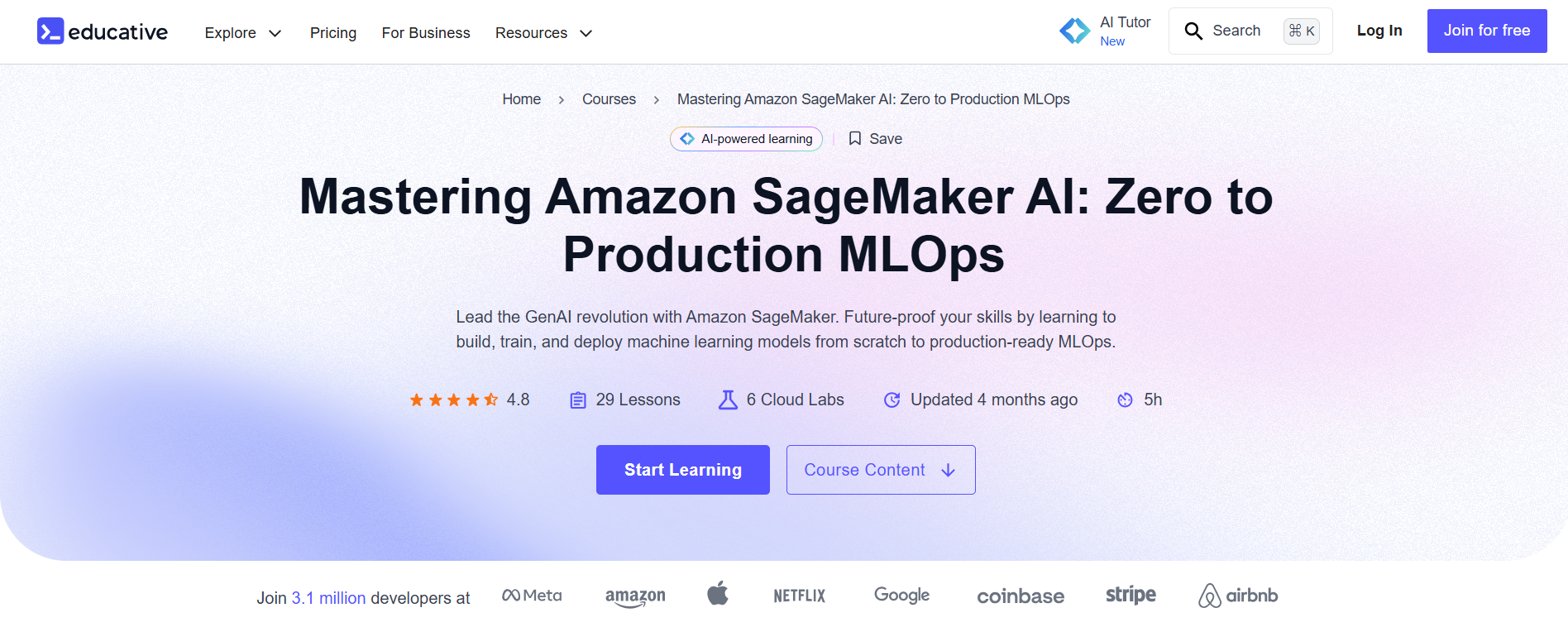
If you want to work with AWS, Educative's Mastering Amazon SageMaker AI: Zero to Production MLOps is worth a look.
The course focuses on Amazon SageMaker AI, AWS's platform for developing, training, and deploying machine learning models.
It takes learners through the process of preparing data, training models, deploying them, and building automated workflows for managing them in production.
You'll learn about tuning models, setting up CI/CD pipelines, and checking if a model is still doing its job properly after deployment.
There are cloud labs included, too, so you can actually try out what you've learned rather than just read about how it works. What I like about this course is that it focuses on AWS.
You get to see how MLOps works on an actual cloud platform and how the different parts of a machine learning workflow come together. I think this is helpful if you're planning to work with cloud-based ML systems.
This course is pretty much all about Amazon SageMaker. If AWS isn't your thing, I'd leave this one for now and pick another course from the list. You can always come back to this one when you're ready to explore AWS.
What You'll Learn
- You'll learn how to establish a secure Amazon SageMaker environment and prepare data for machine learning projects.
- You'll explore data preparation, feature engineering, model training, and hyperparameter tuning using SageMaker.
- You'll learn how to deploy machine learning models using different inference patterns, including real-time and batch inference.
- You'll explore SageMaker Pipelines and learn how CI/CD practices can automate the machine learning lifecycle.
- You'll learn how to keep track of a model after it's deployed, check if it's working as expected, and spot issues that could affect its results.
- The cloud labs let you try training and deploying models yourself and get a feel for how the different steps can be automated.
Course Details
Here are the main details of Educative's AWS-focused MLOps course.
| Detail | Information |
|---|---|
| Level | Intermediate to advanced |
| Duration | Approximately 5 hours |
| Cost | Check Educative's current subscription options and course access requirements |
| Format | Self-paced online lessons, quizzes, and six cloud labs |
Best for: Learners who want practical experience building, deploying, and managing machine learning systems on AWS using Amazon SageMaker AI.
7. Machine Learning Operations Professional Certificate (edX)
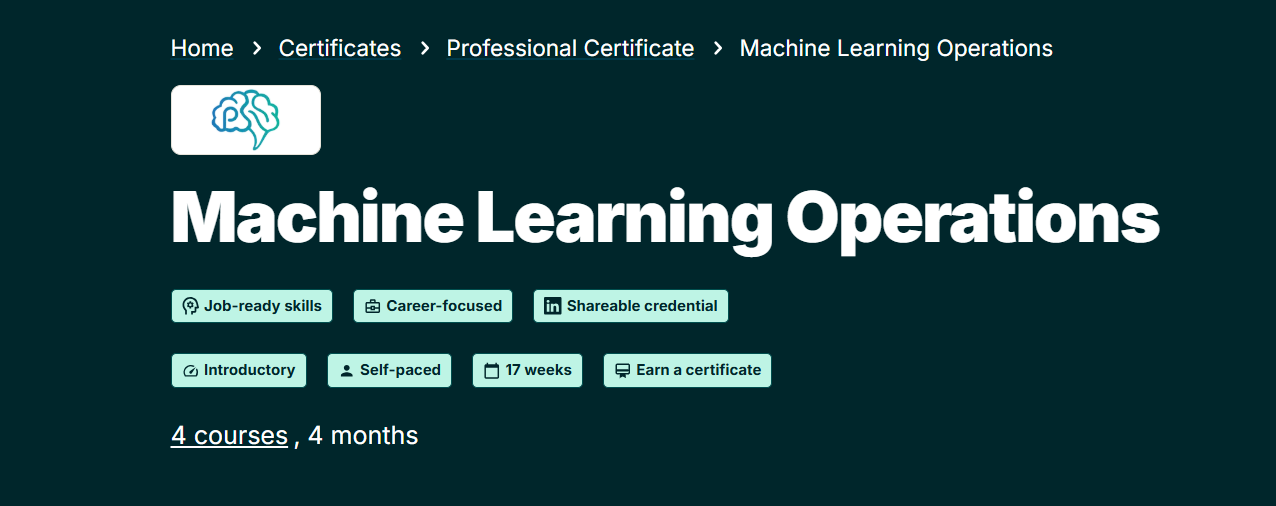
Another option you can look into is the Machine Learning Operations Professional Certificate by Pragmatic AI Labs on edX, especially if you prefer a more structured approach to learning MLOps.
Unlike the individual courses above, this is a Professional Certificate program made up of four skill-building courses. The curriculum covers Python fundamentals, MLOps tools, and cloud-based machine learning platforms.
The idea is to help learners progress from the foundations toward building and managing machine learning workflows. Along the way, the program explores tools used for experiment tracking, model management, deployment, and automation.
Here are the four courses you will get.
7.1 Python Fundamentals for MLOps
Python is widely used in machine learning, so understanding the language is useful before working with more advanced MLOps tools. This course focuses on Python fundamentals for MLOps.
It serves as the programming foundation within the wider Professional Certificate program. If you're comfortable with Python already, you may find this part more familiar than the later courses.
If you're still learning to write and organize Python code, it provides a starting point before you move on to machine learning operations.
What You'll Learn
- You'll develop your Python fundamentals as preparation for working with machine learning and MLOps tools.
- You'll build a foundation for using Python in machine learning workflows and related engineering tasks.
- You'll prepare for later topics involving experiment tracking, model management, and cloud-based machine learning operations.
7.2 DevOps, DataOps, MLOps
DevOps, DataOps, and MLOps might sound like three versions of the same thing, but they deal with different parts of the process. DevOps is about software, DataOps deals with data, and MLOps focuses on machine learning models.
This course looks at how DevOps, DataOps, and MLOps fit into that bigger picture. The course is included in the edX Professional Certificate program.
What You'll Learn
- You'll explore the relationship between DevOps, DataOps, and MLOps and understand how they support different parts of an ML workflow.
- You'll learn how operational practices can help teams manage data and machine learning processes more consistently.
- You'll develop a broader understanding of the engineering practices involved in moving machine learning work toward production.
7.3 MLOps Tools: MLflow and Hugging Face
MLflow and Hugging Face are two tools you'll come across when working with machine learning, but they do different things.
MLflow comes in handy when you're running experiments and want to keep track of what you've tried and which models worked best.
Hugging Face, on the other hand, gives you access to machine learning models and tools that you can use in your own projects, including those built for language-related tasks.
This part of the edX program introduces both tools and shows how they fit into MLOps. You'll get a better idea of how models are managed and how the work you do during development eventually leads to deployment.
What You'll Learn
- You'll explore the role of MLflow in experiment tracking and machine learning model management.
- You'll learn about Hugging Face and how it fits into workflows involving machine learning models.
- You'll build a better understanding of the tools used to organize and manage models as part of an MLOps workflow.
7.4 MLOps Platforms: Amazon SageMaker and Azure ML
The last course covers Amazon SageMaker and Azure Machine Learning. Both are cloud platforms, but if you haven't worked with them before, you might not know what they actually do.
Put simply, they give you a place to train machine learning models, deploy them, and manage them without having to set everything up yourself.
They also have tools that take care of some of the repetitive work involved in running ML projects. I think learning about both platforms is a nice way to wrap up the program.
You get to see how machine learning works on two different platforms instead of learning everything through the lens of just one.
What You'll Learn
- You'll learn what Amazon SageMaker and Azure Machine Learning are used for and how they help with machine learning projects.
- You'll explore how models are trained, deployed, and managed using cloud-based tools.
- You'll develop a broader understanding of how MLOps practices can be applied across different cloud environments.
Professional Certificate Details
The table below summarizes the details of the complete edX program, rather than any one of its four constituent courses.
| Detail | Information |
|---|---|
| Level | Not explicitly specified in the program listing |
| Duration | Approximately 4 months |
| Cost | US$1,796 listed price before discounts; check edX for current pricing |
| Format | Four self-paced online courses |
| Certificate | Professional Certificate upon completing the program requirements |
edX lists the program as containing four skill-building courses, with a suggested commitment of three to six hours per week over four months.
Best for: Learners who want a structured MLOps program that covers Python, operational practices, experiment tracking, model tools, and cloud platforms rather than studying just one area.
Conclusion
In this guide, I have listed the top seven MLOps courses to help you learn from scratch. These courses range from beginner to advanced levels.
Happy learning as you explore MLOps from end to end!
If you have any questions about these courses, drop them in the comments.
I’ll be glad to help!