
I researched in depth about LLMOps, and AIOps.
In this analysis, you will learn what they actually mean, how big the market is, what companies are hiring for right now, and the skills required.
Also, we cover the trends that will define the next few years.
LLMOps is about building, deploying, and managing large language models (LLMs).
AIOps is about using AI to monitor, manage, and improve IT systems and infrastructure.
They may sound similar and are often mentioned together, but they solve different problems, and focus on different areas.
Keep reading, learn more about these, and clear up your confusion.
What is LLMOps?
LLMOps (Large Language Model Operations) is the process of building, deploying, managing, and maintaining large language models in production.
It helps make sure LLM applications are reliable, secure, fast, and cost-effective.
Just think of LLMOps as an extension of MLOps.
While MLOps manages the lifecycle of machine learning models, LLMOps is designed specifically for large language models, which are much bigger, more expensive to run, use natural language prompts, and can sometimes produce incorrect results or hallucinations.
Here are the things, with a one-line explanation, that LLMOps covers:
- Prompt Management - Saving different versions of prompts like code, testing changes before deployment, and releasing updates safely.
- Retrieval Pipelines(RAG) - Connecting a model to your own data so its answers are grounded in facts, not just training data.
- Fine-tuning and adapters - Customizing a base model for a specific domain without retraining it from scratch.
- Evaluation(evals) - Systematically scoring whether a model’s outputs are correct, safe, and on-brand, before and after every change.
- Inference serving - Running the model efficiently in production (batching, caching, quantization, GPU scheduling).
- Observability - Tracing every prompt, retrieval, and response so failures are debuggable.
- Cost and Governance - Controlling token spend, enforcing data-handling policy, and auditing what the model did and why.
In many companies, the same platform team that previously managed MLOps is now responsible for all of these.
What is AIOps?
AIOps (Artificial Intelligence for IT Operations) is the use of AI and machine learning to monitor, manage, and improve IT systems.
It helps teams detect problems, find the root cause, and sometimes fix issues automatically.
Traditional monitoring tools only tell you that something is wrong.
AIOps goes a step further by analyzing data from different sources, identifying the cause of the problem, and, in some cases, resolving it without human involvement.
Here is what AIOps usually handles:
- Collecting system data - Gathering logs, metrics, traces, and events from servers, cloud platforms, containers, and applications.
- Reducing alert noise - Combining thousands of alerts into a small number of important issues.
- Finding unusual behavior - Detecting problems early by spotting activity that is different from normal.
- Finding the root cause - Identifying the exact change, deployment, or dependency that caused the issue.
- Automatic problem fixing - Running predefined actions, restarting services, or scaling resources automatically without human help.
- Planning resources ahead - Predicting future resource needs so problems can be avoided before they happen.
The focus is also changing from simply detecting problems to automatically fixing them within safe, predefined rules.
Market Analysis
Since LLMOps and AIOps are still new fields, different market research companies estimate their market size differently.
This is mainly because each company defines these categories in its own way. Some only include software, while others also include services, hardware, and related products.
Instead of depending on a single report, it is better to look at the numbers from multiple reports.
This gives you a clearer picture of where most predictions are similar and where they differ.
LLMOps Market Size
Different research companies report different market sizes for LLMOps because they measure the market in different ways.
Some focus only on LLMOps software, while others include services, infrastructure, or the entire LLM ecosystem.
According to The Business Research Company, the global LLMOps software market is expected to grow from $7.14 billion in 2026 to $15.59 billion by 2030, with a 21.6% annual growth rate (CAGR).
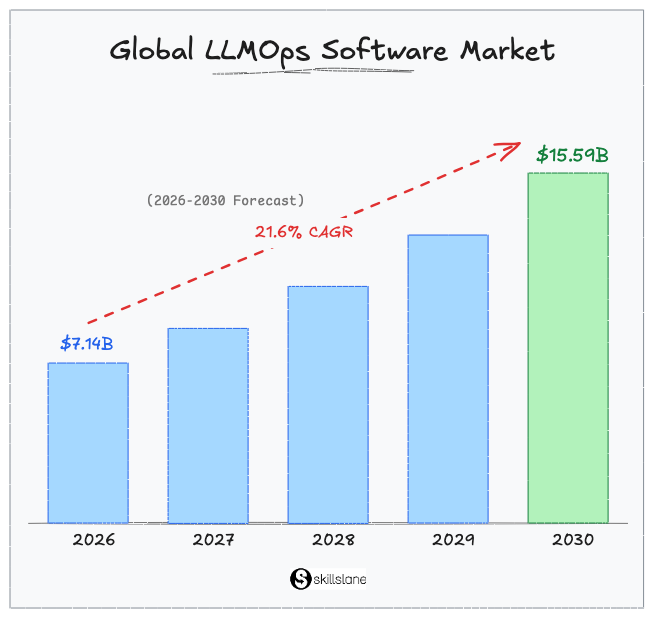
In fact, this growth is driven by wider enterprise adoption of LLMs, which is increased focus on responsible AI, hybrid deployments, and to be better AI monitoring.
North America currently leads the market, while the Asia-Pacific region, especially India and China, is expected to see the fastest growth.
The numbers become much larger when we look at the entire Large Language Model (LLM) market, including models, infrastructure, and applications.
Precedence Research estimates the market will grow from $10.57 billion in 2026 to $149.89 billion by 2035, with a 34.44% CAGR.
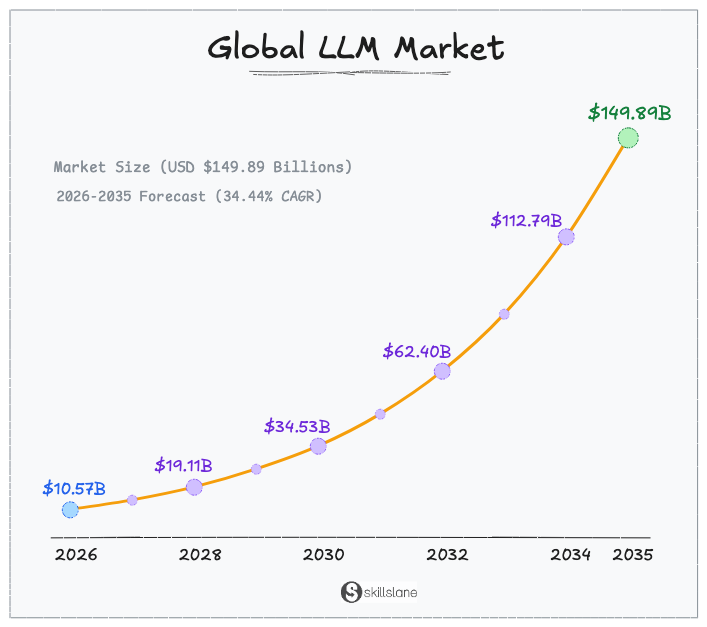
This shows that the overall LLM industry is growing much faster than the LLMOps market itself.
AIOps Market Size
AIOps market numbers are different than other categories because research companies define AIOps in different ways.
Some reports only include AIOps platforms that detect, analyze, and fix IT issues, while others include the wider observability and application monitoring market.
For example, the AIOps market is expected to grow from $14.44 billion in 2026 to $41.6 billion by 2030, with a 30.3% CAGR.
The growth is mainly driven by more companies using cloud-based AIOps tools, increasing investment in automated IT operations, and the growth of AI-powered monitoring solutions.
ResearchNester also expects strong growth, predicting the market will increase from $16.6 billion to $85.4 billion by 2035, with a 17.8% CAGR.
Large enterprises are expected to be the biggest users, making up around 73.5% of the market during this period.
On the lower side, Fortune Business Insights estimates a smaller AIOps market segment, growing from $2.23 billion to $11.8 billion by 2034, with a 20.4% CAGR.
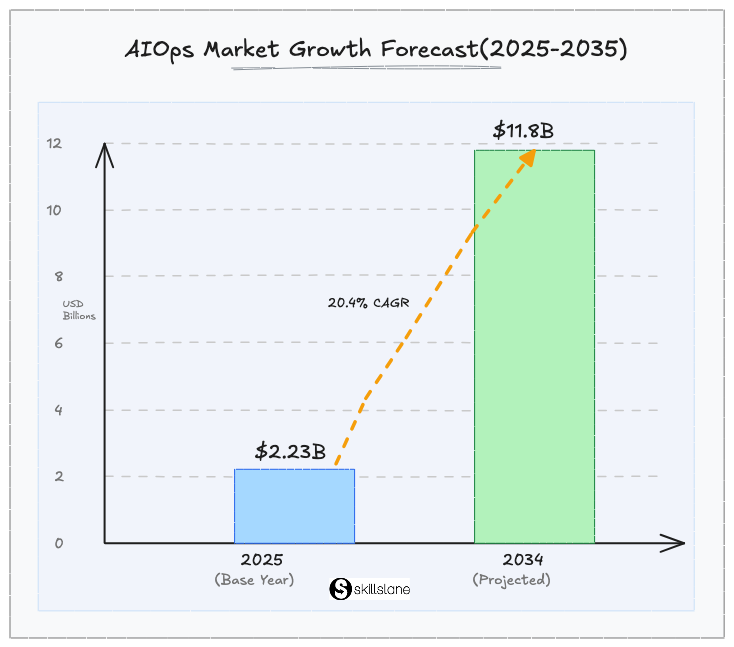
Even though the numbers vary, all reports point in the same direction: AIOps is becoming a key part of modern IT operations.
As IBM summarizes Gartner’s view, the future of IT operations will increasingly depend on AIOps.
Enterprise Adoption
The adoption numbers are more important than market size because they show how much of the technology is actually being used, rather than just being predicted.
According to McKinsey’s latest workforce survey, only 1% of business leaders say their organization has fully matured in AI adoption.
This shows that, despite the fastest growth in AI investments, most companies are still in the early stages.
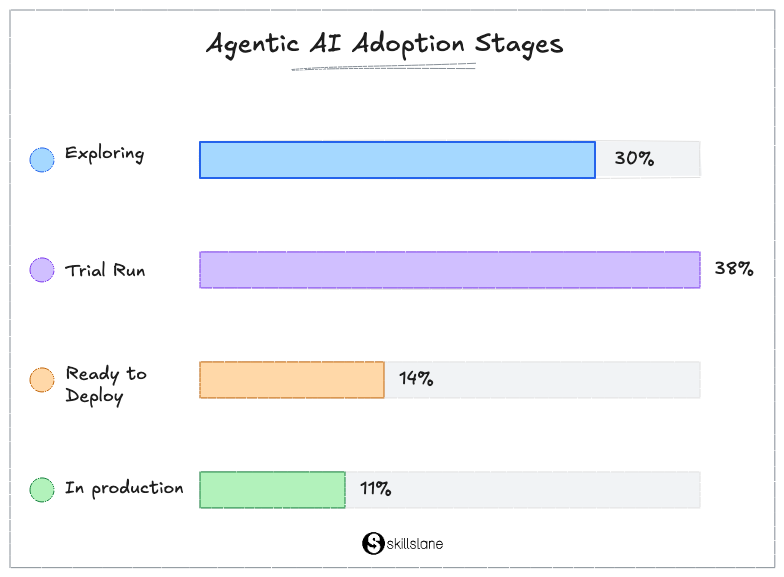
For Agentic AI, Deloitte’s 2025 Emerging Technology Trends report found that 30% of organizations are exploring the technology, 38% are testing it through pilot projects, but only 14% have solutions ready to deploy, and just 11% are using them in production.
One of the biggest challenges is integrating AI with existing legacy systems.
Despite these challenges, Gartner expects AI agent adoption to grow quickly.
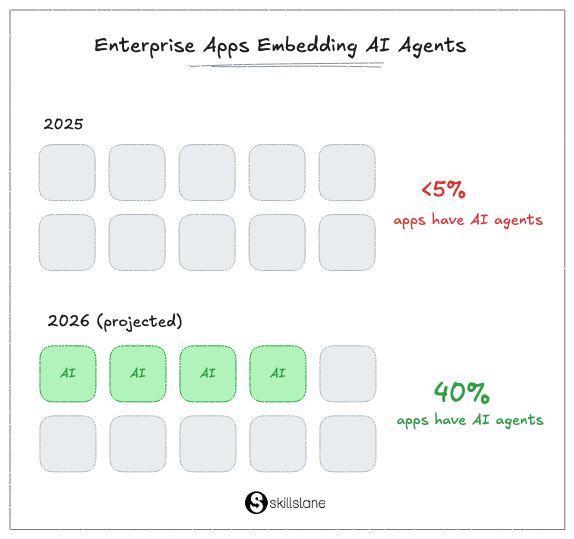
It predicts that 40% of enterprise applications will include task-specific AI agents by the end of 2026, compared to less than 5% just a year earlier.
Job Market Analysis
I analyzed 500+ jobs from LinkedIn, Indeed, Naukri, Glassdoor, and other platforms.
In this section, you will get to know the required and preferred skills you need to develop in LLMOps and AIOps.
LLM / LLMOps Roles
LLM and LLMOps roles are evolving very fast.
The highest-paying candidates are those with practical experience in RAG, model fine-tuning, LLMOps and evaluation frameworks, and inference cost optimization.
Having strong expertise in even two of these areas can significantly increase your earning potential.
On the other hand, prompt engineering is no longer considered a standalone, high-paying role. Instead, it has become a standard skill expected from most LLM engineers.
Among these skills, LLMOps and model evaluation are especially valuable.
Companies want engineers who can measure whether a model has improved after changes, detect performance issues before users notice them, and monitor models reliably in production.
Another fast-growing skill is inference optimization.
Experience with tools and techniques such as vLLM, quantization, batching, KV caching, and choosing the right model size is becoming increasingly valuable as organizations focus on improving AI performance while reducing costs.
AIOps Roles
Job postings show that AIOps Engineers need a mix of IT operations, automation, data analytics, and machine learning skills.
Employers also commonly look for a computer science background and hands-on experience with tools like Kubernetes, Prometheus, Splunk, and major cloud platforms.
Rather than being a completely new role, AIOps combines the skills of a Site Reliability Engineer (SRE), data scientist, and automation engineer.
This makes it a highly cross-functional position.
There is also no single standard AIOps certification.
In fact, most professionals move into AIOps from DevOps, SRE, or platform engineering roles and then build expertise in machine learning and vendor-specific platforms such as ServiceNow AIOps, Dynatrace, Datadog, BigPanda, and Moogsoft.
Experience and Certifications
The experience required depends on the role.
LLM/AI Engineer
Most job postings ask for 3+ years of software or machine learning experience. Senior roles with higher salaries usually require 5+ years of experience, including building and maintaining production LLM or RAG applications.
MLOps Engineer
Mid-level positions typically require 2-4 years of experience. But, strong DevOps engineers with 1-2 years of hands-on ML infrastructure experience can also be competitive.
AIOps Engineer
This is usually not an entry-level role. Most professionals transition from SRE, DevOps, or platform engineering after gaining 3+ years of IT operations experience and then add AI and machine learning skills.
When it comes to certifications,
There is no single industry-standard certification for LLMOps, MLOps, or AIOps roles, unlike the CKA(Certified Kubernetes Administrator) for Kubernetes.
Instead, employers look for a combination of cloud AI/ML certifications from AWS, Azure, and Google Cloud, vendor-specific AIOps certifications, and general DevOps and cloud administration certifications.
These certifications are still considered a strong foundation, even for AI-focused roles.
Salary Ranges
The table below contains the salary range for AIOps, MLOps, and LLMOps Engineers.
| Role | Region / Market | Typical Salary | Source |
|---|---|---|---|
| AIOps Engineer | US | $90,000–$150,000 | ZipRecruiter |
| MLOps Engineer | India (Broad Market) |
₹8.27L–₹22L average ($16,000–$26,000); Top roles can reach ₹31.5L. |
Glassdoor India |
| MLOps Engineer (including LLMOps/GenAI Infrastructure) | India (Mid-Level) | ₹14L–₹22L ($17,000–$26,000) | Kaamwork Hiring Benchmarks |
After analyzing nearly 1 billion job postings across six continents, the report found that professionals with AI skills earn, on average, a 56% higher salary than people in similar roles without AI expertise.
This premium salary is seen across roles such as LLMOps, MLOps, AI Engineer, and AIOps Engineer.
Cloud Platforms and Commonly Used Tools
Job postings across different regions show that employers prefer candidates who are comfortable with AWS, Azure, and Google Cloud rather than experts in just one cloud platform.
They also commonly look for strong Python programming skills, experience with TensorFlow or PyTorch, and knowledge of CI/CD, Docker, Kubernetes, and data pipelines.
These have become the core skills for both MLOps and LLMOps roles.
The most commonly requested tools include:
- LLMOps and Generative AI: LangChain, LlamaIndex, MLflow, vLLM, Triton Inference Server, BentoML, Ray, Hugging Face, and cloud AI platforms such as AWS Bedrock, Azure AI Foundry, and Google Vertex AI.
- AIOps and Observability: Prometheus, Grafana, Splunk, Datadog, Dynatrace, ServiceNow AIOps, Moogsoft, BigPanda, ELK Stack, and OpenTelemetry.
- Shared Infrastructure: Kubernetes, Docker, Terraform, and Git-based CI/CD tools are widely expected across all roles.
Future Trends
Let's look at the trends, which will help you to know what you have to focus on in the coming days.
AI Agents and Multi-Agent Systems
The biggest AI trend in 2026 is the shift from single AI assistants to teams of specialized AI agents.
Instead of one AI model handling an entire task, multiple agents work together, with each one responsible for a specific job.
For example, one agent might qualify a lead, another write an email, and a third check for compliance before passing the work to the next agent.
Gartner predicts that 40% of enterprise applications will include task-specific AI agents by the end of 2026, up from less than 5% a year earlier.
It also expects that by 2028, at least 15% of everyday business decisions will be made autonomously by AI, compared to almost none in 2024.
But, adoption is still in its early stages.
Deloitte found that only 11% of organizations are currently using agentic AI systems in production, even though many are actively exploring or testing them.
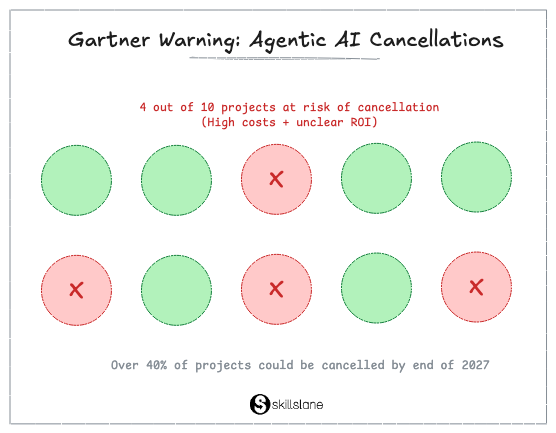
When I looked into Gartner, they also warn that over 40% of agentic AI projects could be canceled by the end of 2027 due to high costs and unclear business value.
For DevOps and platform engineers, this means that learning multi-agent orchestration and governance is becoming increasingly important, much like Kubernetes became essential for managing containers.
AI Gateways
As organizations adopt AI models from multiple providers, such as Claude, GPT, Gemini, Llama, and other open-weight models, they increasingly use a foundation model gateway.
This acts as a single layer that routes AI requests, manages access and security, tracks costs, and allows companies to switch between models without changing their application code.
The leading platforms in this space are AWS Bedrock, Azure AI Foundry, and Google Vertex AI Model Garden, each integrated with its cloud provider's security and governance services.
Microsoft's Model Router also allows organizations to use multiple AI models through a single, governed interface, making it easier to choose or switch models without modifying existing applications.
A2A (Agent-to-Agent Communication)
While MCP (Model Context Protocol) defines how an AI agent connects to and uses tools, Google's Agent2Agent (A2A) protocol defines how different AI agents communicate and work together.
The two protocols complement each other rather than compete.
A2A is supported by more than 50 technology companies, including Atlassian, Salesforce, SAP, ServiceNow, PayPal, Cohere, and is now hosted under the Linux Foundation alongside MCP.
A simple way to understand the difference is:
- MCP helps an AI agent interact with tools and data sources.
- A2A helps multiple AI agents communicate and coordinate with each other.
For example,
An inventory agent can use MCP to check stock in a database, then use A2A to notify an order agent, who contacts supplier agents to place a purchase order.
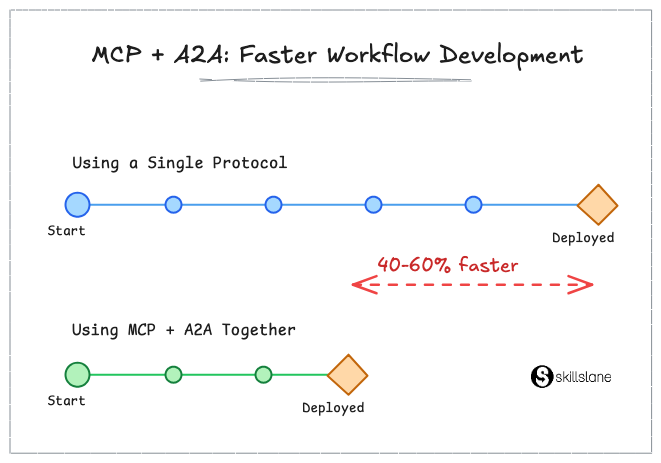
I have seen organizations using both MCP and A2A report 40–60% faster workflow development compared to using just one protocol, making them an important foundation for building multi-agent AI systems.
Small Language Models (SLMs)
Another major trend is the growing use of small language models (SLMs) instead of relying only on large cloud-based AI models.
These models, typically 1-14 billion parameters, are small enough to run on a laptop, smartphone, or edge device.
According to DigitalApplied, around 80–90% of the tasks in an AI agent workflow can be handled by a 3-9B model running locally.
This makes AI faster, cheaper, and more private because most requests do not need to be sent to a cloud model.
These smaller models are also becoming much more capable.
For example, Microsoft's Phi-4 (14B) outperforms GPT-4o on the MATH benchmark, while Phi-4-Reasoning matches the performance of DeepSeek R1, a model about 47 times larger, on the AIME 2025 math benchmark.
Because of these improvements, Gartner predicts that small language models will drive more AI processing to edge devices.
As a result, many AI agent frameworks are adopting a hybrid approach.
Use a local small model for most tasks and switch to a larger cloud model only when more advanced reasoning is needed.
On-Device AI
Closely related to small language models (SLMs) is the rise of on-device AI.
Instead of sending every request to the cloud, AI models are increasingly running directly on laptops, smartphones, and other devices.
This is especially useful for applications that require low latency and strong privacy.
According to Gartner's 2025 AI Infrastructure Report, enterprise spending on local AI model execution grew by 55% year over year.
The main reasons are stricter data privacy requirements and the fact that cloud-based AI can introduce 0.5-2 seconds of delay, which is too slow for many real-time applications.
Modern hardware is making this possible.
For example, Qualcomm's Snapdragon X2 includes a powerful Neural Processing Unit (NPU) capable of running multiple small AI models at the same time.
While Apple now runs many of its iOS and macOS AI features directly on the device, improving both speed and privacy.
Hybrid RAG and GraphRAG
RAG has evolved far beyond the simple approach of using a single vector database with a similarity search.
That early method often struggled with large enterprise datasets, leading to poor retrieval accuracy.
In 2026, production-ready RAG systems use a multi-stage pipeline that combines vector search, keyword search, and knowledge graphs, along with query rewriting, reranking, access control, and continuous evaluation to improve the quality and accuracy of responses.
One important advancement is GraphRAG, which builds a knowledge graph showing relationships between people, places, and other entities.
This makes it much better at answering complex questions that require connecting multiple pieces of information.
But, GraphRAG is also more expensive and harder to implement, so most organizations use a hybrid approach that combines vector, keyword, and graph search, choosing the best method for each query.
As adoption grows, the enterprise RAG market is expanding rapidly.
MarketsandMarkets estimates it will grow from $1.94 billion to $9.86 billion by 2030.
Multimodal AI
AI models are increasingly able to understand text, images, audio, and video together, instead of treating each type of data separately.
This is making AI applications much more capable and flexible.
According to Gartner, 40% of generative AI solutions are expected to be multimodal by 2027.
This trend is already visible in real-world applications, such as customer support agents that can analyze screenshots, voice assistants that have natural two-way conversations, and coding assistants that understand both source code and architecture diagrams.
For DevOps and platform teams, the biggest impact is on data processing.
RAG systems now need to handle not only text, but also PDFs with diagrams, images, dashboards, and video transcripts, allowing AI to work with a much wider range of enterprise data.
AI Observability
As RAG and AI agent systems move into production, simply checking a few AI responses is no longer enough.
Production systems handle thousands or even millions of requests every day, so organizations need a way to monitor every query, retrieval step, response, cost, and response time to quickly identify problems before users notice them.
This has led to the rise of LLM observability tools such as Langfuse, LangSmith, Arize, Galileo, Maxim AI, as well as platforms like Datadog and Honeycomb, which now support AI monitoring.
These tools continuously measure metrics such as answer relevance, context precision, and context recall to ensure AI systems remain accurate and reliable.
This is also where LLMOps and AIOps come together.
Both focus on monitoring, tracing, and evaluating systems continuously, because you can't effectively manage or improve a system if you can't see how it's performing.
Synthetic Data
Synthetic data has become a standard part of AI development, rather than just a solution for situations where real data is limited or sensitive.
Instead of relying only on real-world data, organizations now use AI-generated data to train and improve their models.
Synthetic data is widely used in robotics and self-driving cars, while finance and healthcare use synthetic datasets to build AI systems without exposing sensitive customer or patient information.
It is also helping speed up AI training while improving privacy.
A related advancement is the use of AI world models, which create realistic virtual environments for testing.
For example, companies like Waymo and Wayve use these simulations to test rare driving scenarios that would be difficult or expensive to recreate in the real world.
Similar techniques are now being adopted in defense, healthcare, and enterprise planning to safely test complex situations before deploying AI in real-world environments.
Autonomous Operations
The common trend across AIOps and agentic AI is bounded autonomy.
Instead of giving AI complete control, organizations allow it to make decisions within clearly defined limits, while requiring human approval for high-risk situations and keeping detailed audit logs of every action.
This approach gives AI enough autonomy to improve efficiency without losing human oversight.
In IT operations, for example, AI can automatically detect and fix common issues, but it escalates unusual, complex, or high-impact incidents to a human engineer for review and decision-making.
Predictive Infrastructure
AIOps platforms are moving beyond detecting problems after they happen to predicting and preventing issues before they occur.
Modern AIOps systems can forecast resource shortages, and hardware failures, and automatically rebalance workloads to avoid incidents.
Organizations using advanced AIOps report 15–45% fewer high-priority incidents and 70–90% faster incident investigation, while also speeding up the delivery of new applications.
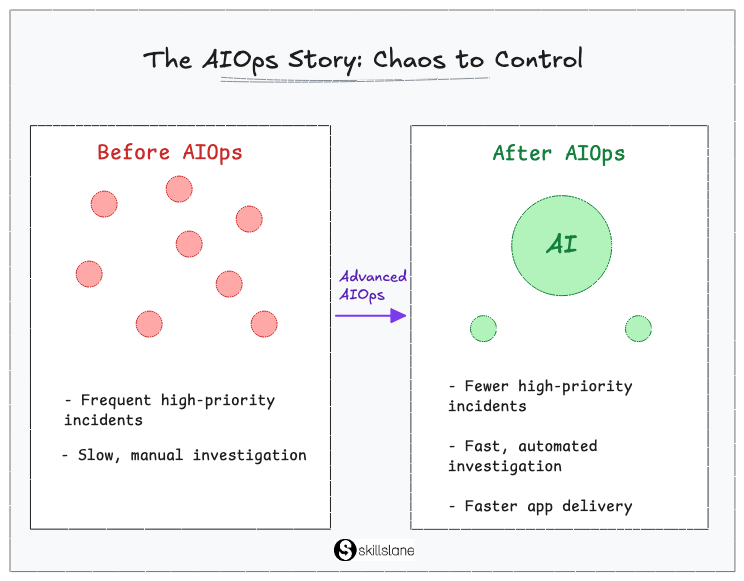
This reflects the same shift happening in agentic AI.
Instead of simply responding to problems, both technologies focus on predicting issues early and taking action before they affect users or business operations.
Platform Engineering + AI Convergence
One of the biggest trends for DevOps engineers is the growing integration of internal developer platforms (IDPs) with AI infrastructure.
As more teams use AI for software development, organizations need a platform that can manage AI tools securely and consistently.
Without proper governance, AI coding assistants can increase complexity instead of reducing it.
The CNCF Platform Engineering Maturity Model predicts that mature platforms will treat AI agents like any other user.
This means AI agents will have role-based access control (RBAC), resource quotas, and governance policies to ensure they operate safely.
AI is also expected to take on more infrastructure decisions, such as choosing the best cloud instances, migrating databases, and optimizing service architectures.
As a result, platform engineers will spend less time on manual infrastructure management and more time defining strategy and governance.
According to Gartner, internal developer platforms must evolve into AI-native platforms that can manage AI agents, data pipelines, and governance.
Otherwise, they risk slowing down AI adoption instead of enabling it.
FinOps for AI
As AI adoption grows, token usage and GPU costs have become major expenses for organizations.
This has led to the rise of FinOps, a practice focused on optimizing the cost of running AI applications.
A common cost-saving strategy is to use small or open-weight models for simple tasks and switch to larger frontier models only when advanced reasoning is required.
This helps reduce costs while maintaining good performance.
The importance of AI cost management is growing so quickly that the Linux Foundation, together with the FinOps Foundation, announced plans to launch the Tokenomics Foundation.
Its goal is to create industry standards and best practices for measuring and optimizing the economics of AI infrastructure, similar to how MCP and A2A became open standards for AI integration.
AI Security and Governance
As LLMOps and AIOps move from experimentation to production, security and governance have become essential parts of AI system design, not just compliance requirements.
The biggest security concerns include prompt injection, tool poisoning, data leaks caused by overly broad tool permissions, and RAG-specific attacks such as BadRAG and TrojanRAG, where malicious content is added to a knowledge base to influence AI responses.
At the same time, regulations like the EU AI Act are pushing organizations to build AI systems that are transparent, explainable, and auditable.
To address these challenges, organizations are adopting stronger security measures such as OAuth-based authentication, role-based and scoped permissions, detailed audit logs, and document-level access controls to ensure AI systems can access only the data they are authorized to use.
Conclusion
In this blog, we covered how LLMOps and AIOps work, their market growth, the tools, top skills that organizations are looking for, and more.
Also, I hope you now have a better understanding of the importance of LLMOps and AIOps, as well as the key differences between them.
If you're working in these roles or planning to move into one of them, consider upskilling yourself in the areas we discussed.
If you have any questions or opinions about the topics covered in this detailed analysis, feel free to share them in the comments.
I will be happy to answer your questions and clear up any doubts.